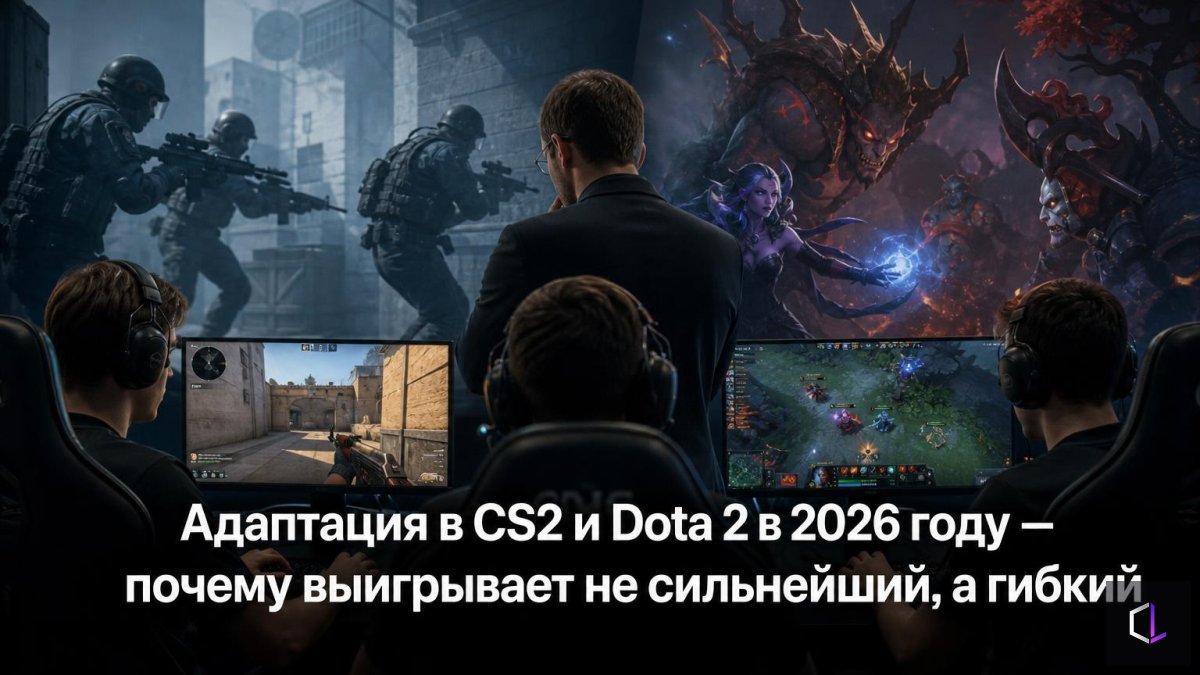
Esports disciplines live by a strange law: everything you have learned will sooner or later become outdated. The currency is updated by patches, maps leave the pool and return, heroes enter the meta and then vanish from it. The meta (from metagame) is the set of the most effective strategies and picks at a given moment; when it shifts, yesterday's working technique turns into a weakness. That is why in 2026 the skill of adaptation is valued almost as highly as mechanics.
The Strong Player and the Flexible Player
Both disciplines offer clear examples. In CS2, a map drops out of the pool or returns to it, and a team that spent years building its game around a single location has to relearn setups, utility lineups and the role scheme. In Dota 2, after a major update, item prices, hero stats, the map and the pace of the game change, and the familiar sequence of actions in the lane stops delivering the same result.
Mechanics do not go anywhere, though: aiming and hero control remain the foundation. But at the moment the rules shift, the advantage goes to the one who noticed the shift sooner and drew conclusions from it. A player with a perfect but memorized scheme loses accuracy exactly to the degree that the scheme has stopped matching the game.
What Adaptation Looks Like in Practice
Adaptation is rarely a heroic decision. More often it is a set of small actions:
- read the patch notes before sitting down to a ranked game, and note what exactly changed for your role;
- play several matches with a single goal — to test a hypothesis, not to raise your rating;
- rewatch recordings of losses and find the moment where the familiar move stopped working;
- agree within the team on which elements of the game you are rebuilding and which you are keeping.
An important nuance: you don't need to abandon everything old wholesale. Good adaptation is selection. The foundation stays, the superstructure changes.
The Market Changes Too
The topic is broader than the game itself. Everything around the disciplines is changing: tournament formats, organizations' requirements, ways of earning. The professional scene and esports education exist within the same economy, and it is also in flux. A player who ties their future to only one game or one role risks ending up in the position of someone whose market has narrowed.
Hence a practical conclusion for those thinking about a career: the ability to learn quickly transfers between games, roles and even professions adjacent to esports — analytics, coaching, event organization. Specific mechanics transfer less well. This does not mean mechanics can go untrained; it means they are not enough on their own.
The CyberLab View: Flexibility Is Trained Separately
A common opinion in the community goes like this: first hone your mechanics, and you'll adjust to the meta later. The CyberLab editorial team disagrees. Adaptation does not appear on its own as skills grow: there are players with excellent mechanics who spend months unable to break out of an old scheme simply because they cannot separate "I played badly" from "the game changed."
The argument is simple. After a patch, results drop, and the player has two explanations: form and rules. If they always choose the first, they start shooting more or farming more and only entrench a failing approach. The ability to ask "what changed?" before "what am I doing wrong?" is a separate habit, and it can be trained as deliberately as drilling positions or lane control. For those who put this skill off until later, an update usually reminds them of it in the most unpleasant way.
The next meta shift will come, as it always has, but how much time you spend noticing it is a question of your preparation alone.