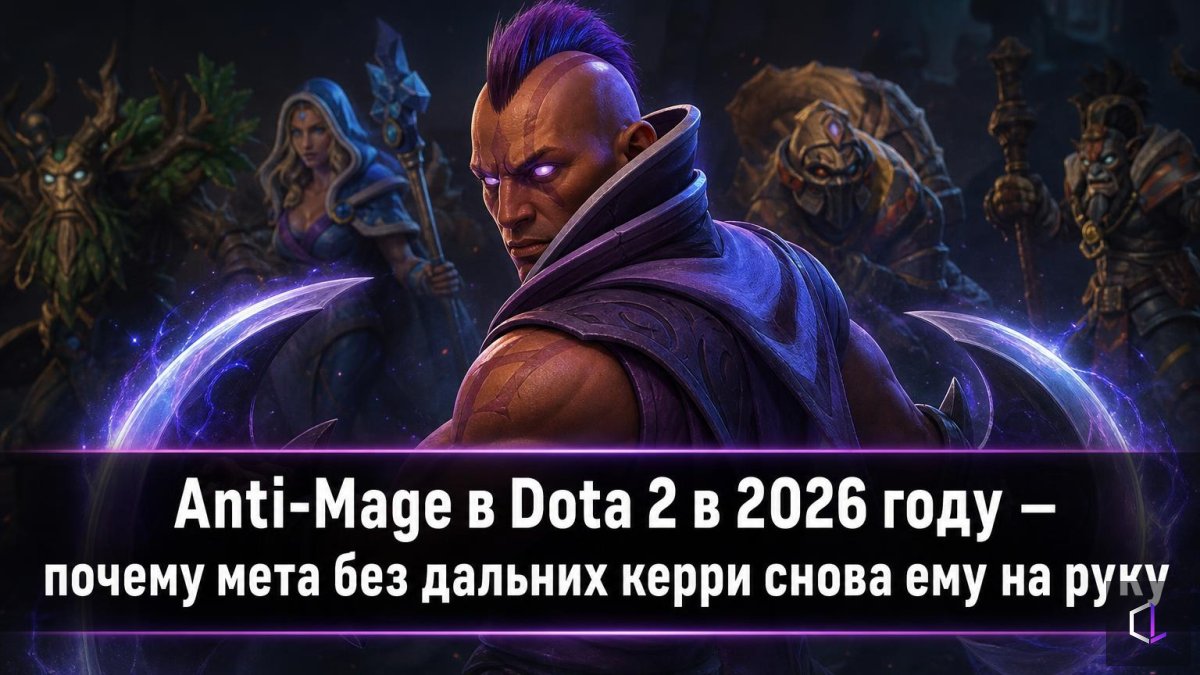
Anti-Mage has lived with a strange reputation for many years: he is loved, but not trusted, and every time he returns to the games of strong teams, the reason is worth looking for not in the hero himself, but in his surroundings. A fresh example is the words of Yatoro from Team Spirit, spoken at a tournament at the start of the season. In his assessment, the meta has shifted a little: there are not many ranged carries left — essentially Nature's Prophet and a few heroes like Windranger and Clinkz. And these characters, in his words, handle Anti-Mage poorly. On top of that, he combines well with the currently popular supports and offlaners, so he can be picked in almost every game.
Those three sentences contain an entire scheme of how strong players think during the draft. The hero is evaluated not on his own, but as an answer to what is happening around him.
The Hero as a Function of His Environment
Anti-Mage is a farm-focused carry: he accumulates items for a long time, and then wins the game through tempo and the ability to quickly destroy the enemy's economy and buildings. His weak spot is always the same: the early and middle stages, when he has little health and the opponent can pressure him in lanes and in fights. Who can hold him back? As a rule, heroes with a ranged attack, who punish him in the lane and don't let him farm in peace.
Yatoro's logic is simple: if there are almost no such heroes in the current meta, the main argument against Anti-Mage disappears. This is what is called a "window" for a pick: the hero did not become stronger after changes, the things that held him back were simply removed.
What Matters Here to Understand About the Draft
The draft (the hero selection stage before a match) is not a list of favorite characters, but a problem with conditions. The conditions are set by three things: whom the opponent picks, whom your team picks, and what is popular in general right now. That is why the same hero is useless in one patch and almost mandatory in another, even though his numbers haven't changed.
From this comes a practical conclusion: before picking a hero who is "overpowered" in the community's opinion, it is worth asking yourself three questions. Who in the current games can get in his way? Does my team have people who will let him farm safely? And is the whole plan not built on the opponent making a mistake?
The CyberLab View: You Can't Copy Someone Else's Pick Without Context
We treat such statements with caution, and here is why. Yatoro plays on a team where roles are well-structured, support works for the carry's farm, and the opponents are strong players who know how to play against Anti-Mage. In an ordinary public game everything is different: you have random allies, supports don't always understand what is needed from them, and the opponent's ranged carry may turn out to be not one of those who are "almost absent" in the meta.
That is why the quote about Anti-Mage being pickable in almost every game should be read as a description of conditions, not as advice. "Almost every" works where you control at least some of those conditions. If you blindly repeat a pick and then are surprised that the hero didn't deliver, the problem is not the hero and not you, but that you transferred a decision without the circumstances it grew out of.
We would suggest a different rule: first formulate why the pick works right now, and only then take it. If you can't explain it in two sentences — don't pick it, and instead practice a simpler option that you understand completely. The ability to explain your own hero choice means more for growth than a dozen "meta picks" learned from other people's streams.
Why the Meta Creates Heroes by Itself
The phrase that Yatoro "creates the meta himself" is interesting for a different reason. At a high level, one player's pick changes the behavior of others: if one picks Anti-Mage and wins, opponents begin looking for ways to hold him back. Ranged carries will be drawn in, there will be more of them, and that means the window for Anti-Mage will close. The meta in Dota 2 is not a stable state, but a pendulum: every advantage produces a countermeasure.
That is why it makes sense to look not only at whom people are picking now, but also at whom they are almost not picking and why. In the gaps between popular picks lie, as a rule, those very "unexpected" victories that are later called a meta shift. And the skill of noticing such gaps in advance is exactly what distinguishes a player who adapts from one who catches up.