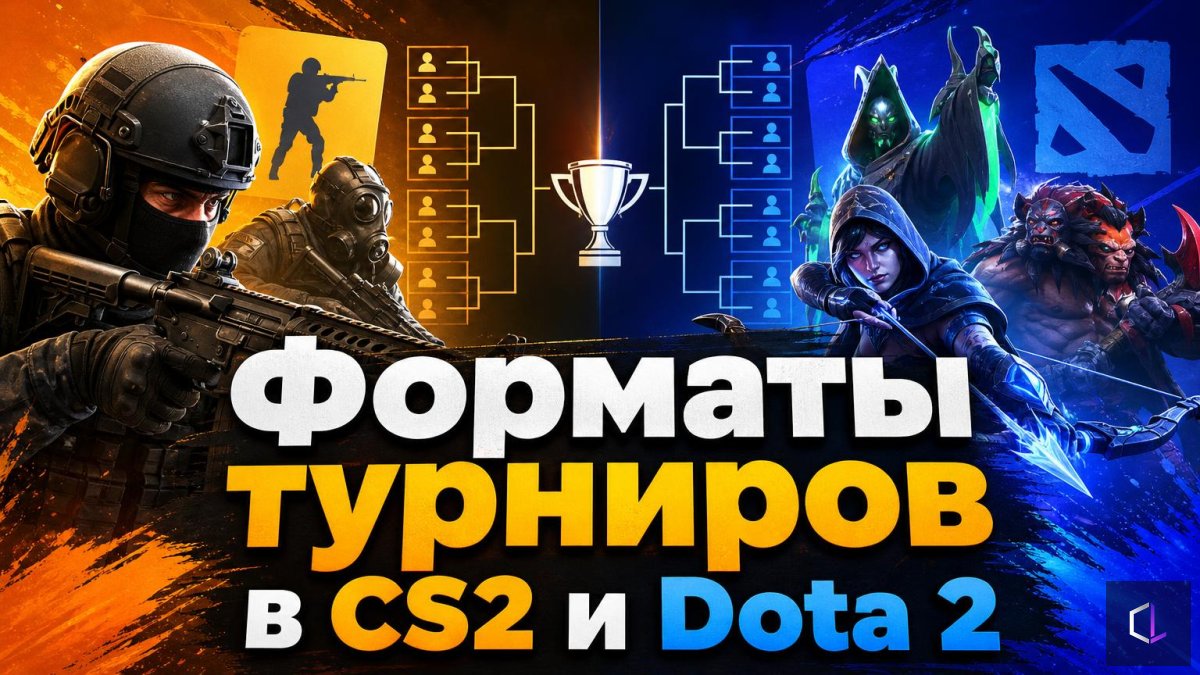
The same roster can look strong or weak at a tournament, depending on the format it is made to play. A short match of a single map follows one logic; a long series to three wins follows a completely different one. Let's look at the building blocks esports tournaments are assembled from and why organizers choose the ones they do.
Bo1, Bo3, Bo5: How Many Maps Are in a Match
The abbreviation Bo (from "best of") shows the maximum number of maps a pair of teams can play. The winner is the one who first wins the majority.
- Bo1 — one map. A single encounter decides everything, so randomness is higher: a weaker team can knock out a stronger one with one lucky run. The format saves time, which is why it is popular in the early stages and in large groups where there are many matches.
- Bo3 — up to three maps, and a team needs to win two to take the match. This is the workhorse of most tournaments: it gives a chance to correct a mistake while still fitting into the broadcast schedule.
- Bo5 — up to five maps, and three wins are needed. A series can drag on for several hours, but the result reflects the teams' strength far more accurately. That is why Bo5 is most often reserved for finals and decisive matches.
In CS2, series include a map selection procedure: teams take turns removing ("banning") maps from the pool and picking the ones they want to play on. In a Bo1, a single remaining map is left; in Bo3 and Bo5, each side gets a chance to impose its strong locations. In Dota 2 there is only one map, so a series is simply several games in a row, and the key battle takes place at the draft stage (hero selection).
How Teams Enter a Tournament: The Main Schemes
Single elimination. Lose and you're out. An 8-team bracket consists of three stages (quarterfinal, semifinal, final), a 16-team one of four. This is the fastest scheme and the easiest for viewers to follow, but it is brutal: one bad series wipes out weeks of preparation.
Double elimination. The bracket is divided into an upper and a lower one. A team that loses in the upper bracket is not eliminated but drops into the lower one and gets a second chance; elimination comes after the second defeat. The format is fairer, since a random loss doesn't kill a favorite, but it takes more game days. It is the traditional choice for major Dota 2 tournaments.
Group stage. Teams are divided into groups, within which they play each other in a round robin, and the best advance. Everyone gets a guaranteed number of matches, which is convenient for both the teams and the broadcast.
Swiss system. It is often used at CS2 Majors — the biggest tournaments, with a special status. Teams are not eliminated after their first loss: each round, opponents are chosen based on the current result, so that teams with a similar balance of wins and losses meet. Usually a team advances after three wins and is eliminated after three losses. The scheme gives many participants several matches and reduces the role of chance in early encounters.
Playoffs and Why They Are Called That
The playoffs are the final stage, where play is elimination-style: a bracket of 8 teams (sometimes 4 or 16), most often in a Bo3 format with the final in Bo5. It is preceded by a qualifying part — groups or a Swiss stage — where it is decided who has earned a place in the bracket at all. This pairing explains the industry's logic: the long stage weeds out random participants, while the short, sharp one creates the spectacle.
How the Format Is Chosen
The organizer balances three things: time, fairness, and entertainment value. More teams and fewer days mean more Bo1 and single elimination. If you want the fairest possible winner, you get double elimination and a Bo5 final. The TV schedule matters too: a series that unexpectedly stretches to five maps breaks the timetable, but it often turns into the best episode of the entire tournament.
There is also a practical point for the players themselves: in a Bo1, the winner is the one who performed better on a single map, while in a Bo5 it is the one who can readjust between maps and find an answer to the plan the opponent has studied. That is why the same team can confidently get through long series and stumble in short ones, and vice versa. When you see the familiar "Bo3" and "16-team bracket" on the poster for the next tournament, you already understand that behind them lies a deliberate compromise between speed, fairness, and keeping the viewer interested all the way to the end.