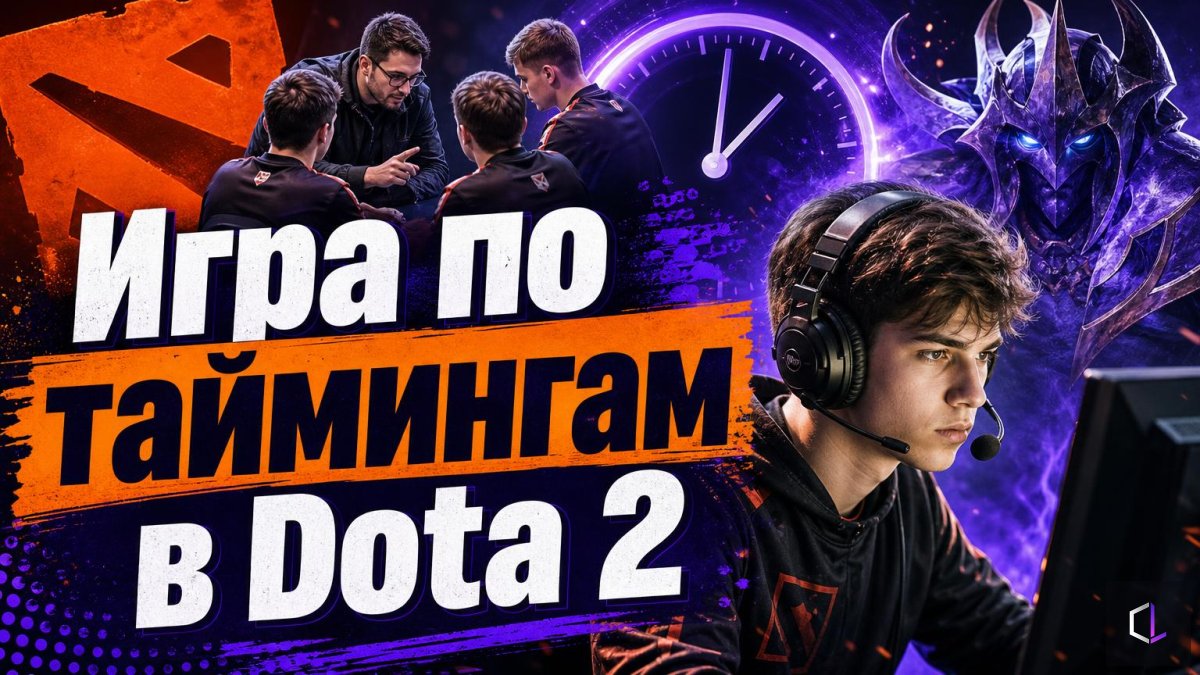
Recently iLTW said that Dota 2 has become easier: according to him, today you don't need to come up with anything, it's enough to play by timings. The community immediately split into two camps: some agree, others call Dota 2 the hardest game in the world. Let's try to figure out what lies behind this phrase and who is right in the argument.
What does "playing by timings" mean?
A timing is a moment in the game by which a team must manage to do a specific thing: finish buying a key item, take a tower, gather for Roshan, go out for a fight as a full five. "Playing by timings" means not improvising, but checking the course of the match against a known schedule: at such-and-such a minute the hero should have such-and-such an item, at such-and-such a minute the team is ready to push.
To a newcomer this sounds like a life hack, to an experienced player — like a description of routine. The schedule has existed for a long time, but the better it is studied, the less room is left for surprises. This is exactly what iLTW means: when it is clear what to do at every minute, the game turns into the execution of a plan rather than a search for decisions.
So has the game become easier?
The "yes" argument looks like this. The meta is stabilizing, breakdowns and statistics are available to everyone, and the builds and lane assignments of heroes have long been known. If you know when your hero is strong, you simply arrive at that moment prepared. There is nothing to invent: the difficulty has moved from creativity into discipline.
The "no" argument is also weighty. Knowing a timing and executing it are different things. The schedule breaks down in the first minutes: the opponent grabbed the rune, the support was late to the lane, you were killed at the twentieth second. Someone who can rebuild the plan without losing tempo plays a harder game than someone who simply follows the scheme. The difficulty has simply shifted: from "how to play" to "how not to fall off the schedule."
Where the difficulty hides now
If the schedule is known to everyone, the one who adapts better wins. Several places where this is visible:
- Deviations from the plan. The ability to understand that the opponent has broken your timing and to change priorities in time — for example, giving up one lane in order to make it to another objective.
- Information about the opponent. The opponent's timing is the same kind of quantity as yours. Noticing that they have run out of a key item and using the window is a skill with no template.
- Team synchronization. Five people can each know the schedule individually and still arrive at the fight at different times. Coordination is a separate skill that is almost invisible from the outside.
These layers do not disappear even when the basic plan has been memorized. They are simply harder to explain than "buy the item by such-and-such a minute."
Why the argument won't end
iLTW's phrase works as an observation about the top level: where everyone knows the schedule, the game really does look like execution. But for most players, who have not yet learned to consistently hit their own timings, this is more of a goal than a bore. The different sides of the argument are looking at different steps of the same ladder.
So the honest answer to the question in the headline is this: the game has not become easier, it has become more predictable within the plan and more demanding beyond it. Someone who has learned the timings gets a smooth game. Someone who knows how to break them and repair them on the fly gets an advantage that cannot be calculated in advance.