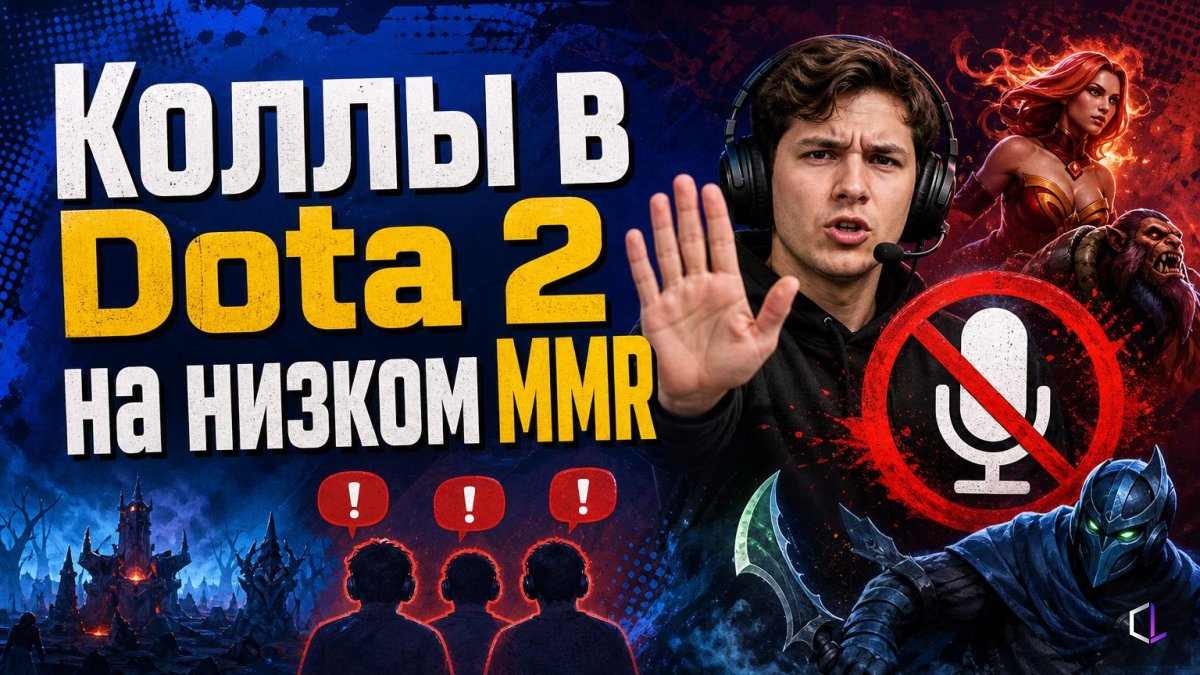
Malr1ne recently spoke briefly and without much diplomacy about what many players at mid and high ratings in Dota 2 are busy with. According to him, at 7–8k MMR (the hidden rating the game uses to match opponents) nobody needs to know how to call. To call means to manage the team out loud: naming targets, calling for a fight, deciding where to go. His advice: play the way you feel. In his opinion, it makes sense to shotcall closer to nine thousand, that is, at high ranks. And even there, he adds, calls are not always needed, because people simply don't listen.
The phrase sounds like a joke, but behind it lies an observation that is worth examining seriously.
Why the team doesn't hear
A call works only when all five players share the same picture of the game. If you shout "let's go Roshan," but two people are thinking about farming, one is sitting in the lane, and another is looking at a different part of the map, the call turns into noise. They hear the words, but they don't understand why or at what moment they need to act.
At high rating this is easier: players read the same situation faster, and a short remark is enough. At mid rating the pictures diverge, and a long command in chat or voice produces not action but an argument. Hence Malr1ne's logic: until there is a common language, shotcalling is pointless.
What to do instead of shotcalling
This doesn't mean you should stay silent all the time. The difference between a command and information is fundamental:
- Information is a verifiable fact: "they don't have their ult," "mid is missing from the lane," "Roshan is alive, I see the ward."
- A command is a demand placed on others: "everyone to the tower," "we're ganking right now."
Information is easy to accept; you don't need to trust the speaker. A command is hard to accept: it requires faith in someone else's decision, and at mid rating there is almost no such faith. That's why a sensible strategy is to report what you see and leave the decisions to those who carry them out.
Playing "the way you feel"
The second half of the advice, "play the way you feel," is not a call for chaos either. The point is that at this level the winner is not the one who manages the team best, but the one who consistently does his own job: farms, doesn't die pointlessly, arrives at the fight on time. Individual play gives more win percentage than attempts to gather five people under one plan.
From this comes a practical conclusion. If you want to learn to shotcall, you should start not with loud exhortations but with observation: when, after your remark, the team actually did what was needed, and when nothing changed. The difference between these two cases is exactly what separates a call from empty words.
Why the threshold is arbitrary
The nine thousand in Malr1ne's words is a reference point, not a boundary. The mechanics matter more: calls start working where players understand the same game in the same way. A team of five friends with an established connection can shotcall at any rating, while a random five won't listen even at a high one. Rating here is only an indirect sign of a common language.
So the honest question to ask yourself before pressing the microphone is not "do I have enough MMR," but "do the others understand what I'm talking about, and why they should do what I'm asking."