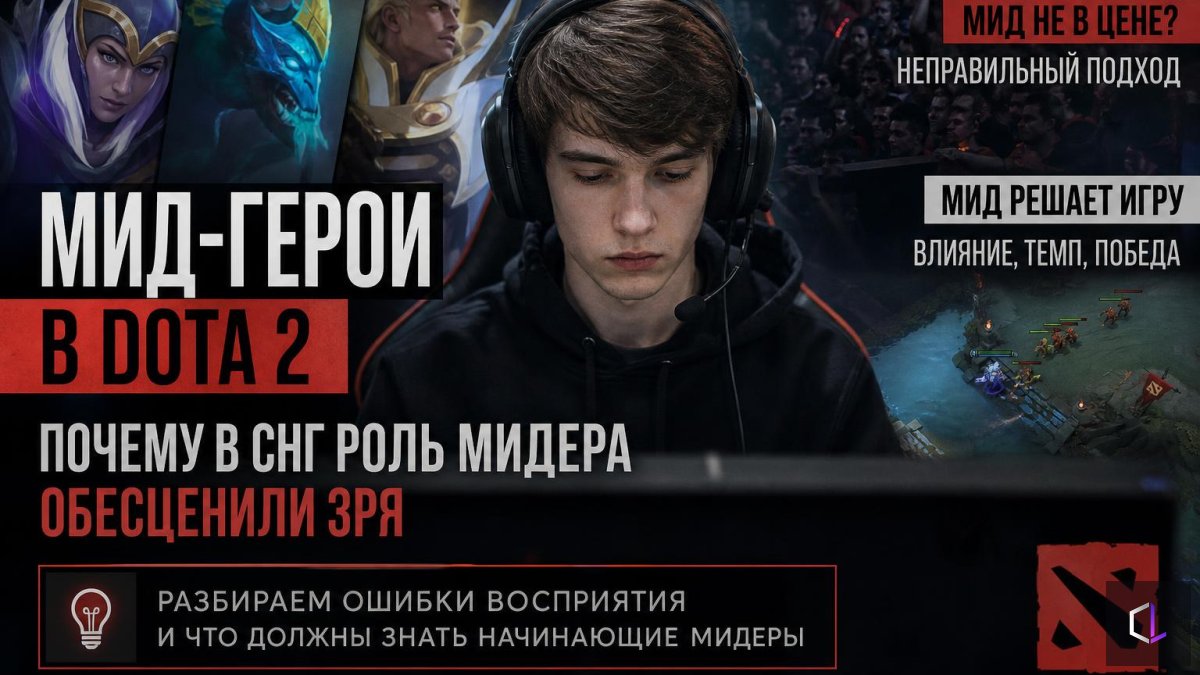
Mid Heroes in Dota 2: Why the CIS Region Wrongly Devalued the Mid Role
Mid without the hype is still the mid that decides the game
A strange role hierarchy has long been established in the CIS Dota 2 community: the carry is the star, the fourth-position support is the fun chaos-maker, and the mid player has somehow remained in the shadows. Even when a CIS player won The International playing mid, the applause was noticeably less than what a flashy carry with spectacular fights receives. It's not about statistics or actual contribution to the win — it's about perception. Mid doesn't "shine" the way hyped roles do, and that's why beginners often treat it coolly.
This creates a strange skew in how young players choose what to train first.
Why beginners specifically undervalue mid
The problem isn't with the role itself, but with how it's presented in streaming and clip culture:
- Mid less often produces "highlight clips." Good mid play is often about tempo, experience trading, and map control — not about a spectacular multi-kill at minute 40.
- The mid player's result is delayed in time. A carry's gold and farm are immediately visible on their items, while a mid player's contribution to the win is a lane won in the first 10 minutes, which converts into an advantage halfway through the game.
- The role requires earlier game IQ. A mid player needs to be able to read the map, agree on rotations, and make decisions without hints — this is harder to "sell" to a teenager who's just starting to understand the game.
The result is a paradox: one of the roles most demanding of game intelligence is perceived as "unfashionable," and beginners' attention flows to where there are more spectacular clips.
What playing mid actually trains
If you break down the mid role without the external hype, it turns out that it's precisely the one that best develops basic skills useful for any position:
1. Solo laning — the ability to survive and deal damage one on one, without a support's cover.
2. Timings and map awareness — the mid player is the first to go roaming, which means they must keep the state of the entire map in mind, not just their own lane.
3. Decision-making under pressure — it's often the mid player who decides whether it's worth risking a kill or better to go back to farming.
4. Draft adaptability — the mid hero is often picked as a counter-pick, which means the player learns not to fixate on a single hero pool.
These skills directly transfer to other roles: a player who can read the map from mid usually progresses faster on both carry and support as well.
Why this matters to parents and beginning players
If a teenager chooses a role in Dota 2 only based on the principle of "where there are more highlights and subscribers," they risk missing out on developing fundamental gaming skills. Mid is a kind of school of game thinking: less spectacle, more systematicity. And it's precisely this systematicity that ultimately distinguishes a player who consistently climbs in rating from one who gets stuck at the same level, relying only on flashy moments.
Hype fades quickly, but the ability to read the game stays with a player in any role and at any stage of their career — from the first matches to serious tournaments.