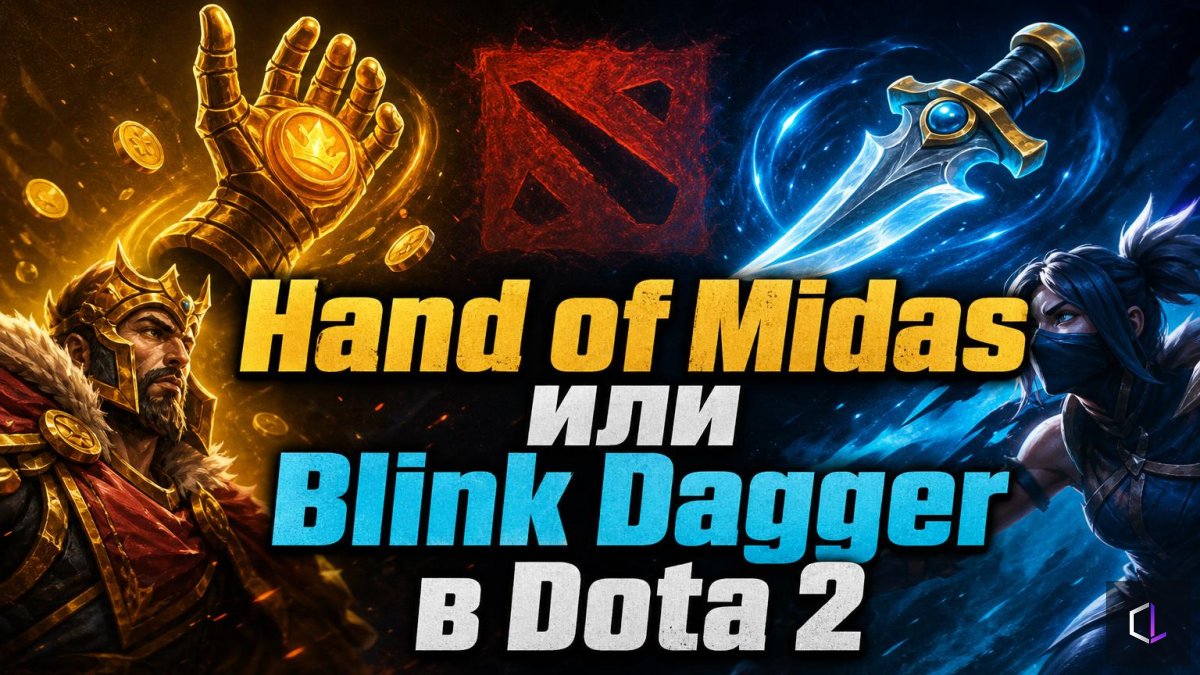
The debate over Hand of Midas in Dota 2 has been going on for years: some consider the item mandatory for any carry, others call it the worst purchase in the game. The conversation recently flared up in the community again, and it deserves a calm look: the question is not whether the item is "good" or "bad," but when it works and when it eats up time you already have too little of.
What Midas does and what it doesn't
Hand of Midas is an active item: it is used on a killed enemy creep and turns it into extra gold and experience. It is economy invested into economy. The item gives no strength in a fight, no mobility, and no protection — it speeds up the accumulation of your next items.
The first consequence follows from this: Midas pays off only if the hero has the time and space to use it. Each use requires a free creep nearby and that nobody is bothering you at that moment. If the lane is being pushed in, the hero is sitting under the tower, and the enemy team is already moving around the map, the item turns into a pretty icon in the inventory.
When Midas is justified
The item works when three conditions are met:
- you hold the lane confidently and can farm without constant pressure;
- the enemy cannot quickly punish passive play — they have no strong early heroes with initiation;
- your team can survive ten to fifteen minutes while you build up your economy.
If even one condition is not met, the purchase becomes a bet that the game will wait. Usually it doesn't.
Why Blink Dagger is a different kind of decision
Blink Dagger gives an instant dash over a distance. It is not economy but opportunity: reaching a target, escaping a fight, taking a position from which the hero can use abilities. For heroes whose strength depends on initiation or on reaching the right target, Blink turns potential into results.
The logic of a comeback is different here. When you are losing, you can rarely afford the luxury of farming for a long time: the enemy has already built items and is pressing. But a single successful fight can turn the course of the game. An item that raises the chance of such a fight is, as a rule, more useful than an item that speeds up gold accumulation.
How to make a decision rather than guess
It is most useful to ask yourself three questions before buying:
1. How much time do I have? If the enemy is already breaking buildings, an economic item won't have time to pay off.
2. What stops me from winning the fight — a lack of gold or a lack of a way to reach the target? If the problem is access to the target, you need Blink, not Midas.
3. What does my hero do best? The item should amplify the hero's strength, not cover for someone else's weakness.
The trap here is the phrase "I'll buy the item and come back." A comeback is not bought with a single artifact: it is assembled from decisions made earlier — which fights to take, which to give up, where to place a ward, when to leave the lane. The item only reinforces a right decision or aggravates a wrong one.
Why such debates are useful
Loud statements like "this item is dead" work as provocation, but underneath lies a legitimate question: how deliberate is your choice of items. A player who buys Midas "because everyone does" and a player who ignores Midas "because people criticize it" make the same mistake — they hand the decision over to someone else's opinion.
A working habit looks different: look at the specific game, the composition of both teams, the timer, and your own position on the map — and only then open the shop. There are almost no items in Dota 2 that are always good or always bad; there are items bought at the right time and at the wrong time.