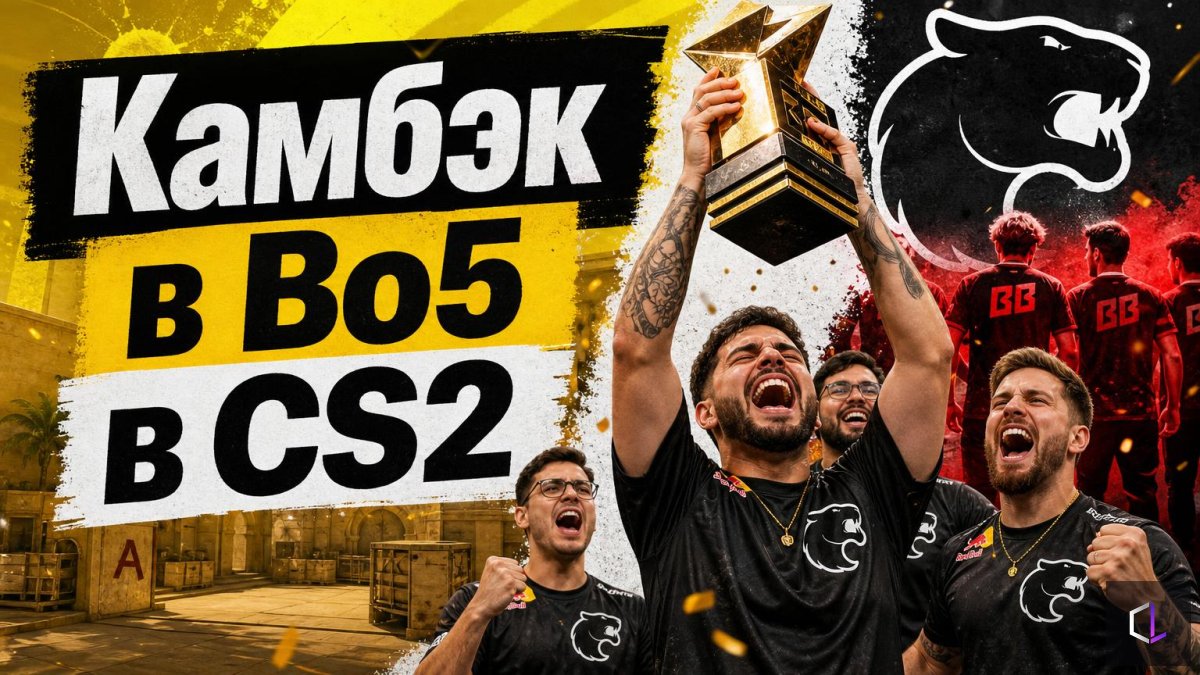
When FURIA trailed 1:2 in maps, and BetBoom Team found itself one step from victory at the decisive stage of the final, the picture of the series looked unambiguous. But in the end FURIA won the Bo5 3:2 and took the Thunderpick World Championship 2026 title, along with $500 thousand in prize money — half went to the players, half to the organization. KSCERATO was named tournament MVP.
The Bo5 (best of five) format means a series played to three won maps. It is longer than the familiar Bo3, and that is exactly what makes coming back from 1:2 a fundamentally different task: there are at least two more maps ahead, which means there is more time for corrections than it seems at the moment of defeat.
What makes 1:2 dangerous
The main trap for the trailing team is the urge to urgently "fix everything." After a lost map, you want to change setups, swap roles, come up with something new. But in a Bo5 against a strong opponent, a sharp overhaul almost always costs more than sticking with a working plan. A team that climbs out of a slump usually doesn't invent a new game, but removes specific mistakes from the one it already knows.
For the viewer this is invisible: from the outside, a comeback looks like a surge of impulse. For the players it is more like work on the level of one or two details: who trades whom in a position, who covers a timing, where they stop rushing.
11:2 — the most dangerous moment for the leader
The most interesting part is the deciding map on Cache. BetBoom led 11:2 — four rounds were then left until winning the map — and still allowed its opponent an almost complete return, ending up in overtime. Overtime in CS2 is additional rounds at a tied score of 15:15, where each side plays several rounds in a row.
The lesson here mirrors the previous one. A leader with a large margin often makes the opposite mistake: it starts playing "not to lose" rather than "to win." The tempo drops, round execution becomes more cautious, and the opponent, who has nothing to lose, gains freedom of action. A team that is ahead must play the same style as it does at an even score, otherwise it will have to pay for that lead.
This is not a reproach to BetBoom. Almost coming back from 2:11 to overtime is a great credit to FURIA, and BetBoom held out through the overtime to the final rounds. But the collapse in such a situation shows that the psychological pressure at the end of a series is the same for both sides, just with different sources.
Why age and experience are no small thing here
Among FURIA's five is FalleN, who is 35 years old and has lifted the trophy once again. In a Bo5, when trailing 1:2, teams need not only strong shooters but also people who can keep calm in the lobby. An experienced captain and a player who has already been through similar series choose short, clear wording at the most nerve-racking moment: what we do next round, who goes where, what the economic round is.
FURIA's lineup for this final: yuurih, KSCERATO, FalleN, molodoy and YEKINDAR. molodoy, like YEKINDAR, played in a freshly assembled pairing, but it was precisely the cohesion in communication and roles that helped them come back: when a group has lived through a slump together, the second half of the series goes differently from the first.
What you can take into your own game
Any team in ranked play faces a mini-version of this scenario: a lost map, a tense break, a feeling that everything is going wrong. Instead of general motivation, a few concrete things work. Appoint one person who voices the plan for the map and the next round. Don't change your entire tactics after a single defeat. And when you are leading by a big score, play at the same tempo at which you built that score.
The TWC 2026 final shows well that a series ends not where the score seems hopeless, but where one of the lineups stops playing its own game.