The Race for the CS2 2026 Major: Why Teams' Chances Change Every Day and What It Teaches Players
What's happening right now
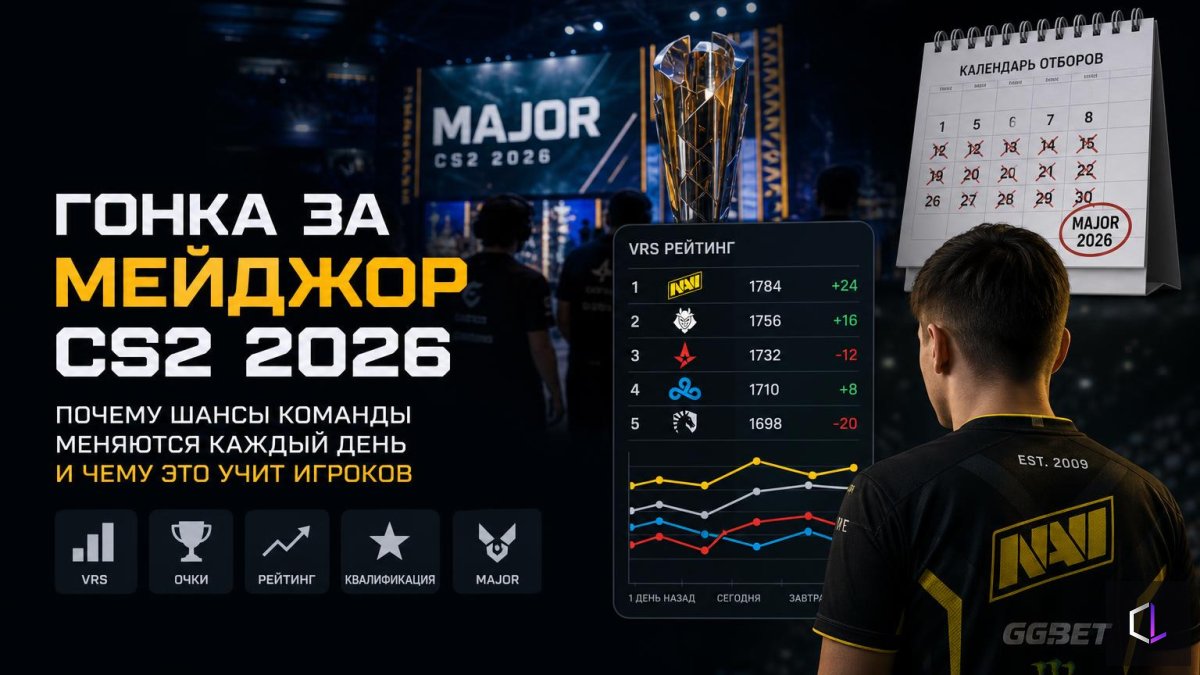
Just days before the CS2 Major deadlines, the qualification picture is changing literally every day. Some teams that were sitting in the elimination zone just yesterday are suddenly gaining in their qualification percentages today, while others — established top teams like NAVI — are dropping out of even the top twenty of Valve's world ranking (VRS). Meanwhile, somewhere on the Asian scene, one team has practically already "reserved" itself a slot, while another is fighting for a ghostly 6% chance.
To an outside observer, this looks like chaos made of numbers. In reality, it's invaluable material for understanding how professional esports actually works and why there's almost no room for randomness in it, even if it seems otherwise.
Why the ranking changes so sharply
VRS isn't just a table of wins and losses. The system accounts for opponent strength, round difference, the freshness of results, and dozens of other parameters. That's precisely why a single loss at a tier-2 tournament can crash a team's chances by as much as 10-15%, while one confident win over a stronger opponent can pull an underdog into the real qualification zone.
This explains NAVI's drop out of the top 20: it's not about one bad day, but the cumulative effect of unstable results over the past few weeks. A team with a name and a history of victories isn't protected from the math of the ranking — it works the same way for everyone.
Why young players should know this
It might seem like tournament statistics are a topic for analysts and bookmakers, not for someone who's just starting their path in CS2. But in fact, understanding such systems is exactly what shapes mature gaming thinking:
- Results matter more than emotions. The ranking doesn't remember beautiful clutches — it counts objective indicators. This teaches you to focus on consistency in your play rather than individual flashy moments.
- Form matters more than status. Even an experienced team can slip if it doesn't work on its form every week. For a teenager, this is a direct lesson: regular training matters more than a one-off result.
- Analysis is part of the game. Professionals break down not only their own demos but also ranking tables, opponents' chances, and the tournament calendar. This is a skill just like aim or grenade lineups.
Tournament cancellations and their consequences
A separate detail from this week is the cancellation of one of the last tier-2 tournaments before Major invites are handed out. For teams fighting for points, this is a blow: fewer matches means fewer chances to prove their form to the ranking system. For young players, this is also a telling moment — in esports, as in any professional sport, infrastructure and tournament organization affect a career just as much as personal skill.
The bottom line
The race for the Major isn't just a game schedule — it's a live example of how the system evaluates teams objectively, with no discounts for name recognition or past achievements. For those who want to grow seriously in CS2, this is a great occasion to reconsider their approach to their own statistics: not relying on the feeling of "I played well," but analyzing concrete numbers — just as teams do on their way to the Major.