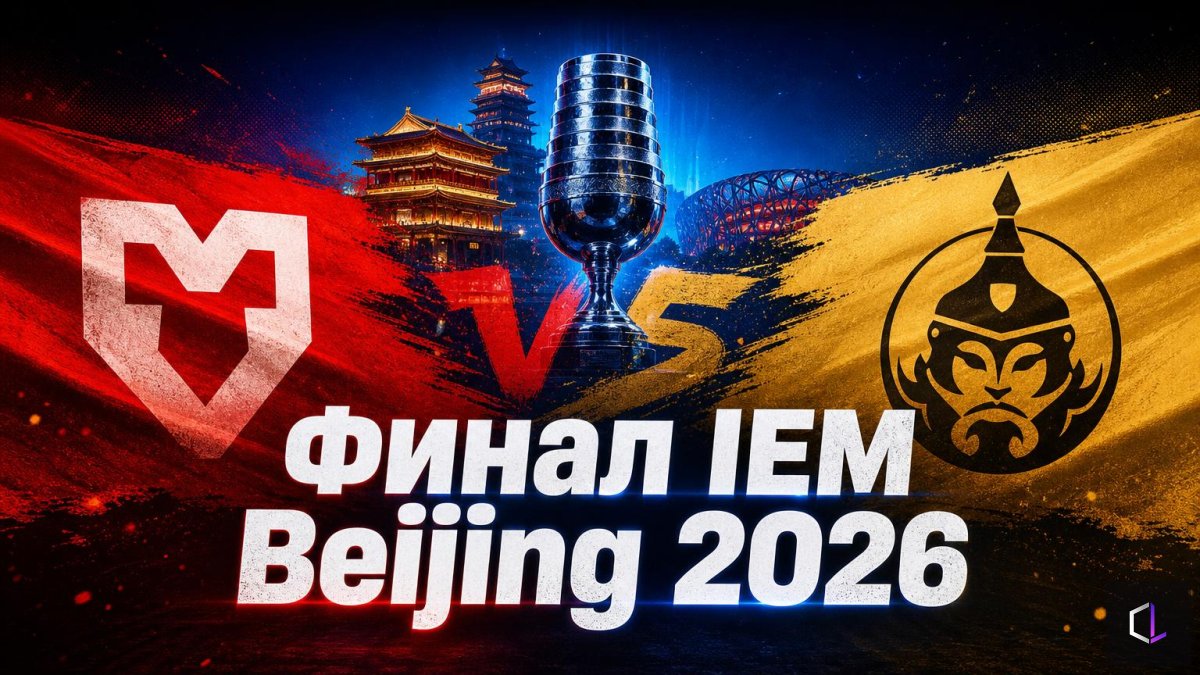
The final day of IEM Beijing 2026 is arranged so that viewers get two storylines at once. First in the schedule is the third-place match: NAVI play against BetBoom Team. Then MOUZ and The MongolZ take the stage, and they will play for the title. The Europeans' path to the final was short and clean: the semifinal against BetBoom Team ended 2:0, that is, without losing a single map.
What the Dry Score Says
A 2:0 in a best-of-three does not necessarily mean the opponent was weaker. It means the winning team won the key rounds on both maps at the right time: pistol rounds, economic turnarounds, late-round situations with equal numbers. For the losing side, a score like this is especially hard, because there is no "next map" to win back. The series is over, and the review begins right in the locker room.
For BetBoom Team, this is exactly where the final day begins. A team that the day before could count on the title goes out in the morning to a match where it is no longer on the line.
The Bronze Match: Stakes Without a Trophy
The third-place match is often called a formality. That is inaccurate. There is no title in it, but there is everything else: tournament points, prize money, the impression left on viewers and sponsors, and the mood inside the team ahead of the next event. What is especially telling is how a team handles the transition itself. Within a night or a morning, you have to turn a defeat into working information and go out to play at full strength again.
We consider this ability one of the most underrated components of professional play. Aim and map knowledge are comparable among top teams. The difference more often shows up where players have to force themselves to play at their limit even though they want to finish the tournament and go home.
How to Reset Your Head After a Loss
There is no universal recipe, but practitioners tend to arrive at roughly this sequence:
- A short break without playing. Spend about ten minutes on water, food, and a walk, without discussing the map. A review done in the heat of the moment almost always turns into a search for someone to blame.
- Two points instead of twenty. Take a maximum of two concrete things from the previous series, for example one mistake in the economy and one in positioning. Everything else is set aside for later.
- A mechanical warm-up. Twenty minutes of shooting at bots or in a warm-up mode is enough for the hands to feel "their own" again. Working with the hands relieves emotional weight better than conversation does.
- The first round as a separate task. Before the pistol round, the whole team agrees again on one simple thing: what we do in the first thirty seconds. This restores a sense of control.
There is one universal rule here: the next map must not begin with an assessment of the last one.
The Final as a Separate Tournament
For MOUZ and The MongolZ, the task is different. Both teams have already gotten what they wanted from the tournament: they reached the final. Now they have to withstand the pressure of expectations. The favorite risks "playing not to lose," while the underdog, by contrast, can afford bold decisions in the early rounds. That is exactly why finals so often look different from semifinals between the same teams: what changes is not the level of play but the risk the players are willing to take.
For a viewer from Kazakhstan, this final is also interesting because an Asian team is playing in it. The strong Asian scene remains one of the fastest-growing stories in CS2, and every such final broadens the sense of who is capable of fighting for the title at international-level tournaments.
Whatever the final shows, the main lesson of the final day is already visible: the third-place match and the title match test different qualities. One requires composure after a blow, the other endurance at the peak of expectations, and strong teams learn both.