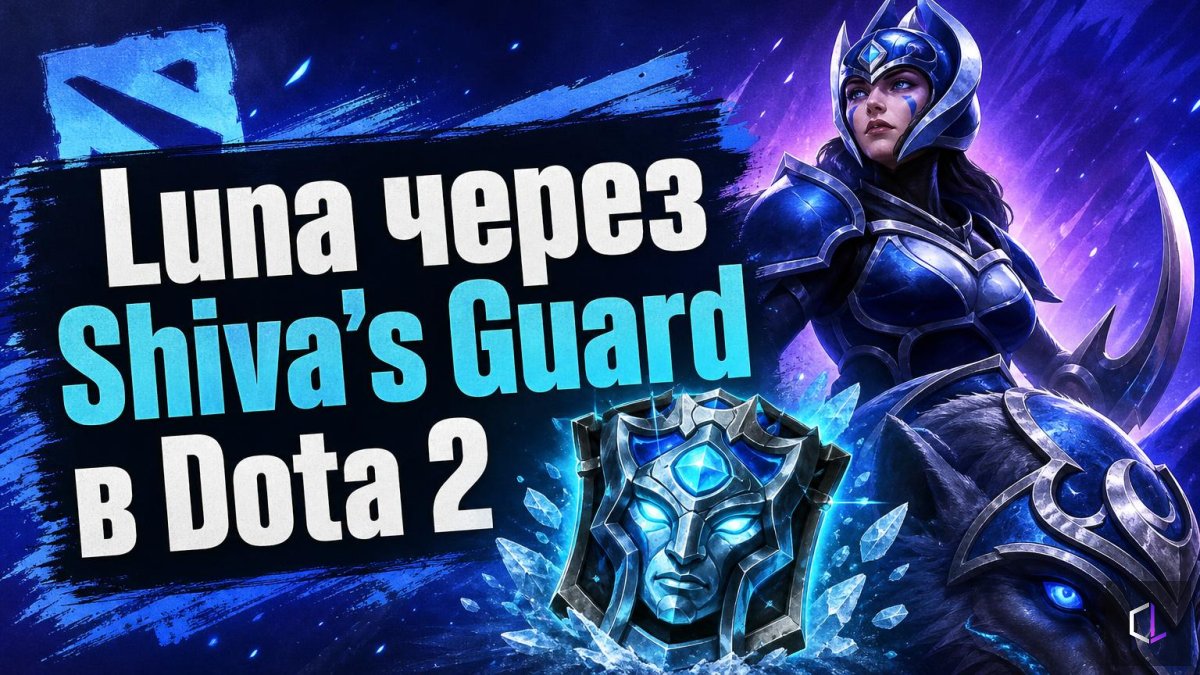
What is this Luna build that "takes over pubs" through Shiva's Guard, and is it worth copying? A reasonable question: in public games across different ranks, you increasingly see a carry who has an item in the slot that is usually bought by tanks and supports instead of the usual damage setup. Let's break down what is behind it, without relying on loud promises of a "secret" build.
Why a carry needs an item with intelligence and an aura
Shiva's Guard is an item that gives intelligence and armor, and on activation releases a freezing wave that slows enemies and deals damage to them. Passively, it reduces the attack speed of nearby enemy heroes. For Luna, this is an interesting combination for one reason: her strength is mass damage. Moon Glaives — an ability where the attack bounces between targets — makes her strong in brawls with many targets, and Eclipse adds explosive area damage.
That is, Luna in this build doesn't just hit harder, but changes her role in the fight: while the opponents are trying to close in, the enemy's strike force is already being slowed and having its attack speed reduced. For a hero that is fragile by nature (little health and armor at the start), this is a way to survive the moment when the whole team jumps on you.
Why it was noticed specifically in pubs
A pub is a game without a pre-agreed strategy, where five random people rarely have a shared plan. In such an environment, any item that works without perfect coordination gets an advantage. Shiva's Guard is exactly like that: you can press the activation yourself, and the result is visible immediately, while the slow and attack speed reduction help even if your allies didn't enter the fight at the same time as you.
An important caveat: the build's popularity in pubs is not yet proof that it is stronger on the professional scene or in organized games. There, opponents split fights better, look at your inventory in advance, and play against the slot. What works well to break the chaos of a pub may be excessive when the opponent is organized and disciplined.
When the purchase is justified
Simple logic applies here, one that is worth checking in every game rather than taking on faith.
- Against a team with several melee heroes. The attack speed reduction and slow really work when enemies are forced to come close to you.
- When there is a lack of control and armor. If Luna goes down in the first seconds of a fight, an item with armor and an activation gives her extra seconds.
- When the game drags into multi-target brawls. The freezing wave and Glaives bounces add up to good area damage.
And here is when the build is a mistake:
- If the opponent builds heroes with long attack range and engages you from a distance, the passive aura simply doesn't reach.
- If you spent a slot and gold on the item, and your farm stalled: Luna without damage and speed is a hero who stands nearby and presses a button but doesn't win the fight.
- If the team already has a player whose job is to take this item. Two copies of the same effect on one side barely stack.
How not to fall for the trend
A build from pubs is good as a hypothesis, but not as an instruction. A trend in Dota 2 lives by a clear pattern: someone gets a winning streak on an unconventional build, it gets written about, dozens of players copy it, and then it turns out that part of the success was just the element of surprise. The opponent didn't expect the carry to have a freezing wave — and paid for it. When the expectation appears, the advantage melts away.
So the sensible path is to try the build once against a specific set of heroes, and then watch the recording: at what moment the item changed the outcome of the fight, and at what moment Luna would have gained more from classic damage. If the recording shows that you pressed the activation, but the team didn't take advantage of the slow — the problem is not in the build, but in the coordination with the players.
The very fact that the discussion of the build went beyond a single game shows a healthy trait of the Dota 2 meta: an inventory slot is not dogma, but an answer to a specific situation, and the one who can read the situation beats the one who simply copies other people's purchases.