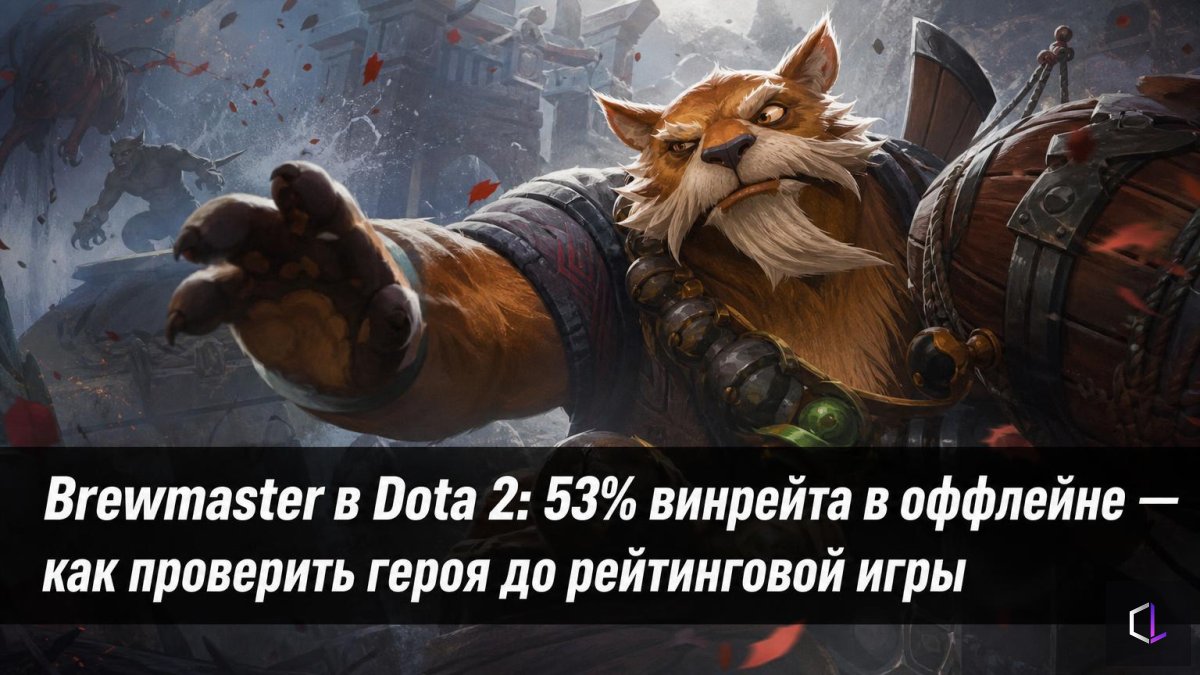
Brewmaster is currently winning around 53% of games in the offlane according to D2PT, and people love to write "just pick it and climb" about numbers like this. It sounds tempting, but 53% is an average across thousands of different players, team compositions, and skill levels. It doesn't follow that the hero will suit you specifically. Below is a sequence of steps that lets you test a pick without sacrificing your rating.
What stands behind the number
A three-percent bonus over 50% is noticeable, but not huge. On a sample like this, it may rest on several factors at once: the hero handles the current phase of the patch well, he is picked deliberately (rather than as a random pick), and he is played mostly by those who already know how to use him. The last one is called selection effect: difficult heroes are picked by strong players, and the win rate rises not because of the hero, but because of the hands.
Brewmaster is exactly one of those with a high skill ceiling. His strength rests on two things: the ability to enter a fight at the right second and the ability to use his ultimate, Primal Split, which divides the hero into three elemental spirits, properly. If the ultimate is pressed "on cooldown" rather than according to the situation, the numbers from the table don't apply to you.
Five steps to test a hero
1. First, look at your own history. Open your recent offlane games and count how you play the lane against different matchups. If you consistently survive the lane, the hero has a chance on it. If not, the problem isn't Brewmaster, it's the lane.
2. Play 5–10 unranked matches. Unranked mode is for tests: learn the rhythm of the abilities, understand when and how to lift an opponent, and see how the hero feels against different enemy heroes.
3. Determine who the hero works against. The same number hides different matchups. Write down for yourself in which compositions the ultimate gives the most benefit, and where you enter a fight with no result.
4. Don't copy a build blindly. The most popular item build is what's bought most often, not what suits your play best. Compare it with what you actually lacked in recent matches: mana, survivability, or initiative.
5. Decide in advance when you're leaving the hero. If after about ten games your win rate is below your usual bar, go back to your familiar pick. One losing streak proves nothing yet, but ten matches with an honest record is already a sample.
Why "rating abuse" is a questionable phrase
The word "abuse" creates the impression that there's a button that gives wins. In reality, any hero with good statistics has a price: he needs a certain role in the team, a certain pace of play, and allies who don't get in your way. Brewmaster in the offlane is good where the team is ready to fight around his initiative. In a silent pub game with no communication, his strengths disappear.
That's why a useful habit is to treat win rate as a hypothesis. It says that a pick is worth testing, but it doesn't promise a result. Testing costs a few games and an hour of watching your own replays; a mistake in a blind pick costs rating and your mood for the whole evening session.
What remains after the patch
In a month the number will change: heroes will be adjusted, the meta will shift, and 53% will turn into 50 or into 55. But the ability to quickly test a pick on yourself will stay with you. A player who can break a match down into "what I did," "what the opponent did," and "what the composition decided" will pick heroes deliberately in this patch and in the next one.