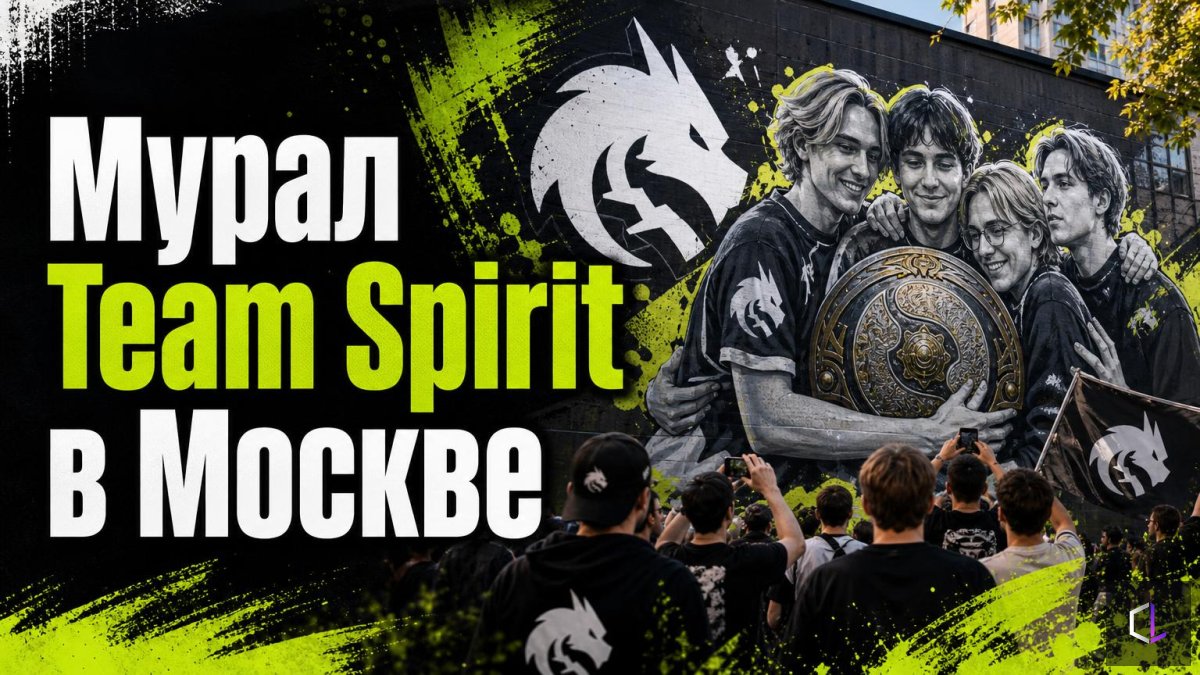
A mural honoring Team Spirit has appeared in Moscow — a Russian Dota 2 team whose victories at The International are now marked on a city wall. For esports this is a rare kind of recognition: usually teams are talked about in broadcasts and standings, but here their name has ended up in public space, alongside ordinary passersby.
Below are answers to the questions most often asked when this news comes up.
What is this mural and why Team Spirit?
A mural is a large-scale painting on the wall of a building, a form of street art. The work in Moscow is dedicated to Team Spirit's victories at The International.
The International is the main Dota 2 tournament, traditionally considered the pinnacle of the season: all the world's strongest teams strive to get into it, and winning it is equated with the title of the game's champions. That is why victories there are called historic: holding on to such a result or repeating it is a task that only a few manage.
Details such as the exact address, the authors of the painting, and the opening date are not specified in the source topic, so we will not speculate about them. The fact itself matters more than the details: an esports team has been honored in the same way musicians and athletes were honored before.
Why does a mural about esports players matter?
Urban art works for recognition. If a team is painted on a wall, it means its achievements have gone beyond the audience that watches broadcasts. A person who has never opened Dota 2 can stop, ask who this is, and hear a story about victories at The International.
For the industry this is a sign of maturity. Esports has long filled large arenas and offered multimillion-dollar prize pools, but recognition in the urban environment is a different level: it cannot be bought with advertising, and it appears when a team is accepted as part of the shared culture.
There is also a more practical side. Any mural is also a reason for conversations in the media and on social networks, and therefore additional attention for the discipline itself. For Dota 2, which has existed for many years, such a wave of interest is a way to attract people who previously never gave competitive games a thought.
What did Team Spirit do to deserve such attention?
The team is associated with victories at The International — these are what became the occasion for the mural. The text of the topic speaks of victories in the plural, and that is enough to understand the scale: this is not one successful tournament, but a result that has become entrenched in history.
Esports evaluates such things in a particular way. Winning once is already a huge achievement, but what gives a team real weight is the ability to return to the top when opponents have studied its style and are ready for its tricks. It is precisely this resilience that explains the desire to fix the success in stone — or, more precisely, in paint.
What does this say about how esports is moving beyond the screen?
Previously, a team's path from the lobby to the public was short: match, broadcast, chat. Now an entire environment is being built around it — merch, documentary videos, collaborations, and now street art. Each such point expands the audience with those who come not through the game but through the story.
For the viewer this means that you can root not only for the result. You can value the team's character, its journey, the moments when it fought back from a losing position. A mural is the visual outcome of such a story, but not a replacement for it: to understand what exactly the team was painted on a wall for, you will still have to watch the matches themselves.
It is in the recordings of the final series that you can see what does not make it onto the wall: how the team makes decisions on key maps, where it changes tempo, and why the opponent ends up a step behind.