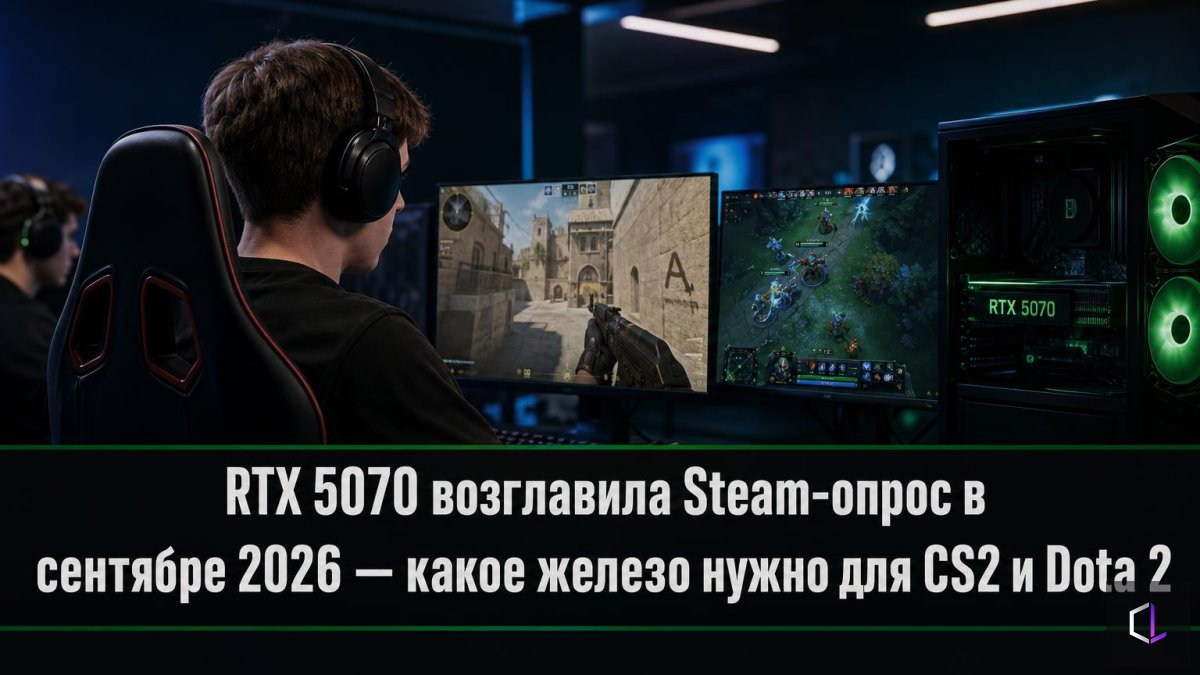
According to the results for September 2026, the most widely used graphics card on Steam became the GeForce RTX 5070: it accounts for 6.15% of the users participating in the survey. The previous leader, the RTX 3060, dropped to fifth place for the first time in a long while. Alongside the leader, the top three included the RTX 5060 and RTX 5060 Ti. The survey also showed that more than 42% of users have 32 GB of RAM installed, and 47.91% play on monitors with a 1080p resolution.
The Steam Hardware Survey is a voluntary sample: the statistics are collected from users who have agreed to share data about their computer. It is not the same as "all players in the world," but it has long worked as a benchmark for the market. The main thing visible in the latest figures is a generational shift in the mass-market segment. Not long ago, a card from the previous series held the top spot; now it is being displaced by new mid-range models.
What Lies Behind the Numbers
The most interesting thing is not who is in first place, but that the leader is not a flagship. The RTX 5070 and its lower-tier neighbors are cards that people buy "for everything": to play new releases without thinking about settings, while not overpaying for the top tier. For the market, this is a signal: the bulk of players choose a balance of price and performance rather than records.
The second figure is 1080p for nearly half of the audience. For competitive shooters, this is a familiar picture: many players deliberately stay at a lower resolution for the sake of the maximum number of frames per second. The more stable the frame rate, the smoother the mouse response and the easier it is to keep your crosshair on a moving target.
What You Actually Need for CS2 and Dota 2
It is easy to be swayed by impressive names here. A mid-range graphics card handles both titles with plenty of headroom: neither CS2 nor Dota 2 requires a top-tier graphics accelerator to deliver a comfortable frame rate. In competitive games, the limiting factor is more often not the graphics card but other things:
- Processor and RAM. In CS2, with many players and effects on screen, it is the processor that determines how smoothly the picture runs in the heavy moments of a round. Memory capacity matters: 16 GB is considered a reasonable minimum today, while 32 GB gives you headroom if a stream, voice chat and a browser are open at the same time.
- Monitor. Refresh rate affects the smoothness of perception more than resolution does. A high-refresh-rate screen often gives more benefit than moving up a tier in graphics cards.
- Peripherals and network. The mouse, the mousepad and a stable ping are not reflected in the survey, but in practice they affect results no less than any hardware novelty.
From this comes a simple conclusion for those thinking about upgrading: first find out where exactly the system "sags," and only then spend money. Turn on a frame counter, look at processor and graphics card load in heavy scenes — and buy whatever is actually hitting its ceiling. A new card will not cure an unstable frame rate if the processor or slow memory is to blame.
Why Such Surveys Should Be Read with Caveats
Any sample reflects those who take part in it. Users with very old or, conversely, exotic configurations may be represented unevenly, and the shares of individual models fluctuate from month to month. It is therefore wiser to look at the trend — which generations are displacing one another — rather than at a single percentage.
For those choosing components for competitive play, the main lesson of September's statistics lies elsewhere: today's mass-market gaming computer is a moderately priced graphics card from a new series, a good amount of memory and a 1080p screen. Everything else is a matter of personal priorities and budget, not a mandatory condition for confident play.