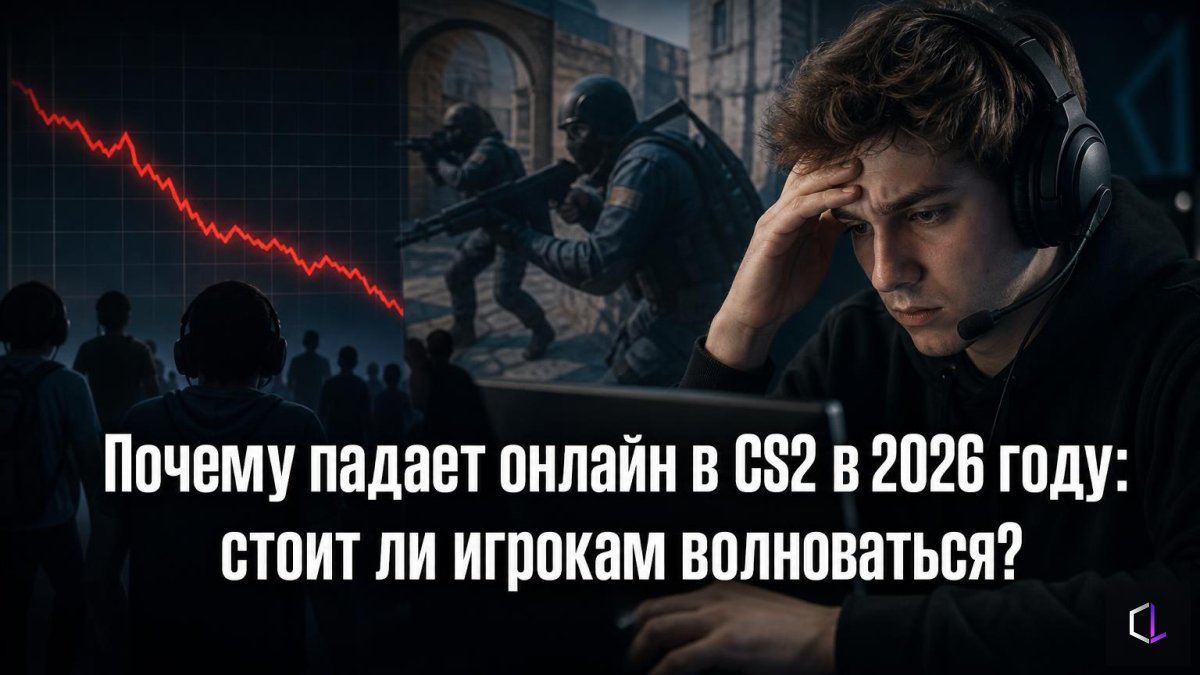
Short answer: the drop in CS2's player count is real, but you can't say the game is dying from a single counter curve alone. Since March 2026, the number of concurrent players has been declining for seven months in a row, and even the pets update, which Valve released precisely to revive interest, did not reverse the trend. This is an alarming signal for Valve, but not a death sentence for the game and not a reason for a player to change their plans.
What does "player count" actually measure?
Public charts show how many Steam clients are running the game at the same time. This is not the number of unique players and not the hours spent in matches. The counter includes those who forgot to close the game, those who "farm" drops and sit idle in the menu, and accounts that don't play at all. That's why the player count shows the scale of interest well, but shows the quality of the gameplay experience poorly. The daily peak and the monthly average can behave differently.
Why it's falling: what's known and what's guesswork
No one outside knows the exact reason, and Valve doesn't comment on the numbers. There are several hypotheses, and they are not mutually exclusive:
- Seasonality. Summer is traditionally a weak time for many games: school holidays, vacations, being outdoors instead of at the monitor. But seven months in a row is too long a stretch to blame it all on the calendar. An honest comparison is only possible with the same months of the previous year.
- Novelty effect. Major updates produce a spike, after which interest returns to its baseline. Pets and other cosmetic additions are interesting once, but they don't make anyone play for their sake.
- Account purges. If the anti-cheat and filters remove cheaters and multi-accounts, the number drops while the environment for real players improves.
- Competition. A player's time is limited, and other projects take away part of the audience.
The conclusion from the pets story is simple: what retains players is matchmaking quality, maps, and competitive content. Cute eggs and critters are no substitute for these.
What does this mean for queues and ranking?
For a player, the number on Steam matters only to the extent that it affects finding a match. It is most noticeable in certain regions and during low-traffic hours: at night and in sparsely populated regions, queues grow first, and the balance of lobbies in Premier may suffer. Platforms like FACEIT live off a separate player pool and depend on the overall player count less. If you've noticed that matchmaking has become longer or that opponents' skill levels are more widely spread, that's a reason to check your play time and server, not to quit the game.
And what about the professional scene?
Here the picture is different: pro esports feeds on viewers, sponsors, and prize money, not on the Steam counter. A telling example: in the coming days, a tournament with a million-dollar prize pool kicks off in Katowice. Sixteen teams will fight for eight playoff spots at the Spodek arena, and Kazakhstani viewers will be rooting for molodoy, Hobbit, and dastan. Major tournaments draw an audience regardless of how many people are sitting in matchmaking at that moment.
How to avoid mistakes when reading such news?
A few rules that will still work six months from now:
1. Look at the trend over many months, not at a single peak or dip.
2. Compare with the same period of the previous year to remove seasonality.
3. Distinguish player count from activity: match hours and the number of unique players are not made publicly available.
4. Look for an official comment instead of guessing at causes from commentators' emotions.
A falling chart makes Valve think about how to retain the audience: with match quality, new maps, or competitive modes. For the player, the most useful thing is to count not the player count, but your own hours spent productively.