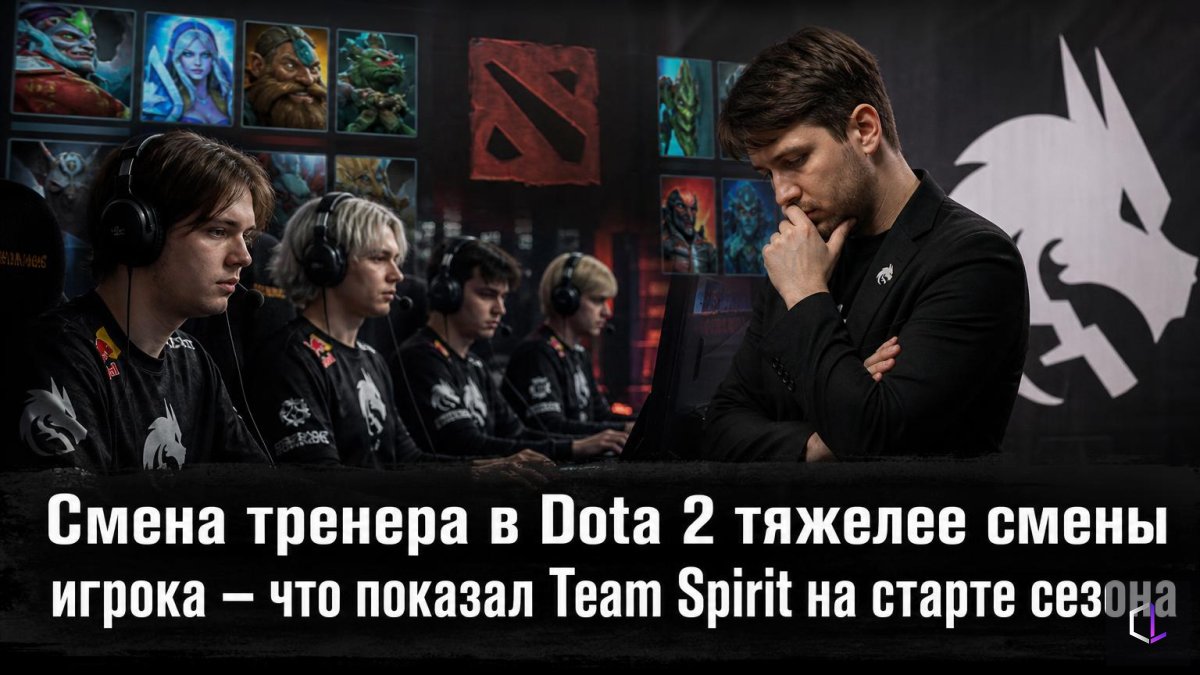
At the very first tournament of the season, Yatoro of Team Spirit answered a question that is usually asked about players, not coaches. Which is harder: replacing a person on the map or a person behind the team's back? His answer came without hesitation: changing a coach is unequivocally harder. According to him, it affects both what happens outside the game and the game itself. He then explained the mechanics: with the new coach Illidan, the team takes a lot — strategies, heroes, ideas — and tries to weave it into its own style.
That remark is more useful than it seems. It describes something that is rarely talked about: how a Dota 2 team is actually put together.
Why a player is easier to replace
A player occupies a specific role: position four or one, offlane, mid. The role is already described in the terms of the game: what is expected of it, on which heroes, at what tempo. The new person comes into a ready-made scheme and fits himself to it. The other four keep playing the way they played.
A coach doesn't occupy a slot. He affects everything at once: the draft (the hero selection stage, where teams try to take away strong picks and hide their own), which strategies are considered acceptable at all, the review of mistakes, and how the team prepares for a particular opponent. When he changes, the "operating system" on which all five players run changes.
Someone else's ideas can't simply be copied
An important detail in Yatoro's words is the verb "try." The team doesn't copy the new coach's ideas wholesale, but builds them into an already established style. This is separate work, and it is never instantaneous: a strategy devised for one set of habits may not work with another. A hero the coach loves and knows how to play demands a certain tempo, exchange of resources and roles from the team. If the five are used to playing differently, the pick turns into a formality.
From this comes a practical conclusion for any level, not only the pro scene. When you take someone else's draft, someone else's setup or a coach's advice, the question isn't whether it is a good idea. The question is whether it matches how your team plays right now, and what will have to change in your habits for it to work.
The result at the first tournament is neither a verdict nor an excuse
In parallel, discussions featured numbers for Spirit's offlaner Batyuk: at the first tournament of the season, he took first place in KDA, GPM and XPM among offlaners. KDA is the ratio of kills and assists to deaths, GPM and XPM are gold and experience per minute. These figures look impressive, but one tournament is a small sample. They say that the combination of the new roster and the coaching ideas is working for now, but not that the adaptation is finished.
Here lies the main lesson. Good statistics at the start easily create the feeling that the changes went smoothly. Yatoro, however, says the opposite outright: the price of a rebuild is high, and it is paid with attention, time and attention to small details that aren't visible from the outside.
What remains off-camera
The viewer has access to the matches, not the preparation. But it is precisely the preparation that changes the most when a new coach arrives: the review of recordings is structured differently, responsibilities within the team are distributed differently, decisions at the draft are made differently. That is why talk about the "roster" is often misleading: five surnames on the tournament website are only the visible part. The same five players with a different coach can play noticeably differently, and vice versa: a new player in the old system quickly becomes similar to his predecessor.
If you look at teams through this lens, it becomes clearer why some reshuffles pass unnoticed while others take months. Change a player — one element changes. Change a coach — the logic by which the elements are connected changes.