It used to be that the decision to ban a player over a report was made by people: volunteers watched recordings of disputed rounds and voted. Now a neural network looks first, and that changes the very mechanics of fighting cheaters. Let's break down what it was like and what it is like now.
How Overwatch Worked Before VACNet
Overwatch is a system where players with a good reputation review recordings of matches that have been reported. A submitted case is several rounds from the suspect's first-person view. The reviewer watches, decides whether the player was playing fairly, and delivers a verdict. If the majority opinion agrees, the account receives a ban.
This approach has a strong side: a human sees the context, understands the in-game situation, and can tell a bold but honest peek from playing through walls. But there are weak spots too. There aren't enough people, the queue of cases keeps growing, and different reviewers judge the same suspicious moment differently. A clever cheater who plays at "half strength" can look like just a lucky player for years.
What VACNet Is and How It Watches Recordings
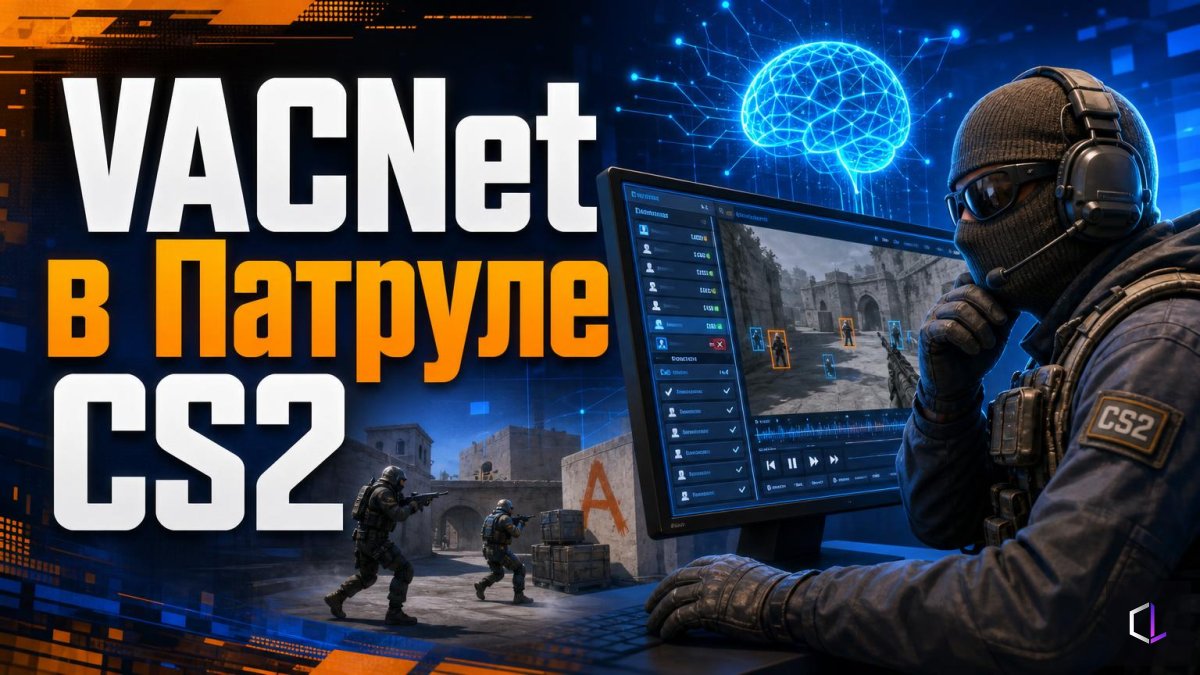
VACNet is Valve's neural network, trained on the very verdicts of Overwatch. A neural network is a program that learns from examples: it is shown thousands of recordings labeled "cheat" and "clean play," and it finds patterns that are hard for a human to put into words.
Valve does not disclose in detail what exactly such a model analyzes, and this is deliberate: if the signs were described, cheaters would adapt. We can speak in general terms: it concerns the player's behavior over time — crosshair movement, reaction to an enemy, behavior before contact. Not a single suspicious moment, but a pattern over a long stretch.
Two Approaches Side by Side
What they share. Both people and the neural network look at round recordings and evaluate the player's behavior, not just the kill count. Both look for a combination of signs, not a single piece of "evidence." Both must not ban without grounds, so disputed cases still require care.
The difference. A human gets tired, a neural network doesn't: it can go through a huge stream of recordings without queues. A human judges subjectively, while a neural network applies the same logic to every case. On the other hand, a human understands unusual context better, while the model is strong where there is a repeating template.
In practice, the neural network and people don't exclude each other: the model filters out the obvious and flags the suspicious, while the human eye remains for complex cases.
How This Helps Honest Players
The main benefit is speed and coverage. The faster a cheater gets banned, the fewer matches they manage to ruin. For an ordinary player this looks like fewer disastrous rounds where you're up against "a person with extra information," and less of a feeling that your rating depends on luck with your team.
The second benefit is trust. When a report is handled in a reasonable time rather than over months, players are more willing to use it, and the system gets more data. It's a closed loop that works for everyone except rule-breakers.
And the third: pressure on cheat developers. If a paid program used to be able to "live" for a long time, now any of its behavioral signatures risks being spotted by a model that is constantly being retrained.
What to Expect and What Not to Expect
A neural network is not a magic button. It is impossible to eradicate cheating completely: the race between protection and circumvention has gone on for years. Mistakes happen in any system, too, so the right to have disputed decisions reviewed remains important.
But the direction is clear: from slow manual reviews to constant automated monitoring, where a human steps in selectively. For the CS2 community, this is a step toward more predictable and fair play, and therefore toward a competitive environment where the outcome of a match is determined by skill, not software.
What you can do: if you come across suspicious play, submit a report and don't try to "figure out" the cheater on your own. The more quality signals the system receives, the better it learns.