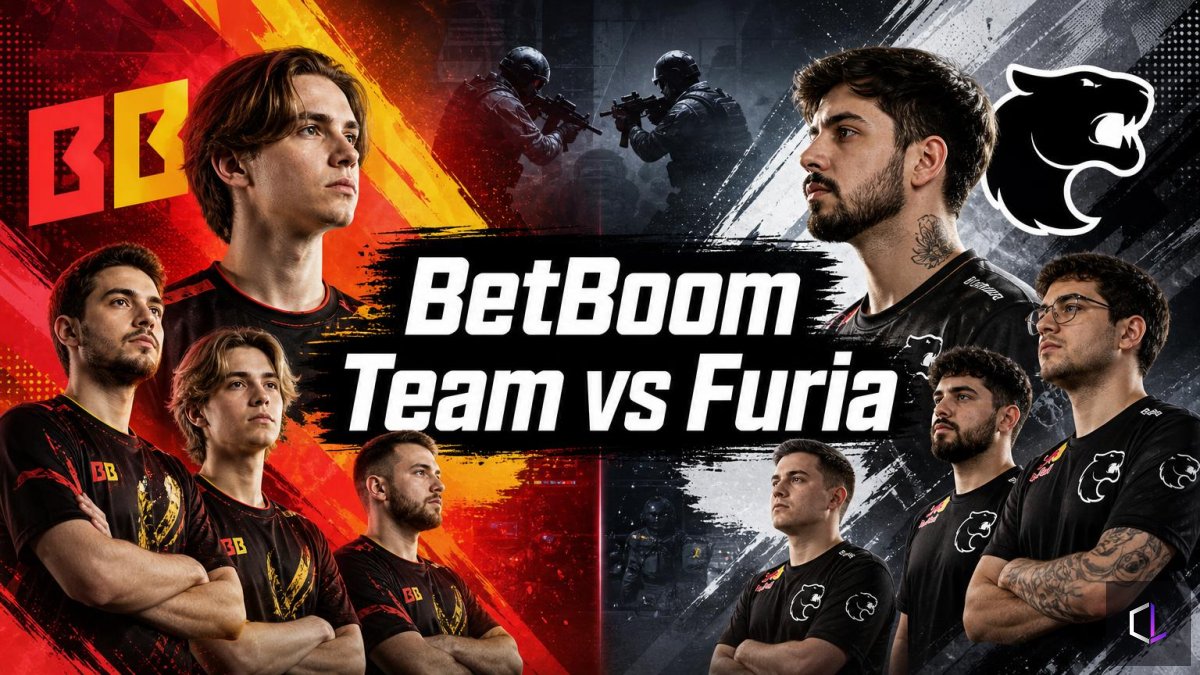
The final that BetBoom Team and FURIA have reached is one of those rare cases where the pairing of opponents alone promises a good show. A Russian lineup against a Brazilian one: two different ideas of how CS2 should be played. We will go through, step by step, what awaits viewers.
A caveat is in order here: we are interested first and foremost in the match itself, so we will not invent details that are not in the announcement. We name no prize pool, no head-to-head score, and no rosters: they are not part of the topic of this piece, and guessing at numbers in a final would be unfair to the reader.
Two Schools, One Map
A contrast of styles is traditionally seen between BetBoom Team and FURIA. The Brazilian team is known for aggressive, fast play, built on initiative and individual duels. The Russian squad is more often associated with more structured, methodical play through utility and timings. This is a generalization, and in a particular series the teams may surprise each other, but it is precisely this framework that helps understand what to follow.
A term for beginners: utility refers to grenades (smoke, flash, incendiary, and fragmentation) with which a team opens the way onto a site or blocks an enemy's passage. A timing is a moment, calibrated to the second, when a team takes a position or throws a grenade in order to catch the opponent off guard.
How the Series Is Structured
A grand final is, as a rule, played in a best-of-five format, that is, first to three maps won. Before the series, the teams take turns removing maps from the pool and choosing those on which they feel stronger. This procedure is called picks and bans, and in many ways it decides the outcome: an opponent's strong map left in play can cost an entire series.
What to watch for:
- Map selection. Which maps the teams remove first and which they keep for themselves. This is the most candid admission of weaknesses.
- Pistol rounds. The first round of each half, where both teams have only starting weapons. Winning the pistol round gives an economic advantage for several rounds ahead.
- Eco rounds. Moments when a team deliberately skips buying in order to save money for the next round. A good eco round sometimes breaks an opponent psychologically more than an honest win does.
The CyberLab View: Finals Are Not Won by Aim
It is commonly believed that in such matches everything is decided by mechanics and the form of the stars. We disagree. At the level of a final, both sides have roughly equal aim, and the difference is made by other things: the ability not to lose your head after a lost round, discipline in the economy, and willingness to abandon a plan that is not working.
The most telling stretch of a series is not a grand shot in a clutch, but the moment after three lost rounds in a row. At that moment one team tightens up and starts playing by template, while the other calms down and changes tempo. The viewer sees this as "they broke" or "they pulled themselves together," but in reality it is a consequence of preparation: of agreements about what to do when everything goes wrong.
That is why we advise watching the final not only through the camera on the best player, but also during the pauses. What is said in the timeout, how the pattern of rounds changes after it, who takes responsibility. For those who play themselves, this is more useful than any highlight with four kills: a highlight shows the result, while a pause shows the cause.
Where to Focus Your Attention
If you need a single landmark for watching, take the second half of each map. By this point both teams have already studied each other, exhausted their prepared setups, and are forced to improvise. This is where you can see who has a deeper reserve of ideas and whose ran out in the first half. Finals are rarely lost in the first round — they are lost at the moment when plan B turns out to be weaker than plan A.