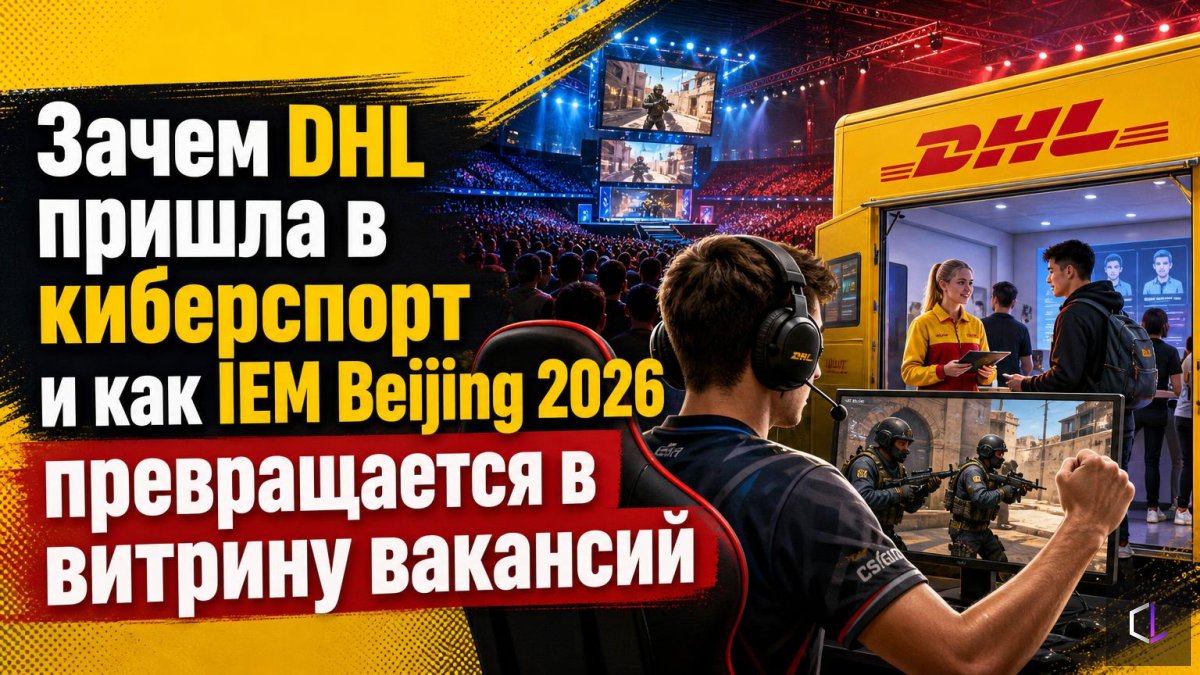
Logistics company DHL, together with ESL FACEIT Group, is launching a program in China to attract young professionals through esports. It kicks off at the IEM Beijing 2026 Counter-Strike tournament. At first glance, it's a strange alliance: freight shipping on one side, gunfights on game maps on the other. But there is a calculated logic behind it, and it explains a lot about how the money around esports works.
Why Logistics in CS2 at All
The classic sponsorship scheme looks like this: a brand pays for a logo on the broadcast and gets name recognition in return. The metric is simple — reach and views. Here, the company states a different goal: not only to raise awareness, but also to interest viewers in careers in logistics, IT, engineering, and other fields.
This is called HR marketing, or employer marketing. The task is not to sell a product to a customer, but to sell the company itself as a place to work to a candidate. For a business that needs young engineers and IT specialists, a CS tournament is a ready-made audience of exactly that age.
China: A Scale That Explains the Choice
The company cites figures. According to its data, China has almost 220 million esports fans, and more than 75% of ESL FACEIT Group's Chinese audience is aged 18 to 29. For an employer, this is almost a perfect fit: young, tech-savvy people accustomed to digital services.
That is where the choice of venue comes from. The Beijing stage of IEM is one of the notable tournaments on the ESL calendar, and China is a market where esports long ago stopped being a niche. The organizer gets a sponsor with a clear objective, and the brand gets access to an audience that is hard to reach with ordinary advertising.
How It Works in Practice
There are several tools, and all of them are geared toward something other than direct advertising:
- Tournament activations — the brand's presence at the venue and in the broadcast, but with an emphasis on talking about the work rather than delivery rates.
- Entertainment content — including the comedy series Dispatch, based on Counter-Strike. The idea is to speak to the audience in its own language rather than show corporate videos.
- Employee stories — real people from the company tell what they do and how they got the job. For a young viewer, this is more convincing than any job posting.
- Career sites — interested users are directed to dedicated pages where they can learn about openings and apply.
The last point is important: the funnel is closed. A viewer saw the content, became interested, went to the site, and submitted an application — the path is measurable, which means the effect can be counted in actual hires, not just in views.
What This Says About the Market
For the industry, such stories are a sign of maturity. Previously, the main sponsors were makers of peripherals and energy drinks, then bookmakers and banks arrived. Now they are being joined by companies that have no product connection to games at all but see esports as a channel for reaching young professionals.
This also broadens the very notion of a career around games. Esports is not only players on stage. Around a single tournament work organizers, commentators, operators, broadcast engineers, logisticians, marketers, and analysts. Equipment for the venue that has to be brought from one country to another by a deadline is a serious task in its own right. It is no surprise that a company from this field feels at home at a tournament.
There is also a flip side for a reader who is thinking about a profession. If you love games but understand that you won't make it to the pro scene, that is not the end of the story: the industry hires people who understand the audience and how tournaments work. And it hires not only in game studios, but also in companies that came to the stage as sponsors.
The open question is how well this model scales. One tournament and one program is a test of a hypothesis. If DHL sees a stream of quality applications, other companies — banks, telecoms, equipment manufacturers — will almost certainly copy similar formats. If the effect turns out to be modest, the sponsor will return to the usual awareness metrics. But the very fact that an employer picks a CS2 tournament for recruiting already shows how much the status of the discipline has grown.