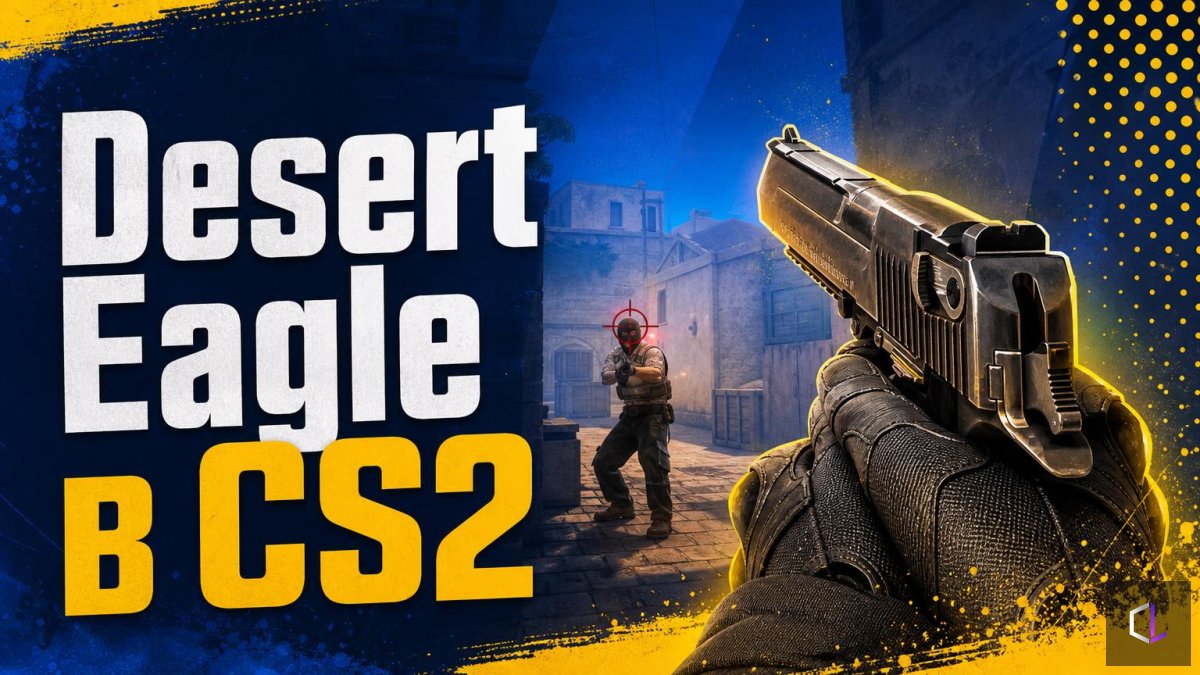
Five shots — five headshots. That kind of Desert Eagle highlight spread across channels the other day: the player m3wsu, rated around 4000 ELO on FACEIT, took out opponents with a single magazine without wasting a single bullet. The clip is spectacular, but the most interesting thing about it isn't the result, but how it is achieved. The deagle forgives the least, and that is exactly why it shows so well whether a player knows how to shoot for real.
Why the Deagle Is Not a "Pistol with a Crosshair"
The Desert Eagle is the most powerful pistol in the game: a headshot kills an opponent without a helmet in one shot at most distances, and against a helmet it usually takes one or two. The price for this is recoil: after a shot, the barrel kicks sharply upward, and the accuracy of the next shot drops if you press the trigger too early.
Hence the main rule: the deagle is a first-shot weapon. The first shot at a full stop lands on the point of aim with minimal spread. Every next one is a lottery until the weapon has returned to its original position.
Stop, Pause, Second Shot
Three habits separate a player who "ultimates" with the deagle from a player who simply bought an expensive pistol:
- A full stop before shooting. In CS2, accuracy drops while moving, and the deagle's penalty for running is especially harsh. Counter-strafing — a short tap of the opposite movement key to cancel inertia instantly — is mandatory here, not "desirable."
- A pause between shots. After a shot the crosshair climbs upward, and waiting for it to come back has to be a conscious choice. Rushing turns the second shot into a miss that feels like "weird RNG."
- Crosshair at head level in advance. Pre-aim means holding the crosshair where the opponent's head will appear before they appear. With the deagle it matters more than with a rifle: you simply won't have time to correct your aim after contact, and a second chance costs too much.
When the Deagle Is a Sensible Buy
The deagle costs noticeably more than ordinary pistols, and buying it for looks makes no sense. It is justified where you plan to play around one or two key duels anyway: on a force-buy, when the economy doesn't allow you to buy a rifle, or as a "surprise weapon" against opponents who are used to standard pistols and don't expect accurate shooting at medium range.
A bad scenario is taking a deagle and getting into a spray fight with it. That way you pay for an advantage you aren't using, and you get a lost round plus wasted money.
How to Train
A 4000 ELO highlight is not talent, but the sum of simple repetitions. A workable order looks like this:
1. A training map with bots or a shooting range. The goal is not speed, but the percentage of first-shot headshots at a full stop. Target for the first week: a stable first shot at medium range.
2. Two shots with a pause. Only after the first shot is stable, add the second — with a deliberate delay until the crosshair returns. The tempo will speed up on its own later.
3. Recording your own duels. Rushing is visible only on a replay: by feel it seems that you "shot on time," but the recording shows that the trigger was pressed before the crosshair came back.
Separately, it's worth checking your settings: a sensitivity at which you can carefully bring the crosshair to the head without "overshooting" matters more than a nice-looking value from someone else's config.
What the Highlight Leaves Out of Frame
A series of five accurate shots looks like magic, but behind it lies something prosaic: the player wasn't trying to shoot fast, he was trying to shoot correctly. The five rounds where he did the same thing and missed didn't make it into the compilation. That is exactly why one beautiful clip says nothing about consistency — and consistency is what raises ELO over the span of hundreds of matches.