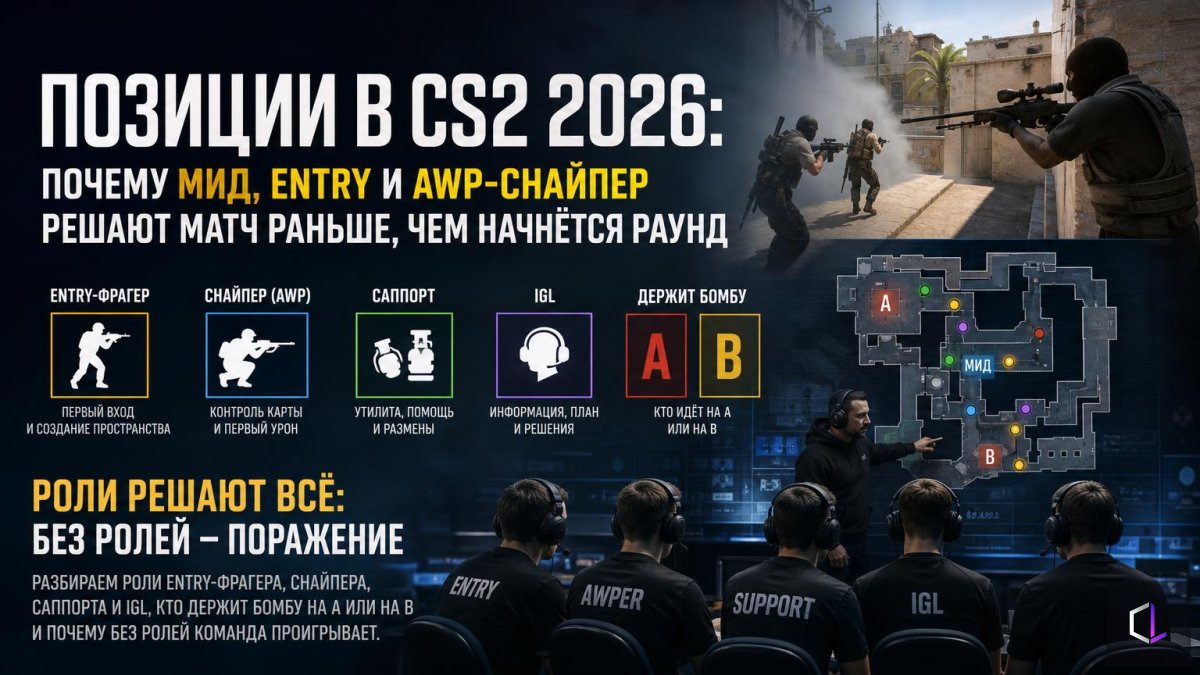
Positions in CS2 2026: why mid, entry, and the AWP sniper decide the match before the round even starts
Why "just aiming well" isn't what CS2 is about
Many parents think esports is all about reaction time and accuracy. Partly true. But any CyberLab coach will tell you: a player who doesn't understand their position on the map will be beaten by a team where everyone knows exactly why they're standing at that particular spot. CS2 is a team game with clearly defined roles, and without them, even five strong shooters turn into a crowd running around the map with no plan.
Main roles in a team
In a classic CS2 lineup, several roles are usually distinguished:
- Entry fragger — the one who enters the site first and starts the fight. Their job is to open up information for the team, even at the cost of their own life.
- AWP sniper — holds long distances, is responsible for controlling key sightlines, and often takes out the most dangerous opponent with the first shot.
- Support — throws grenades, blinds the opponent, covers the entry fragger, and often stays "in the shadows," but it's this player who determines whether the attack goes through.
- Lurker — plays apart from the team, looks for flanks, and creates confusion for the opponent, forcing them to split their attention.
- IGL (in-game leader) — the captain who reads the game, assigns positions, and makes round decisions: whether to play aggressively, whether to go for bombsite A or B.
Mid, A, and B: why a spot on the map is more than just a location
When newcomers hear "mid," "bombsite A," "bombsite B," they often perceive these as just names for zones. In reality, these are tactical hubs of the map. Controlling mid on many CS2 maps provides information about both bombsites at once — the team that holds mid decides where the attack will go or where to expect the defense from. Choosing to play out bombsite A or B isn't a random choice, but the result of reading the round's economy, the opponent's weapon loadout, and the current score.
That's exactly why in CyberLab training sessions we spend time not only on aim but also on map analysis: where support should throw a smoke to cover the push to B, why it's more advantageous for a sniper to hold the long angle at A rather than rush into a crowd.
What a team loses without roles
If everyone in the team picks a position "whatever's convenient," typical problems start to appear:
1. Several players crowd into one spot, while the second one is left uncontrolled.
2. There's no one to cover the entry — support is busy with their own duel somewhere else.
3. The AWP sniper runs around the map instead of holding a line — the main control weapon is wasted.
4. No one takes charge of decisions — rounds are played out chaotically, with no plan for the bomb.
What this looks like in training
At CyberLab, during sessions we deliberately give students different roles in turn — today you're entry, tomorrow support, the day after you try reading the game like an IGL. This isn't just for variety: the teenager starts to understand the team's logic as a whole, not just their own small task. In the future, even if they find "their" role, this understanding of the entire map of positions makes them stronger at any spot — whether it's mid, A, or B.
Knowledge of positions is the foundation on which all CS2 tactics are built. Without it, even perfect aim won't save the team from defeat.