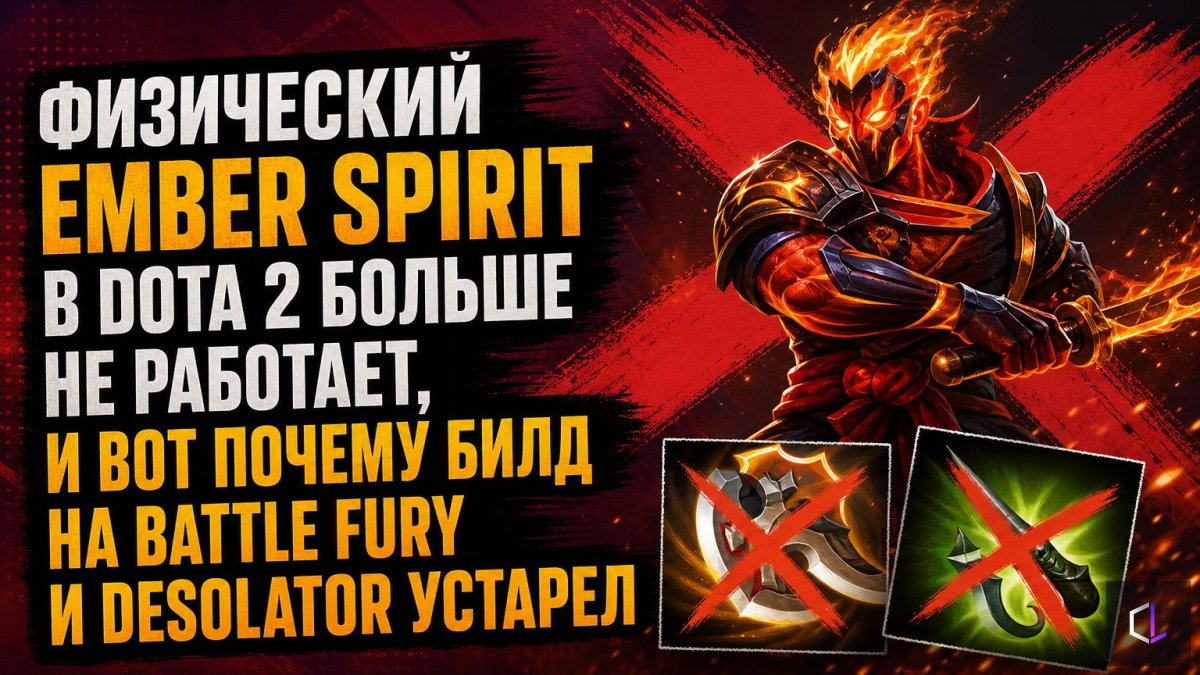
Among Dota 2 players there is a persistent habit: if a hero once won with a certain build, it will win now too. Ember Spirit is a great example of how this habit lets you down. The streamer and strong Ember player Stray228 recently stated outright: physical Ember doesn't work in modern Dota 2, and hasn't for a long time. His arguments are worth examining, because they explain the general logic of the meta, not just that of a single hero.
How it used to work
The classic idea of physical Ember Spirit is simple. The hero has Sleight of Fist — a series of instant attacks on all enemies in a radius — and Flame Guard for protection. If you build items for physical damage and attack power, the hero turns into a "saw": he flies into the team, instantly hits everyone and disappears. Battle Fury adds area cleave and fast farming acceleration, while Desolator strips armor from targets, making every hit more noticeable.
According to Stray228, he himself pushed Ember into the top 30 of Europe with exactly this build — through Battle Fury and Desolator. At that time the scheme really did work: heroes had around a thousand health points in the early and mid stages, armor was modest, and a few area hits turned into a kill. He even recalls an amusing incident: at the fortieth minute, a support hero with boots was running around the map and dying from "fist."
What changed
Stray228's main argument boils down to the fact that the world around the hero has become different. He names two factors.
Growth of health and armor. According to him, modern heroes have many times more health: we are talking about three thousand and higher instead of the former thousand. There is more armor too. Physical damage runs into resistance: the higher the target's armor, the less damage gets through with each hit. A series of instant attacks that used to kill now takes off only part of the health.
Neutral items. He separately notes that the game has gained neutral items, which drop from jungle monsters and strengthen all heroes. They provide protection and survivability, and killing a target in a single go becomes even harder. This hits especially hard at heroes whose strength relies on a short window of burst damage.
The third point is talents. Stray228 dates the "death" of physical Ember approximately to the time talents appeared in the game and the subsequent accumulation of their effect. What matters here is not the number of years but the principle: changes in Dota 2 pile up, and a build that was strong under one set of conditions gradually stops working, even though no patch "killed" it directly.
Two approaches side by side
The comparison is convenient to lay out as a table of differences.
- Old approach: a bet on physical damage, Battle Fury and Desolator, with the goal of taking out several targets with a quick series of hits. It works when enemies have little health and armor.
- Modern approach: not relying on breaking through resistance with area damage. If targets withstand a series of hits, the hero's value shifts from "burst" to his other qualities: mobility, protection, and participation in fights through abilities rather than pure physics.
What both approaches have in common is that the hero remains a mobile brawler who needs to manage to get in and out. The difference is in what the kill rests on: previously it rested on damage arithmetic against a small pool of health, and now that arithmetic doesn't add up.
A lesson about "working" builds
It is telling that a player with a top rating on this hero himself admits that his earlier experience is not applicable today. This is a good example of how the meta outpaces habit. A build that brought rating did not suddenly become bad; it simply stopped fitting into a game where all heroes' durability has grown.
A practical check for any build looks like this: look at how much health and armor typical targets have at your stage of the game, and estimate whether your scheme will kill a target within the window you have. If it doesn't, and you also need to get into the fight, the build should be reconsidered, even if it "always worked" once. For Ember this means not clinging to the memory of the physical strike, but choosing items for what the hero actually does in modern fights.
A separate caveat about the advice itself: one player's opinion does not replace your own tests at your ratings and in your game mode. But the direction of Stray228's thinking — checking a build against current numbers, not against memories — applies to any hero in the game.