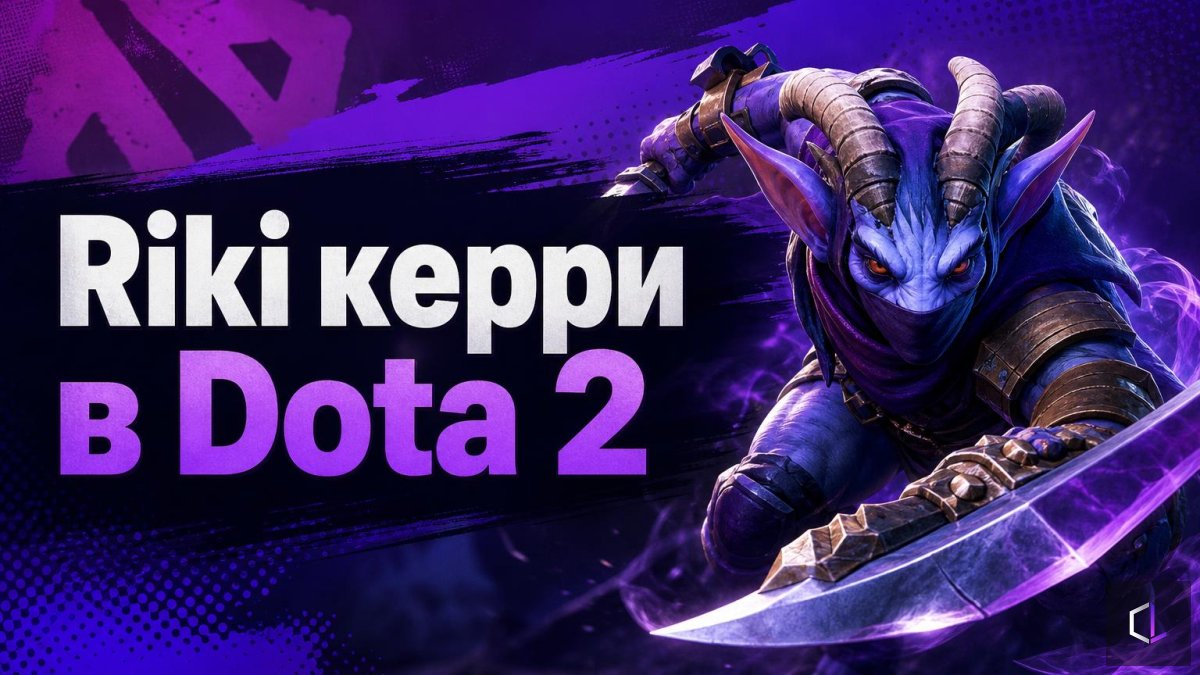
According to Dotabuff, Riki in the first position (carry) at the Titan rank (one of the highest ranked tiers in the game) wins 52.9% of matches. That is a noticeable deviation from the average mark of 50%, and for a hero who was considered niche for years, it is all the more a reason to take a closer look. Let's work out why such numbers are possible and how to read them.
How Riki differs from an ordinary carry
A carry is a player who by the middle of the game is supposed to become the team's main source of damage. Most carries do this through farming (accumulating gold and items in the lane and in the jungle) and then through open team fights. Riki works differently: he is invisible until he attacks, and his main damage comes from behind the target. He doesn't need to stand in an open fight for long to be dangerous.
Two practical properties follow from this. First: Riki punishes heroes who cannot spot an invisible unit in time — without detection (items and abilities that reveal invisible units) he becomes almost unkillable in skirmishes. Second: he depends heavily on the opponent's decisions. If the enemies have a Sentry Ward, Dust of Appearance, or heroes with detection, the advantage burns away quickly.
Why a win rate at a high rank says something different than at a low one
At high ranks, players buy detection better and notice risky positions better. That is why 52.9% at Titan is worth more than the same numbers at a mid level: there, any hero with an "the enemy can't see you" mechanic wins simply because the opponent doesn't know how to play against him. But this statistic comes with a caveat: a hero who is picked less often is frequently played by his most dedicated mains, and that also raises the number. The percentage reflects not only the strength of the hero but also the selection of those who sit down to play him.
Hence the practical conclusion: you shouldn't pick a hero just because he has a good win rate at a high rank. The same figure is produced by the skill of specific players, not by a ready-made formula for victory.
What you need to be able to do for Riki to work
Invisibility is not a defensive spell but a way of choosing your moment. Playing him effectively means doing several things:
- Keep track of detection. Before going in for a fight, you need to understand whether the enemies have a way to see you, and keep that in mind throughout the match.
- Choose targets. Killing a support is less useful than killing the hero on whom the outcome of the fight depends. A good Riki goes after those whose death breaks the enemies' formation.
- Don't rush the fight. Invisibility lets you wait until the team starts the fight and enter at the right moment, rather than jumping out first.
- Be able to farm without being seen. This is the only way to buy time for accumulating items if fights are not happening.
What the neighboring numbers say about the meta
Next to Riki, the same data included other observations: in the European ladder, three out of five players, according to their data, play supports, and items such as Revenant's Brooch (about 37.5% win rate), Heaven's Halberd (about 42.1%), and Hand of Midas (about 44.3%) turned out to be among the worst in terms of results. The connection here is indirect but instructive: when many players go into support, there are fewer competitors for gold in the lanes, and heroes for whom tempo matters get extra time. And a weak win rate for individual items usually means not that they are bad in themselves, but that they are bought in unsuitable situations — for example, Hand of Midas where the game calls for a fight rather than farming.
None of this is a reason to rush to pick Riki in your next game. But it is a good example of how to read statistics: look at the rank, at the role, at who exactly plays the hero, and not at a single number in a table.