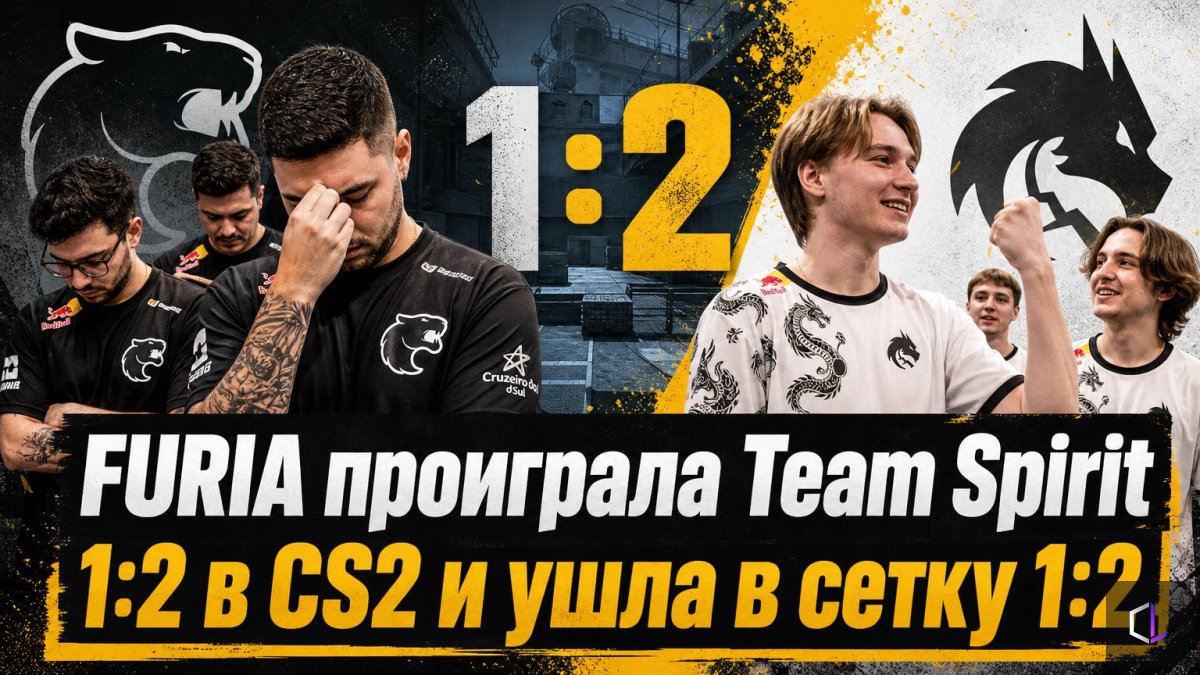
FURIA lost to Team Spirit with a score of 1:2. The Brazilians lost the match to the "Dragons" and dropped to the 1:2 bracket. For the team, this result means a change of objective: now it's the lower bracket, where the margin for error shrinks rapidly. The match itself went to the deciding map, which means the contest was tight rather than one-sided.
If you play on a team, any best-of-three series can be used as study material. Below are five steps worth adopting after a match of this kind.
What "1:2 bracket" means and why it's an alarming sign
A format in which a team already has a loss is called a format with "lives": as long as the losses are below the limit, the team remains in the tournament, but each following match becomes a question of survival. The notation 1:2 here is a tally: one win and two losses. When a team has two losses, the path ahead leaves no room for a slip. That is exactly why losing the deciding map of a series hurts more than the score suggests: it immediately changes the price of every following match.
A first-to-two-wins series (in esports it is called BO3, from "best of three") is structured so that one won map guarantees nothing. The team that lost the first map is still in the game, and the one that won is not yet the winner. That is why a 1:2 map score, as in this match, emerges where the opponents take turns seizing the initiative.
Five steps after losing a series
1. Break the match down by map, not into "won or lost." A best-of-three series is three separate games with different conditions. Write out for each one: whose map it was, who chose the side, how the pistol round went. This shows where the tempo was lost, rather than just "we were unlucky."
2. Find the moment when the game changed direction. In three-map matches there is almost always a stretch of several rounds after which the opponent starts dictating terms. Mark it and ask: what changed — positioning, economy, or tempo? Often the cause is that the team kept playing the same way that had already stopped working.
3. Check the economy around the lost rounds. Economy in CS2 means decisions about when to buy full equipment and when to save money. A mistake in one round can drag the next three down with it. See whether the collapse coincided with a round where the team bought with less than the full squad or, conversely, saved where it needed to push.
4. Prepare a backup plan for the deciding map. The third map of a series is the one where the opponent has already seen your main tricks. Agree in advance on two or three differences from your usual pattern of play: a different starting setup, a different tempo in the opening rounds. You need to change only a little, but enough that the opponent can't play according to a ready-made scheme.
5. Agree on how the team behaves after a lost round. After a loss in a series, mutual reproaches usually follow. Agree on a rule: while the match is in progress, only the next round is discussed, and the review of mistakes comes afterward. This relieves tension and keeps focus on the deciding map.
Why such matches are useful for viewers
For those who watch tournaments, a series like this is a convenient chance to see how teams adjust during the game. The same roster plays differently on different maps: roles, tempo, and choice of positions change. If you watch a match with a pencil in hand, you can notice exactly how a strong team reacts to pressure and carry those observations over into your own games.
The 1:2 bracket for FURIA means the upcoming matches will have to be won back to back, and so each of them turns into a separate test of resilience. It is in such moments that you can see how well a team can hold its form when the safety margin has run out.