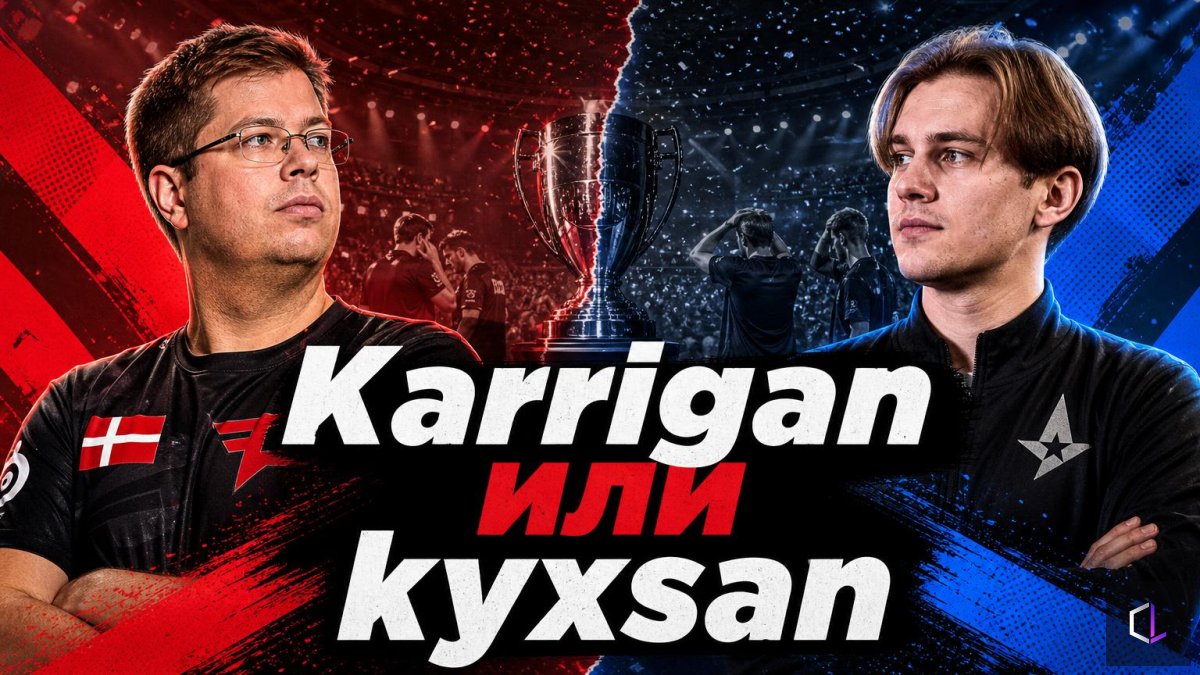
A debate has surfaced in the CS2 discussion that seemed settled: kyxsan stated that under him the team played more consistently than under Karrigan and almost always reached semifinals and finals, but couldn't win them. The thesis itself sounds like a reproach to himself, and that makes it more interesting than an ordinary squabble over who is stronger. It is, in essence, about the difference between two qualities that are constantly confused in conversations about teams: the ability to get through a bracket and the ability to win at its end.
It is worth clarifying the terms here. Stability in esports is not about weak opponents; it is about a predictable level: a team rarely collapses against those it should beat and often reaches the playoffs. Final form is something else: the ability to make the right decisions in a decisive match, when a mistake costs the title. The first is measured over a long series of tournaments, the second over a few matches, and the sample there is tiny.
Why stability does not equal titles
A team that constantly plays semifinals is most often built on a system: rehearsed setups, clear roles, minimal improvisation. Such a scheme withstands routine and doesn't fall apart in the groups. But in the final the opponent has already studied this system. Against the same patterns he has prepared counters, and the advantage of stable play disappears: both sides know what to expect.
This is where the second layer is needed: the ability to break your own pattern. That is the job of the in-game leader (IGL, the in-game captain who chooses tactics and runs the round). A good leader in a final changes the tempo, tries options uncharacteristic for him, sacrifices a round for information about the defense. A poorly prepared leader holds on to what worked all tournament, and he gets read.
What exactly can be compared
The "who is better" debate in this form has no answer, because different tasks are being compared. It is more useful to break it down into questions that can be checked against recordings:
- how the team played the first round after a lost pistol round and after a won one;
- what changed in the economy and positioning after a streak of three lost rounds;
- how many non-standard moves versus habitual ones there were on decisive maps;
- who took responsibility for calling a difficult round: the leader or the star shooter.
No figure from this list replaces a living understanding, but together they show where the boundary lies between "we are reliable" and "we know how to win."
The player's own role
A side of the question that is often forgotten: when a former player talks about stability, he is also assessing his own contribution in his own way. A player in the leader's role and a player without leadership duties answer for the result differently. A stable team may rest on a strong core of shooters who can pull out any round, and then the lack of wins in finals is not a question of leadership but of shooting form falling short precisely on the most nerve-racking day. A single quote doesn't allow us to say which of the options applied to a particular roster, and it is more honest to leave this as a hypothesis.
An important practical conclusion: a title does not come down to one person. If a team regularly reaches finals and doesn't win, the game should be examined as a diagnosis: where exactly the chain breaks, whether in preparation for opponents, in decision-making in the moment, in nerves, or in the difference in shooting. Each cause is treated differently, and debates about personalities only cloud the picture.
So the next time you hear "the team is stable but not a champion," it is worth asking not "who is to blame" but "what works for it in the group stage and stops working in the final": the answer almost always lies in specific rounds, not in the character of the people.