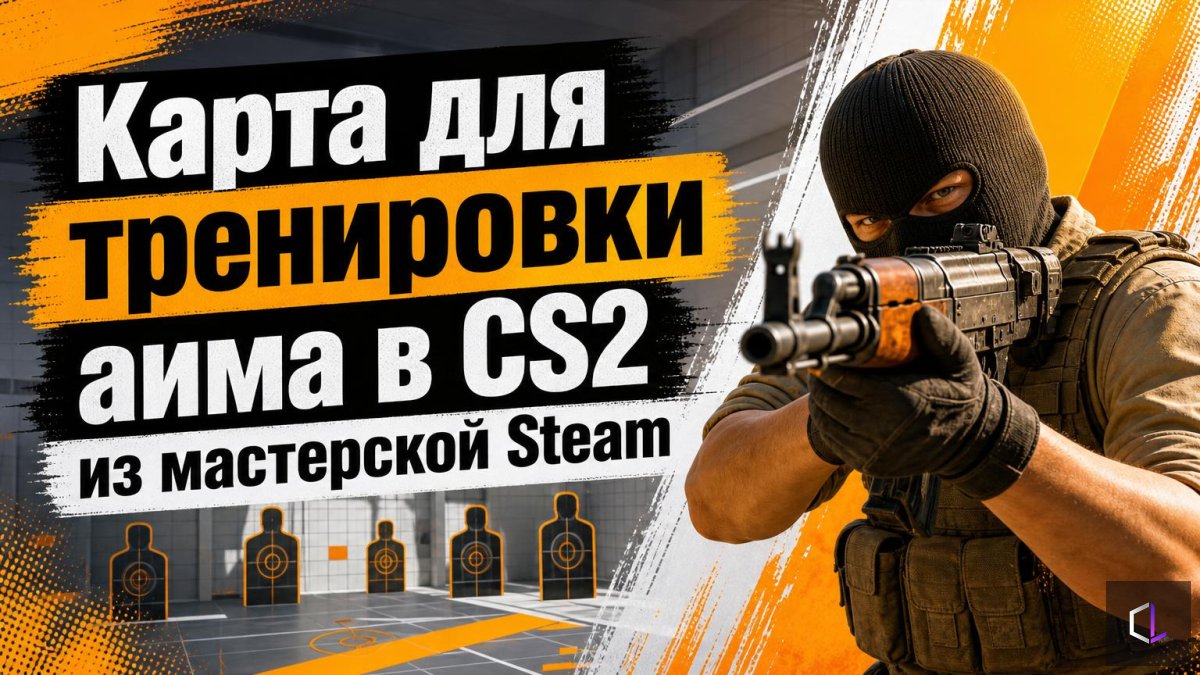
A new aim training map for CS2 has appeared in the Steam Workshop. It has 25 exercises split into five categories, five difficulty levels, 34 weapons, and large 3D targets. There are plenty of similar maps in the Workshop, but this one has a good structure: it lets you build a training session out of individual skills rather than just "shooting at bots."
Five skills instead of one "aim"
In everyday speech, the word "aim" lumps together several different abilities. The map neatly separates them:
- Flicking — flicks, that is, fast sharp turns of the crosshair to a target, stopping precisely on it, and switching between several targets.
- Precision — accuracy and mouse control on small movements.
- Speed — speed of target acquisition and reaction to a target appearing.
- Bursting — firing in short bursts rather than holding down the button.
- Tracking — following a moving target: the crosshair is "glued" to it rather than catching up in jerks.
This breakdown is useful in itself. A player who says "my aim is bad" usually means one or two specific weaknesses: for example, they confidently hold the crosshair on a target while moving, but miss on a 90-degree flick. Until the skills are separated, there is nothing to fix.
How to build a training routine
The main trap of any aim map is to run through all the exercises in a row, see nice numbers, and decide that the work is done. A workable approach looks different.
1. Diagnostics first. Run through one exercise from each category once at medium difficulty and write down the result. The worst category becomes the priority for the week.
2. Short blocks. Three or four exercises for 15–20 minutes before playing work better than an hour-long marathon: when you're tired, your hand starts reinforcing sloppy movements.
3. Weapons matched to your role. The map offers 34 weapons, and it's worth using them deliberately. Those who play with the AWP need flicks and speed; those who carry a rifle need bursting and tracking, because real duels with the AK-47 and M4 are built around short bursts and counter-strafing.
4. Raise difficulty in steps. Move up to the next level when your result at the current one has been stable for several days in a row, not when you got lucky once.
What the map won't replace
An aim map trains mechanics in a vacuum: the target appears in a predictable zone, nobody flashes you, and nobody kills you in return. In a match, the target most often appears where you didn't expect it, and your crosshair should already be at head level at that moment. That's why aiming and pre-aim (placing your crosshair in advance on likely enemy appearance points) are trained separately, on real maps, in a mode with bots or in deathmatch, where the position isn't set in advance.
There is a second caveat: a trainer builds confidence faster than results. If after a month of exercises your numbers in the map have gone up, but your hit rate and trade rate in ranked matches haven't changed, then the skill isn't transferring into the game. That's not a reason to quit, but a signal to look at how you take positions and at what moment you shoot. You can compare your "before" and "after" numbers using demos: in a recording you can see how many duels you lose because of mechanics and how many because of choice of spot.
The most effective way to use the map is as a tool for targeted correction: find the skill that has slipped, bring it up over two or three weeks, return to playing, and check the effect in real rounds.