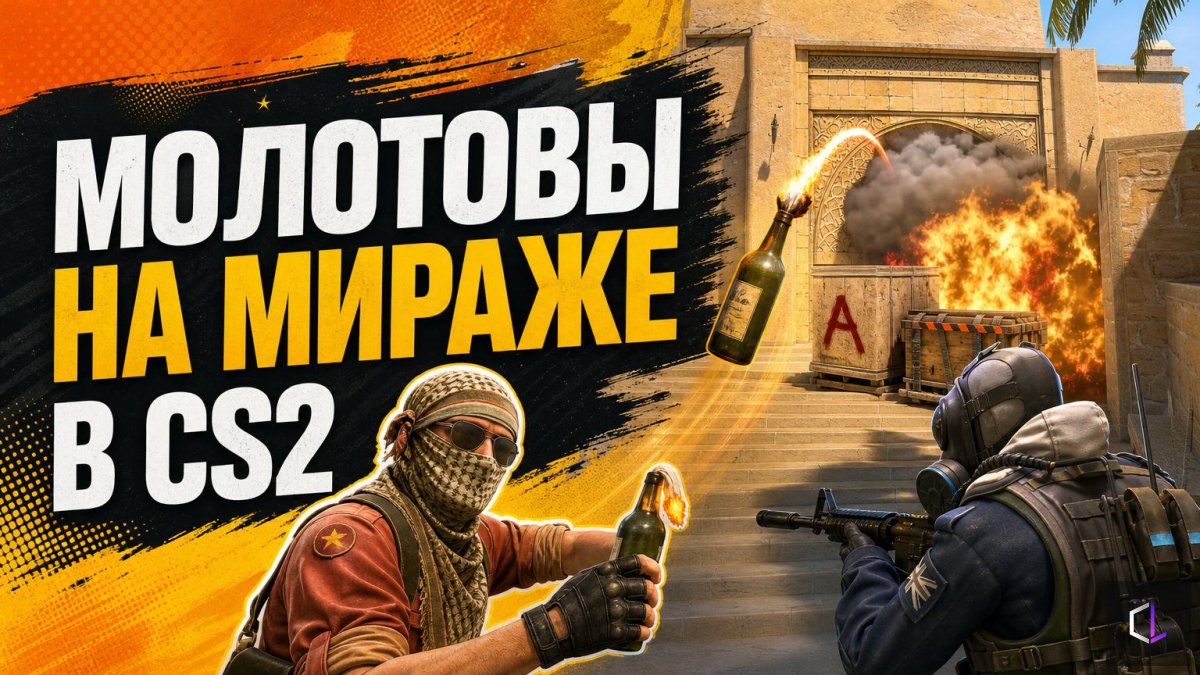
A molotov on Mirage is often seen as "that one ladder grenade," and people stop there. Yet a whole principle is built into this pair of throws: an incendiary grenade (molotov, or "molly") is useful not for its damage, but because for a few seconds it makes an area of the map impassable and forces the opponent to make a decision.
The Ladder: When Smoke Doesn't Get in the Way
The ladder on Mirage is a narrow staircase next to A site, from where a defender can hold the approach and interfere with attackers' exits. The first of the two molotovs currently being discussed in the community burns it out entirely. A practically important detail: the throw is possible even when smoke is already standing in the window. This solves a typical problem: smoke in the window is often thrown first, and many players then assume they have no suitable throw left for the ladder.
The logic here is not in the spot itself, but in the order of actions. If you have a smoke and a molotov, you shouldn't treat them as mutually exclusive. Smoke cuts off vision, fire cuts off passage — these are different tasks, and they don't conflict. Whoever is sitting on the ladder takes either damage or a forced retreat, and in both cases the attackers gain seconds to get out onto the site.
The Connector Exit: Molotov as Insurance
The second throw solves the opposite problem and will come in handy for defenders. It is used when exiting connector (the passage from mid toward A). The goal is twofold:
- to keep the opponent from getting you in their crosshair from ticket (the name for the position by the ticket booth, from which the exit is covered);
- to help teammates who are going through the pit with the palace — that is, to cover another route with the same grenade.
Note the economy of this: one molotov covers two interests at once. This is the mark of a good setup — it works not only for the one throwing, but for their neighbor on the route.
What to Take Away from This Pair
Both grenades share something that is easy to miss when memorizing "lineups" from videos: a molotov is thrown by scenario, not by map. The question "where" is secondary. The primary questions are "whom do I want to force off their position," "how many seconds do I need," and "what are my teammates doing at this moment."
That is why, when practicing on an empty map, it's useful to say three things out loud:
1. Which enemy position this grenade cancels.
2. Which side gains the time advantage — you or the team.
3. What interferes with the throw in a live situation: smoke, flash, someone else's molotov, lack of money.
The third point is especially important: a memorized throw falls apart at the first unforeseen detail, while understanding the task lets you come up with a backup option.
Mirage remains a map where utility decides more than aiming mechanics, and the two molotovs from this breakdown are a good reason to finally stop treating fire as a "just in case" grenade. In the right round, it becomes a full-fledged tool for controlling space, and the one who wins is the one who thought about it before the round began, not at the moment of the throw.