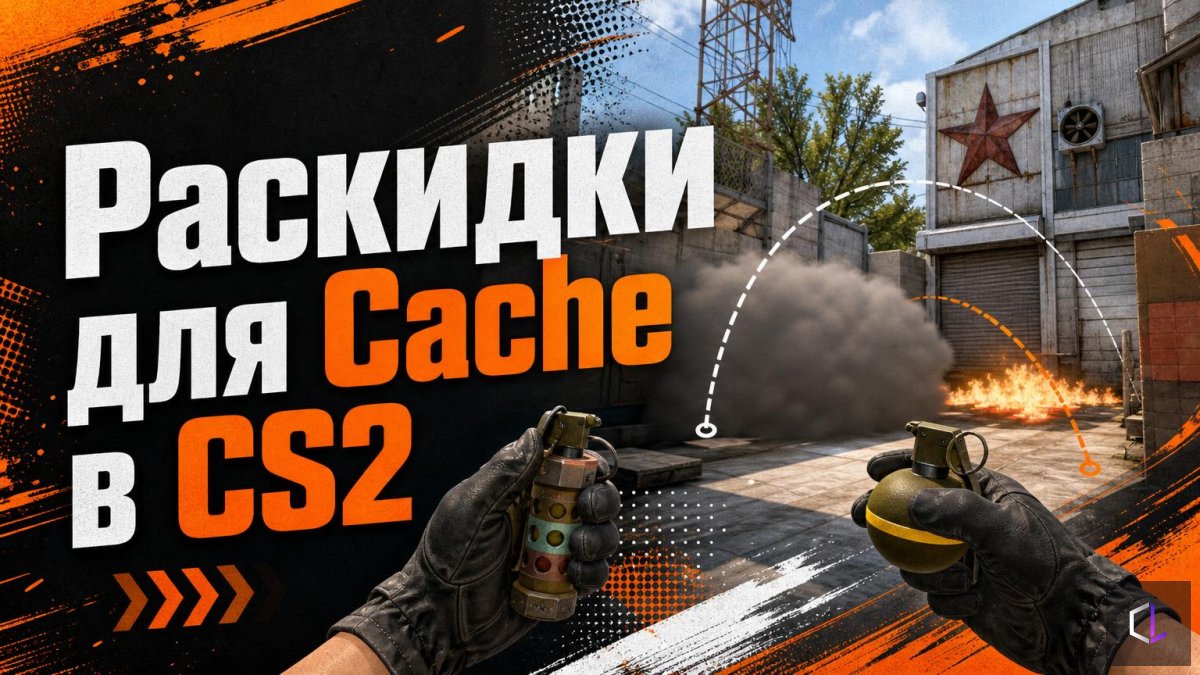
Cache is back in the map pool, and with it the talk about lineups has returned. One of the most popular packs in the community is built around a B site execute: a smoke on CT, a molotov for one awkward position, and an entry flash. Three grenades, one goal. Let's work out why such sets work and how to keep them from turning into a memorized ritual that falls apart at the first deviation from your opponent.
A lineup is not a grenade, but a set of decisions
A lineup is a pre-practiced throw: an aiming point, a position on the map, and a throwing method (standard, jump throw, run-up throw). A pack is several such throws assembled into a single sequence for a specific task. The task in our case is to take B site and not give away the round in the first two seconds.
The composition of the set is logical. The smoke on CT blocks the vision of defenders who come to rotate or hold the far line. The molotov (or incendiary grenade) removes a player from a position that is hard to clear with gunfire: he either leaves or takes damage. The entry flash blinds those who remain at the moment the first player enters the site. Each grenade covers its own threat, and together they provide a window of roughly a few seconds. That is exactly the window that is usually missing when you push in "head-on".
Why order matters more than spots
Beginners memorize where to throw. Experienced teams memorize when and in what sequence. If the smoke lands later than the flash, a blinded opponent can still shoot through a passage that is not yet closed. If the molotov is thrown too early, the fire burns out before the entry and the position is free again.
That is why it is useful to break the pack down into timings and assign each player a role in the signal. A typical scheme: one calls the start, the second throws the smoke, the third the molotov, and the entry fragger waits for the flash and enters under it. The fewer words needed, the better: in a round you have seconds, not minutes, for discussion.
Where such packs break
Any prepared play has a weak spot: the opponent can read it. If the defenders saw a grenade in flight and changed position, the set hits empty space. If there turns out to be one more player on the site than you expected, the entry flash will blind the wrong people. If the bomb is already in someone else's hands after a rotation, the whole calculation for a "clean" execute loses its meaning.
Hence the practical rule: a pack is a starting point, not a script for the rest of the round. It is good when a team has a second branch in case the first one fails: for example, abandoning the entry and switching to the other site. Without a backup plan, a lineup turns into a bet that the opponent will play predictably.
How to test a set before a match
You can learn a pack in an evening on a local server, but you can only truly test it in a game. A useful order is as follows:
- Practice each grenade separately until the hit becomes consistent.
- Assemble the combo and run it several times in a row with the team, timing it from the signal to the entry.
- Play the set against bots or in a practice match with a condition: the defenders deliberately behave differently each time.
- Review the recording and mark the rounds where the pack worked and those where the opponent got ahead of it.
The last item is often skipped, yet it is the most valuable. It is the recording that shows at exactly which moment a grenade was unnecessary or late.
Stockpile grenades or save them
Three grenades for one execute is a noticeable expense. If the whole team invests in the pack, less utility is left for other areas of the map. That is why the set is appropriate where you really intend to go B in earnest, not as a "check just in case". A good lineup saves rounds, but only when it is used as intended and with a clear purpose, and not simply because "we learned it, after all".