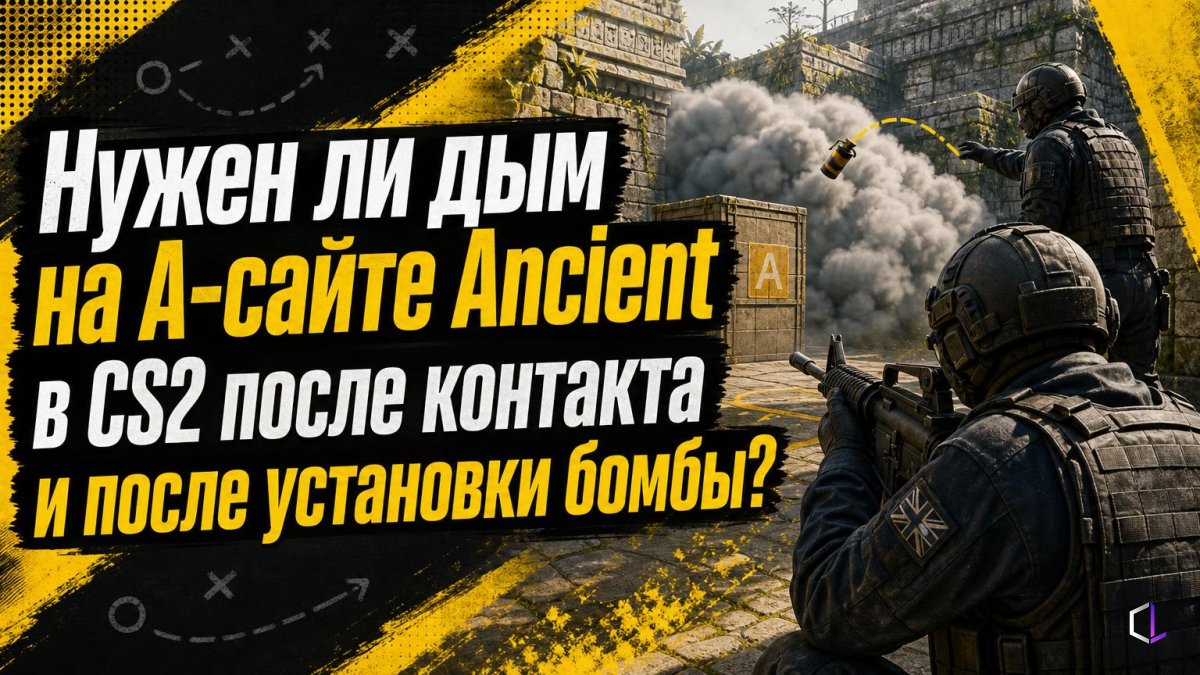
Do you need a smoke on the A site of Ancient in CS2 after contact and after the bomb is planted? The short answer: yes, but only in two specific situations. In all other cases, an extra grenade is wasted money and a lost chance to use it later in the round.
Ancient is rightfully called a map where discipline in the small details matters. The A site here is open, with plenty of angles, and defenders have plenty of places to shoot at the entrance from. That's why the question of "where to put the smoke after the main execute" becomes not a minor detail but part of the plan.
Situation one: you took A on "contact"
"Contact" is when the team goes onto the site without full preparation: without pushing the defenders back with grenades, without closing all the lines of sight, and relying on information as you move. A classic example is a standard fast hit where you expect the opponent to control the site poorly.
A full execute (a set of grenades: smokes, flashes, molotovs, thrown in advance) closes the lines from which you can be shot. When there isn't one, you go onto the site while some angles remain open. It is precisely at that moment that an additional smoke is needed, to block the most dangerous line while you establish yourselves.
The logic is simple: the fewer grenades invested in the entry, the more sense it makes to add a smoke after the first contact with an enemy. It doesn't replace the execute, but it cuts off the most dangerous shooter while the team pulls onto the site.
Situation two: the bomb is planted, you went to main
The second situation occurs in the post-plant, the play after the bomb is planted. The defenders need to defuse it, and the attackers need to hold the site until it explodes. Flexibility matters here: part of the team may leave the site for the main passage (main) to help teammates in another part of the map.
If you've left your position, the smoke thrown on the entry may have already dissipated or stopped covering the needed line. Refreshing it on "donut", the central zone of the site where the bomb sits, means making the defuse difficult again and giving yourself time to return or help the team. In essence, you aren't defending the position personally, but using the smoke to extend someone else's delay.
When this smoke is unnecessary
Refreshing the smoke isn't always worth it. It's useless if:
- you already have a full execute and all lines are closed — then the grenade simply has nothing to do;
- you stayed on the site and control the bomb personally, and no change of position is planned;
- the opponent is already dead and the site is under your control: the grenade will be more useful in the next round.
The rule here is the same as with any utility in CS2: throw a grenade for a specific task, not "just in case."
A related question: how not to run out of grenades
A second smoke requires money and a free inventory slot. That's why such decisions are better made in advance, at the buy stage: agree on who holds the "insurance" smoke specifically for the post-plant. Otherwise, at the crucial moment everyone will have one grenade each, and everyone is sure someone else will throw the second smoke.
A related question: how to practice
Post-plant smokes are better practiced not in regular play, but on an empty map or in training mode. The task is simple: learn the lineup where the grenade lands on donut on the first try, without adjusting your aim. Then add the scenario "left for main": while you're leaving the site, the smoke should already be in place.
A good benchmark is to repeat the throw ten times in a row without a miss. If that doesn't work, the lineup isn't learned yet, and in a real match you'll spend precious seconds on it.
A related question: why all this matters in ranked
In public matches, such details are often ignored: threw a smoke, went in, whatever happens. But it's precisely in careful work with utility that the difference between levels is most noticeable. Plenty of people have the same aim, but understanding when a second grenade is needed and where it should land is what separates a team that closes out rounds from a team that gives them away.
A smoke on Ancient, framed this way, is not a separate trick but part of a general habit: before every throw, ask yourself which exact line it will cut off and how many seconds that will give the team.