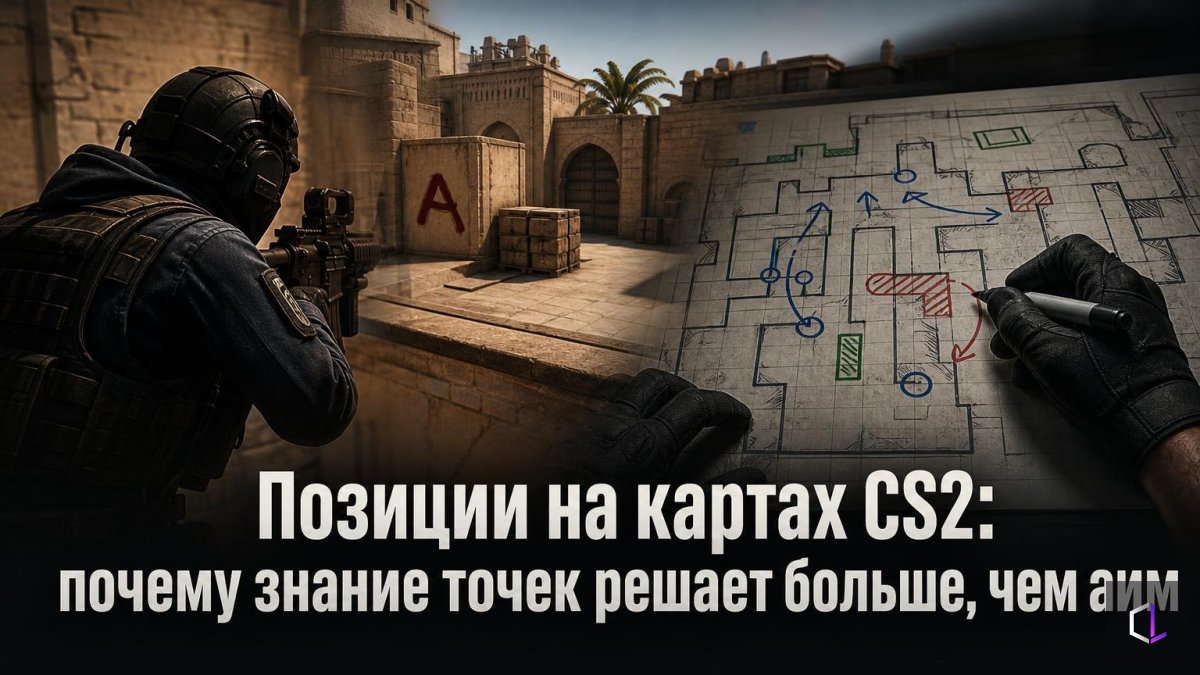
Imagine a round: four players are running to plant, and the fifth is already dead. The two remaining defenders know that an enemy is shooting from a short angle, but they don't know that there is another one behind him, pressed against the wall. They peek out one at a time, and both die within three seconds. Their aim was no worse than their opponents'. What they lacked was something else: an understanding of where people usually stand on the map and why.
A position is not a coordinate
A beginner perceives a position as a point: "I'm standing by the box on B." An experienced player sees a set of connections in it. Where can I be seen from? Which angle am I covering for my teammate? How many seconds do I need to fall back if a push comes? The same point on the map can be strong at the start of a round and a trap at the end, when the opponent already has information about your location.
This is the main point of knowing the map: a position by itself means little until it is clear what task it solves. Some positions provide information, others ensure a trade, and still others cover a teammate. If you stand where your role doesn't require you to be, even a perfect shot won't save you.
What knowing the map includes
"Knowing positions" usually hides several layers at once:
- Standard setups. How a site is usually defended on a particular map and where players like to sit in pubs and team matches.
- Wallbangs and pixel angles. Places where you can hit through a thin barrier or see an opponent by exposing only part of your model.
- Rotation paths. How much time it takes to move between zones and which routes let you avoid coming under fire.
- Timings. When the enemy appears at a key point by default — this lets you prepare a grenade or take a position in advance.
A rotation is the movement of a player or a group from one point to another in response to the opponent's actions. This is exactly where knowledge of the map turns into practical benefit: a player who knows the path and the time arrives where another would be late.
Why team play doesn't work without it
In a team, each player takes a position not on their own but as part of a link. If one player covers a long angle, the second must know where support will come from, and the third must know where to fall back if things go wrong. When players have studied the map separately and each has their own idea of the "right" spot, the setup falls apart: two people stand in the same place, and the adjacent passage is left open.
That is why exchanges like "you're on A, I'm mid" look simple, yet behind them stands a shared language. The names of positions on the map are an agreement. Without it, a call like "two on short" carries no information, because everyone pictures a different place.
How map knowledge breaks the other side's game
There is also the flip side. A player who knows the standard positions well can anticipate them. He enters a site having already checked two or three typical angles, and doesn't waste time on unnecessary checks. He knows where an opponent might be sitting in an unexpected position, and is ready for it. Such predictability of the opponent is a weapon in itself: the better you understand where a person stands by default, the less often he surprises you.
This is worth remembering when choosing a non-standard position, too. It works precisely because it differs from the usual one. But to deliberately depart from the template, you need to know the template itself well.
Where to start
The most direct path is to rewatch your own rounds and other people's recordings. Pause the demo at the moment a player is killed and ask yourself: what task was he solving by standing here? Why exactly at this spot? What would he have seen if he had stood a meter to the left? This kind of analysis teaches you to read the map not as a set of nice places but as a system in which every position has a reason and a cost.
Knowing the map does not replace mechanics, but it makes them useful: good aim without understanding where to aim and where to expect the opponent from remains a talent without application.