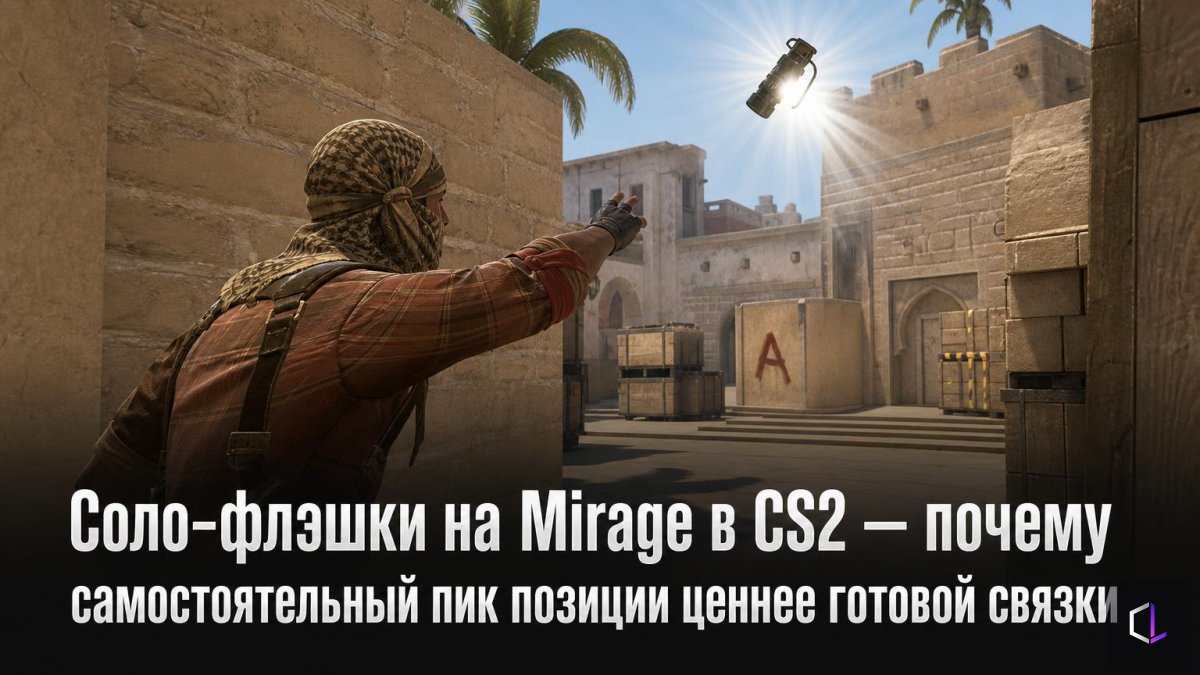
Among CS2 lineups there is a genre that the community likes less than flashy molotovs and map-wide smokes: solo flashes. These are flashbangs that a player throws for themselves in order to peek a position without a teammate's help. Recently the community started talking again about the three most common variants of this technique on Mirage, and the occasion is worth using to look at the idea itself: why it exists and where the limit of its usefulness lies.
What a Solo Flash Is and How It Differs from a Paired Flash
The classic setup is one player throws a flash and a second one goes out to peek. It is reliable, but it requires two people, synchronized timing, and good communication. A solo flash solves the same task alone: the grenade is launched so that it detonates at the right spot while you are yourself moving out to the angle. The peek here is a move out of cover for a quick fight with an enemy who has been blinded while you are not yet in direct line of sight.
Mirage is well suited to such techniques because of its geometry. The map is dense, with many narrow passages and short angles where an enemy stands close to a wall or in a niche. A flashbang that bounces off the right surface cuts off the opponent's vision exactly at the moment you show yourself. This is not magic but work with bounces and time: the grenade flies, you start moving, and the detonation has to coincide with your appearance.
The CyberLab View: Why This Is an Underrated Skill
The community more often copies ready-made combos from videos: throw a molotov from here, a flash from there, and the whole five goes onto the site. We think solo flashes are underrated precisely because they look modest. The CyberLab editorial team is convinced that peeking a position on your own should be practiced before complex team combinations, and here is why.
It doesn't depend on a partner. In ranked matches and on FACEIT you constantly have to play with people who don't hear you or can't keep up with your pace. If your only way to get out to an angle is to wait until someone throws a flash, you depend on someone else's discipline. A solo flash gives you a tool that works with any communication.
It teaches you to feel time. For a flash to work, you need to understand how many seconds the grenade takes to fly to the bounce, when to start moving, and how much time you have to get out. This is the same skill that underlies round timings: the ability to count short intervals without looking at the timer.
It teaches you to decide, not to repeat. Here we part ways with the familiar approach of "memorize a lineup and apply it." Any flash can fail: the enemy has already moved away, the bounce came out slightly differently, a sound gave you away. A player who simply repeats what they memorized loses the round at that moment. A player who understands why they threw the grenade has time to make a different decision: fall back, outplay, or take the fight without the flash.
There is also the opposing view: that a solo flash is a wasted grenade and it is better to save it for team play. There is some truth in that. When there is little utility in a round, spending a flash on a solo peek really is risky. But that is an argument not against the technique, but for knowing when to use it.
How to Train the Technique, Not Just Memorize a Spot
It is more useful to work on a solo flash on an empty server than in a match. Here are a few principles that suit any map:
- First the bounce, then the peek. Practice the throw separately, achieve a stable detonation spot, and only then add your own movement out.
- Count the time out loud. How long you wait after the throw before showing yourself. This pause needs to become a habit, not a guess.
- Train the abort. Deliberately practice the situation where the flash didn't work and you fall back. A technique without a plan B is gambling, not tactics.
- Test it against bots and real players. A bot doesn't react like a human, so after the empty server, run the technique in regular games with low stakes.
Mirage is a good proving ground here precisely because it has many recurring situations: the same angles, the same choke points, the same standard enemy positions. But a principle learned on one map carries over to others: on Dust2, Inferno, and Ancient the same logic of bounce and time works, and only the spots change.
A solo flash doesn't turn a player into a star and doesn't replace team play. It closes a specific gap: situations where you are left alone against an angle and can't count on help. Moments like these decide more rounds in ranked matches than flashy five-man executes that succeed once in ten games.