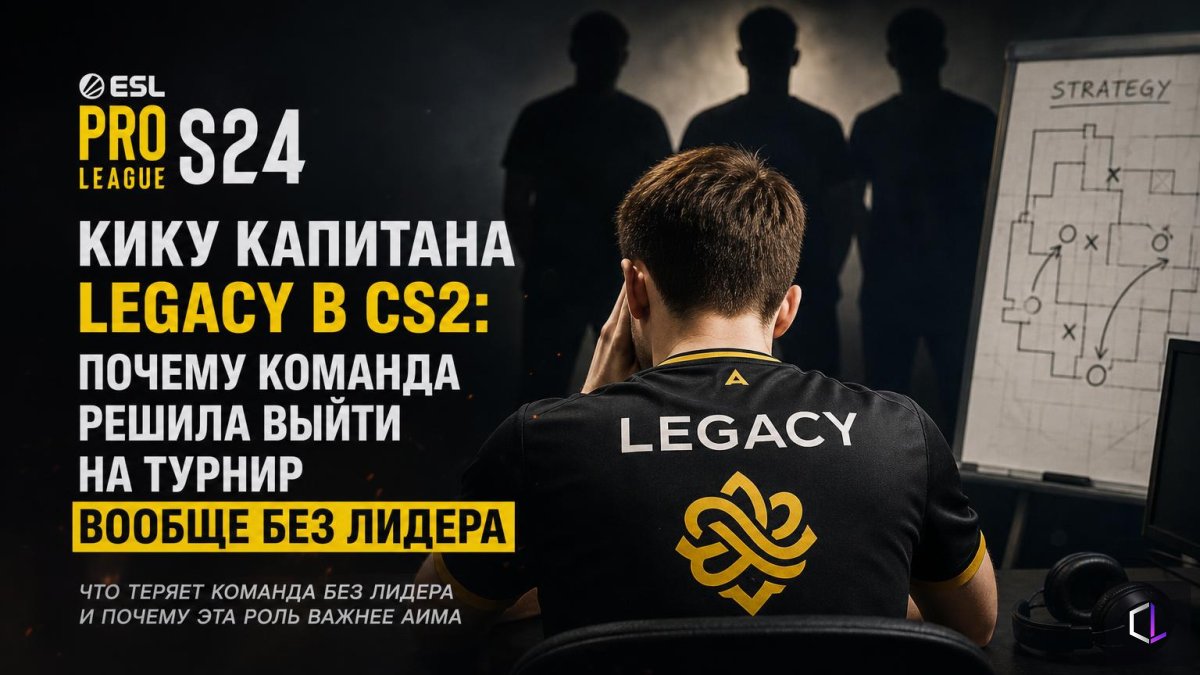
Legacy's CS2 captain quits: why the team decided to enter the tournament without a leader at all
The Brazilian team Legacy is entering ESL Pro League Season 24 without a captain. The decision looks strange: usually clubs spend months searching for a replacement leader, but here the roster is simply going to the tournament as is — without a person who takes charge of calling and analyzing the opponent. For many viewers, this is a minor organizational detail. For us at CyberLab, it's a great occasion to talk about what a captain actually does and why his absence hits the team harder than it seems from the outside.
A captain isn't just "the one who shouts the loudest"
From the outside, it seems that a captain in CS2 is a player who shouts out commands at the decisive moment of a round. In reality, his work begins long before the match: analyzing the opponent's demos, preparing anti-strats, distributing roles within the five-man squad, and, hardest of all, making quick decisions under conditions where there isn't enough information and no time for discussion.
Without this person, decisions become blurred. Some of the players take the initiative situationally, but that's not the same as a systemic role with responsibility. In a moment of panic — and in professional CS2 panic happens even to top teams — the absence of a clear voice in the headset can cost a round, or even a map.
Why teams sometimes take the risk anyway
The decision to play without a captain is rarely voluntary — more often it's the consequence of a departure or a roster rotation, when a replacement hasn't been found yet and the tournament calendar doesn't wait. A similar situation becomes a test: is the team able to distribute the captain's duties among several players, or does chaos begin without a management vertical?
This is also interesting from a psychological point of view. Players who previously simply executed the leader's decisions suddenly have to analyze the round themselves, argue, and negotiate on the fly. Some reveal themselves in such a situation, others get lost.
What this means for young players
For young players training in academic conditions, it's useful to see this story not as an oddity, but as a clear lesson: a team isn't five good aims, it's a system of roles where someone has to see the whole picture.
A few takeaways worth carrying away from this situation:
- The captain's role can and should be trained in advance. Even if a team has an obvious leader, it's useful for every player to be able to take on the calling for some time — it's insurance in case of a force majeure.
- Team play holds together through communication, not just mechanics. A silent sniper with a perfect headshot is useless if no one on the team understands what's happening on the map.
- Analyzing other people's demos is no less important a skill than warming up on an aim trainer. This is usually what a captain does outside of the game, and it too can be learned deliberately.
Legacy's story hasn't yet shown what playing without a leader will lead to — the tournament is just beginning. But regardless of the result, it's a good case for talking to young players about the fact that behind beautiful frags there's often much less visible, but no less important, work.