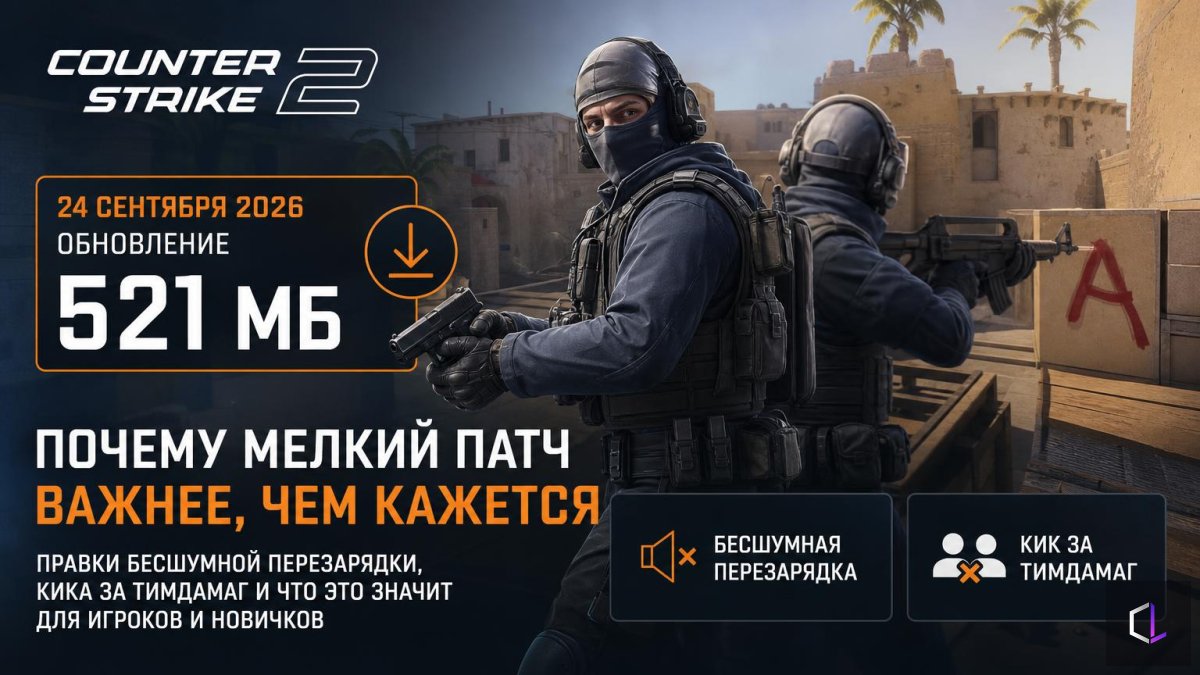
CS2 Update September 24, 2026: Why a Small 521 MB Patch Matters More Than It Seems
A small patch with a big meaning
Valve has released another Counter-Strike 2 update — at first glance, a routine one: 521 MB, a couple of lines in the patch notes, no new maps or weapons. But if you look closely at what exactly the developers fixed, it becomes clear: this update concerns things that directly affect the fairness of the game and the comfort of new players.
What actually changed
Three groups of fixes deserve a closer look.
Silent reload is no longer a loophole. Previously, some players knew how to slightly speed it up by quickly tapping the reload button before holding it down. The same trick worked with shotguns — it allowed firing slightly faster than normal while still remaining "silent" to the opponent. Formally, this isn't cheating in the usual sense, but in practice it was an exploit that gave an unfair advantage to those who knew about it. Now the loophole has been closed: the mechanic works as intended, without micro-tricks.
The rules for team damage kicks have become more precise. The system that decides when to kick a player for team damage has received adjusted logic. This is important for team matches — especially in academic and amateur environments, where accidental hits on teammates happen much more often than in professional matches, and an unfair kick can ruin the game for an entire team of five.
Plus — a set of cosmetic fixes: an improved rules description on the loading screen (a small thing, but useful for those just starting to figure out the game), fixes to invisible map boundaries, and a fix for the jittery AK-47 inspect animation.
Why this matters more than it seems
Often the most noticeable patches are the ones that change weapons or add a map. But it's precisely these "quiet" updates that shape what's called the integrity of the game. If micro-exploits like accelerated reloading remain in the game for months, they gradually become part of the meta-knowledge among experienced players — and turn into an invisible barrier for newcomers who simply don't know about such tricks.
Clarifying the kick rules solves a similar problem from a different angle: fairness of moderation. In children's and teen teams, where reaction speed is still developing and aim accuracy is unstable, accidental damage to a teammate is a common occurrence during the learning stage. An overly strict kick system in such a situation punishes not the cheater, but the person who is simply learning.
What this means for those learning to play
For young players and their parents, such updates are a good reason to discuss that esports rests not only on reflexes and strategy, but also on understanding the rules of the game at a technical level. The ability to read patch notes, understand the logic behind changes, and quickly adjust tactics accordingly is a separate skill that distinguishes a player who "just plays" from one who is actually growing in skill.
Small patches come out almost every week, and not all of them make it into news headlines. But it's precisely from such details that the overall picture emerges of how developers balance fairness, accessibility, and gameplay dynamics — and that's worth noticing, not scrolling past.