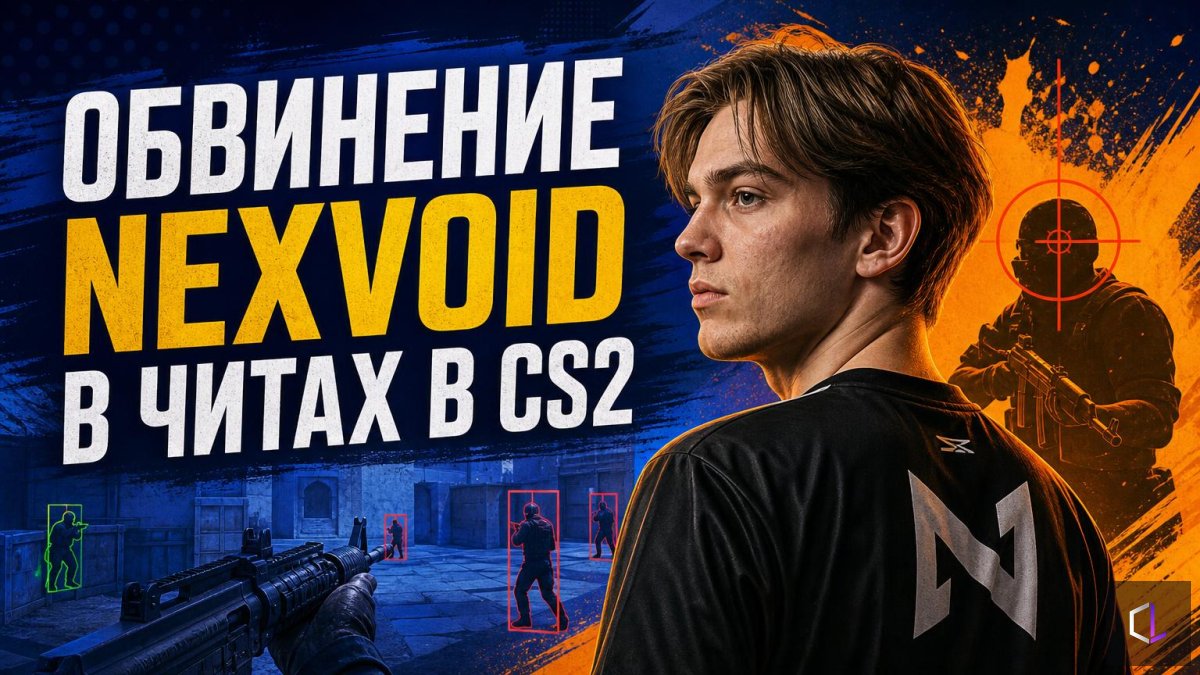
Lynn Vision player EmiliaQAQ has publicly accused the Mongolian team NEXVOID of cheating. He posted moments from the match after which his team was knocked out of the race for the major. James Banks commented under the post: he called on the tournament organizers and Valve to look into the situation.
For now this is an accusation, not a proven fact. There is no official verdict, and it would be wrong to call anyone a violator before the organizers make a decision. But the situation itself is a good illustration of how the "suspicion — verification — sanctions" chain works in esports, and why it so often stalls.
What an accusation looks like from the inside
These stories always come with the same standard set: a compilation of rounds in which the opponent supposedly shoots "through a wall," instantly snaps onto an unseen target, or guesses positions too accurately. The author picks episodes that look suspicious and asks the community to judge.
The problem is that a compilation, by definition, selects the most spectacular moments. A professional match has dozens of rounds, and among them there will always be a moment where a player predicted a position "too accurately." Professionals really do know standard setups, hear footsteps and play off sound, so at times it looks like knowledge through walls. Strong play and assistive software are indistinguishable over a short stretch; the difference only shows over the course of a whole match or series.
What counts as a cheat and how it differs from "suspicious play"
Assistive software in CS2 falls into several types:
- Wallhack (WH) — a program that shows opponents through walls. Sign: the crosshair follows an opponent who can be neither seen nor heard.
- Aimbot — automatic aiming. Sign: inhuman speed and precision in the crosshair's adjustment; in "quiet" versions (legit mode), the deviations are deliberately masked.
- Triggerbot — automatically fires the moment a target crosses the crosshair.
A separate category is "ghosting," where a player receives information about positions from a spectator or through a delayed broadcast. Formally this is not a program running in the game, but it is also a violation of tournament rules.
Who decides such disputes, and how
In professional tournaments the investigation proceeds along several lines. The organizer requests the match's demo recordings (files that store the entire course of the game and let you rewatch every round from any point). Referees and anti-cheat teams compare the player's behavior with his usual play in other matches. Often the computer itself is checked too: most major organizers have a clause in their rules granting the right to request such a check.
Valve is responsible for the VAC anti-cheat system and for decisions related to account bans, but not for the outcome of a specific tournament. The ruling on a match result is made by the organizer. That is why James Banks's appeal is addressed to two parties at once: the organizers, who can revise the result or order a check, and Valve, which can examine the accounts.
Why such stories matter for the scene
For regional qualifiers the story is especially sensitive. The major is the main tournament of the CS2 season, and slots at it are decided through a chain of qualifiers. A single disputed match can determine who travels to a competition of that level. Hence the tension: a team knocked out after a suspicious match loses not just a victory, but a chance to reach the world stage.
The Mongolian scene has been gaining weight in the Asian market in recent years, and a high-profile accusation hurts the reputation of the entire region, whether or not it is confirmed. That is why both the accuser and the accused side need a transparent procedure with a public outcome, not a war of compilations on social media.
Until the organizers and Valve have spoken, the sensible position for a viewer is simple: look at the facts of the investigation, not at the most spectacular clips. Emotions around the eliminated team are understandable, but they are exactly why compilations look more convincing than they really are.