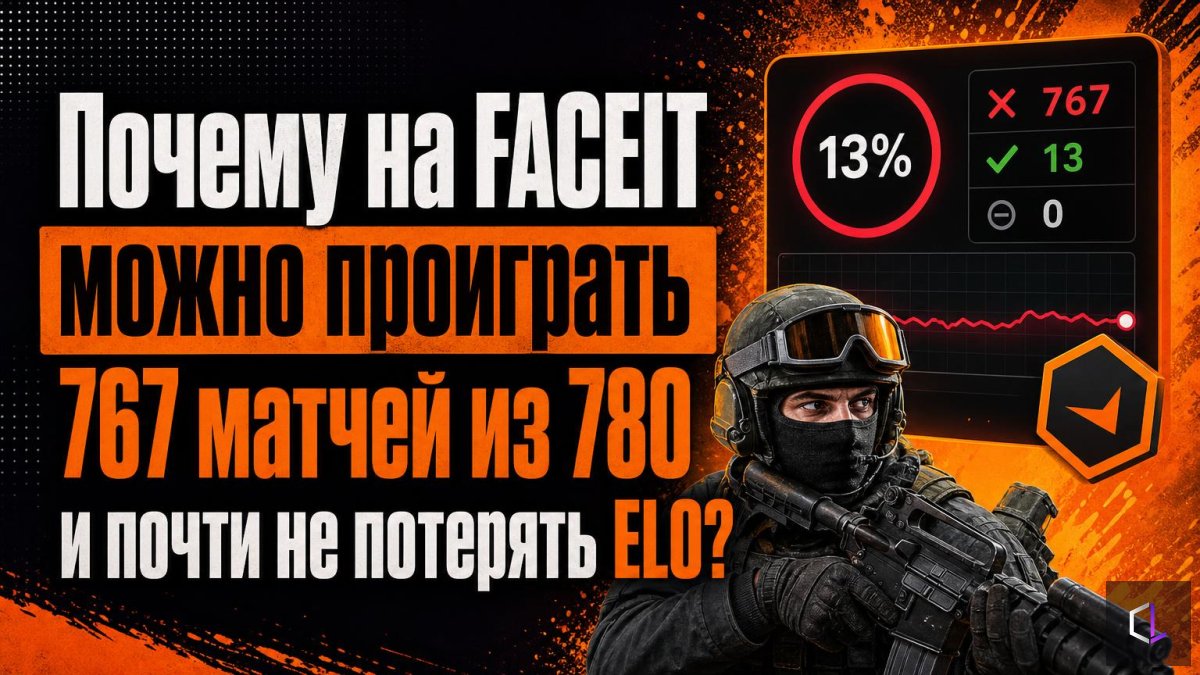
A FACEIT profile was found belonging to a player with the nickname Dokonegon: 13 wins in 780 matches, that is, a win rate of about 1.7%. Over the last 150 games the rating rose by only 100 ELO, and the entire gain came from a single win. A couple of days after the profile was noticed on social media, the account was banned. People laughed at this, but the story has a useful side: it shows how the rating actually works.
How FACEIT calculates ELO and why it doesn't collapse
ELO is a rating number that rises for wins and falls for losses. The platform estimates the expected outcome of a match from the ratings of the players in it: if you beat strong opponents, you gain more; if you lose to equal or weaker ones, you lose more. The size of the change in a single match is limited, and at the lower bound of the scale the rating does not drop endlessly.
Hence the first observation: a steady losing streak does not necessarily turn into a plunge into negative territory. When a player has long been sitting at the lower bound, each new loss hits the floor, while a single win gives a noticeable gain. So "100 ELO for one win" looks strange, but does not contradict the mechanics.
Does a low win rate mean the player is weak?
Not necessarily. A win rate of 1.7% is not a level of skill, but a figure almost unattainable in honest play. Even a very weak player, entering matchmaking (selection of opponents by rating), ends up again and again among players roughly equal to themselves. The system strives for balance: if you lose, you are moved to weaker opponents, and wins start coming at least by chance. To win only 13 out of 780, you have to lose deliberately or systematically fail to take part in the game.
Several explanations are possible here, and it cannot be said for certain which one is correct: the sources reported only the fact and the ban, not the reason. It could be deliberate match ruining (in games this is called "griefing," when a player harms their own team), an experiment for the sake of statistics, boosting someone else's account, or a change of the profile's owner. Platforms usually punish such behavior separately from cheating.
What to look at in your own statistics
From this case it is convenient to take away a few rules for reading your own profile:
- Look at the sample size. Ten matches prove nothing, while a few hundred already show a trend.
- Follow the dynamics, not the number. A rise of 100 ELO over 150 games is a flat line, and it speaks of stagnation even if you are "in the plus."
- Compare win rate with rating. If you are standing still with a win rate of around 50%, you are playing exactly at the level of your rank. To move up, you need a steady edge, not one good evening.
- Don't confuse win rate with contribution. You can win thanks to a strong team, and you can lose while being the best player in the match.
Why rating gets stuck for ordinary players
The stagnation that players complain about is most often simple in nature: the rating converges to your real level and freezes there. If you are standing still while playing honestly, it means the system has already placed you where you win about half of your matches. You can break out of this equilibrium only by changing the game itself: positioning, grenade usage, playing as a team, not by simply increasing the number of matches.
That is why the 1.7% story is an extreme case, not an example for comparison. In practice, the lower part of the rating is filled with players who play out draws with the system: they neither grow nor fall because their behavior is stable. To change this, you need not a new account or a streak of games into the deep night, but concrete work on weak spots: what exactly you do in lost rounds and how it differs from what the winners do.
The Dokonegon ban also reminds us of one last point: the platform looks not only at cheats but also at behavior. A match in which you knowingly harm your team is the same kind of violation as using third-party software, and it is punished just as quickly once attention is drawn to the profile.