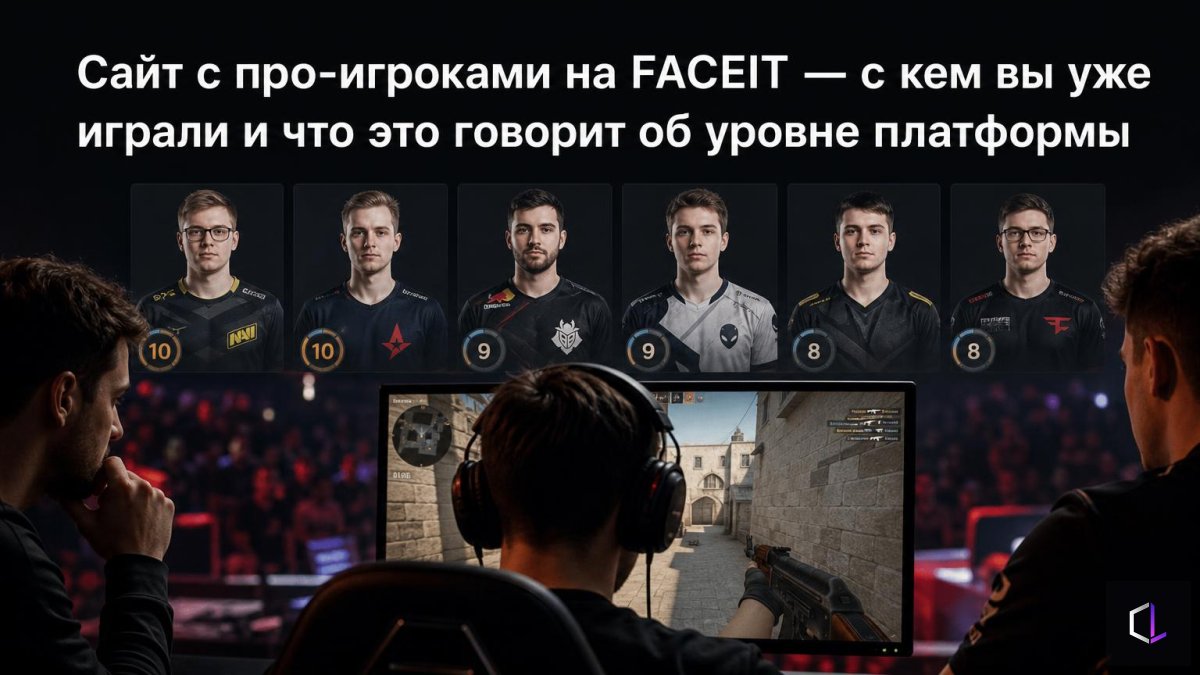
A site has appeared in the CS2 community that shows which professional players you have met on FACEIT over your entire history. All you need to do is enter your profile, and the service pulls familiar nicknames from your match history. The reaction was predictable: some brag about a list of big names, others joke that at their ELO the only ones they run into are "proNOOBS". It's a joke, but behind it lies a question worth examining seriously: how the field of opponents on FACEIT works and why "I played with pros" says less than it seems.
Where Professionals on FACEIT Come From
FACEIT is a third-party platform for competitive matches: players receive an ELO rating (a number of points that grows with wins and drops with losses) and levels from 1 to 10. For professionals this is not entertainment but a working tool: the ladder provides practice in conditions close to tournament ones, without the need to arrange scrims (practice matches between teams).
But pro players are distributed unevenly on the platform. They sit at the top of the ranking, where matchmaking picks opponents with similar ELO. To cross paths with a professional, you either have to be near that ceiling yourself, or end up in a match where the person is playing not on their own account or with a lowered rating. The second option does happen: on a new account, a player of a top-team level ends up for a while among much weaker opponents, until the rating "pushes" them upward.
What Such a List Actually Shows
The mere fact of an overlap in a match is a weak metric. Playing in the same lobby and playing against a person are not the same thing: they could have been on your team, they could have been on the other side, they could have behaved in the match completely differently from how they do at an official tournament. A professional on the ladder is often practicing something specific: new lineups, opponents' timings, an unfamiliar role. The result of such a match is not an indicator of their strength.
For the player themselves, something else is more useful. A list of familiar nicknames is a reason to open the demo (a recording of the match) and look at exactly how the strong opponent behaved: where they stood at the start of the round, when they took a duel, how they used utility. For this you don't need to compete with them in aim. It is enough to notice the difference in decisions.
CyberLab's View: ELO Is Not a Diploma
The CyberLab editorial team treats this kind of "acquaintance statistics" with a degree of skepticism, and here is why. People like to measure progress with external markers: level, ELO number, big names in the match history. But these markers share a common flaw — they say nothing about the causes of a result. You can play with strong players for years and not grow if your match review boils down to "bad luck" or "my teammates are weak."
We believe the FACEIT ladder has real value precisely as an environment for observation: it delivers a dense stream of rounds with live opponents of different levels, and patterns can be drawn out of it. But the value arises only when the player asks the question "what would I have done differently" about a specific round, rather than about the match result. A new toy in the form of a site with professionals is a good starting point for that habit, not a reason for pride or disappointment.
It can be debated: part of the community is convinced that only direct contact with pros forces you to step up, because you see the bar. But the bar cannot be "felt" through a single encounter; it is visible only when you have something to compare your own rounds against.
How to Use Such Statistics Without Self-Deception
The first step is to determine what exactly you are looking for. If you are simply curious, then a list with a professional's nickname is a curiosity, nothing more. If you want to learn, take a specific match where they were in the lobby and look at their movements around the map, not at the final score.
The second step is not to overestimate the sample. A few overlaps over the entire period are not a picture but a coincidence: the player might have logged into the account once a month, or might have played for a week straight. No conclusions about "my level" can be drawn from such a base.
The third step is to remember that the rating on the ladder reflects your results in ladder conditions: random teammates, varying discipline, the absence of a shared scheme of play. Professionals live in a different environment — with a coach, an analyst, and a schedule. Comparing the numbers directly is impossible, but comparing approaches is useful: how they prepare a round, how they react to losing a position, how they play after a lost pistol round. All of this is visible in the demo, not in a list of nicknames.
That is why the new site should be taken as a convenient index: it hints at where in your match history there is material valuable for observation. After that, the work remains the same — open the recording and watch.