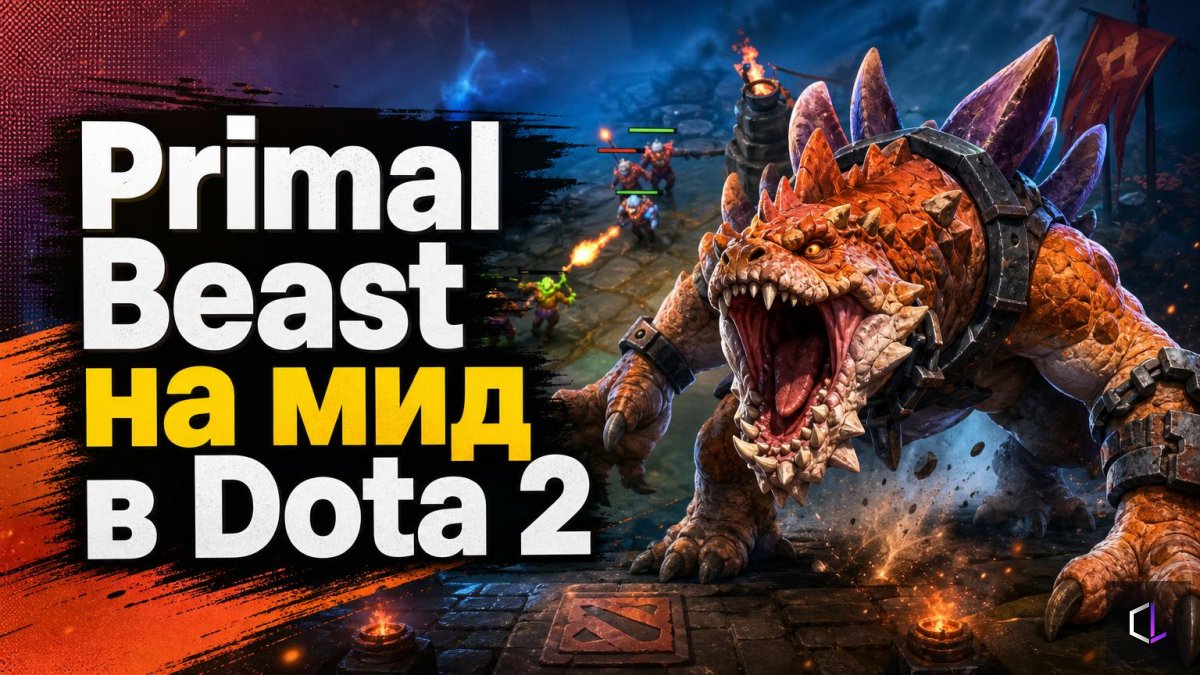
In public matches, Primal Beast in the center lane wins about 55.6% of games — according to D2PT, a service that collects statistics from open ranked games. For a hero who is traditionally seen as an offlaner or an initiator, this is a surprisingly high result in a position where mobile and nuker heroes are usually expected. Let's go through the questions that usually come up for those who see such a number.
Why did Primal Beast end up in the mid lane at all?
The mid laner gets experience faster than everyone else: he has a solo lane, which means all the experience from it goes to one hero. If a hero quickly reaches key levels on it, he gains access to his main set of abilities earlier than the others. Primal Beast wins exactly here: he has powerful control and area damage abilities, and they don't require expensive items to start being useful.
The second factor is predictability. The hero doesn't need to "play out" the lane perfectly with tricks: his strengths are clear to the opponent, but hard to defend against. Pubs, meanwhile, are matches without coordinated communication, where a simple and reliable pick often outplays a complex one.
Is it true that a high win rate in pubs is an indicator of a hero's strength?
Not always. Win rate in pubs reflects not only the hero's strength, but also who picks him and in what context. If the hero is picked by players who specialize in him, the statistics are inflated. If he is picked randomly, they are deflated. So 55.6% is a reason to check the hero out, not a guarantee that he is stronger than the others at your rating level.
It is useful to distinguish two questions. The first: "does the hero win on average?" — the number answers that. The second: "will I win on him?" — only your own practice answers that. Between them lies the question of comfort: a hero with a high win rate whom you don't enjoy playing will give you worse results than an average hero whom you feel comfortable with.
What is the most popular build right now?
The source post shows the purchase order with icons, without item names, so I won't retell a specific list — without a decoding, it would be guesswork. Something else is more important: the most popular build has a main purchase route, and it also has a variable branch that is taken occasionally, adapting to the game. Such a structure — a stable core plus a flexible part — is typical for heroes who perform well in ranked. The core doesn't require thinking in moments of stress, and the flexible part lets you respond to the opponent's composition.
If you want to test a build, don't copy it entirely. Take the core and deliberately change one slot, writing down what exactly you changed and why.
Will the hero fit any composition?
No, and here it's worth being honest. Primal Beast is a hero who wins through pressure and control, and he needs a team capable of taking advantage of the window after his initiation. If there isn't a single hero in the lineup who will secure the result of his engage, the potential of his control is partly lost. Likewise, against compositions with quick escapes from control and high mobility, it is harder for the hero to find a target.
A practical selection criterion: before the pick, ask yourself what you will do in the second or third minute if the opponent refuses to fight in the lane. If there's no answer, the hero may turn out not to be the best choice, no matter how good his win rate looks.
How do you test a hero yourself without trusting someone else's statistics?
The most reliable way is a series of a small number of games on one hero with the same plan and notes after each. Don't try to derive patterns from three matches: the sample is too small. But five to seven games with a record of how you played the first ten minutes and what broke you there already show where the problem lies — in the hero, in the lane, or in your reaction to pressure.
A hero's statistics are a map of the terrain, not a route. It shows where it is safe on average, but you still have to walk it yourself.