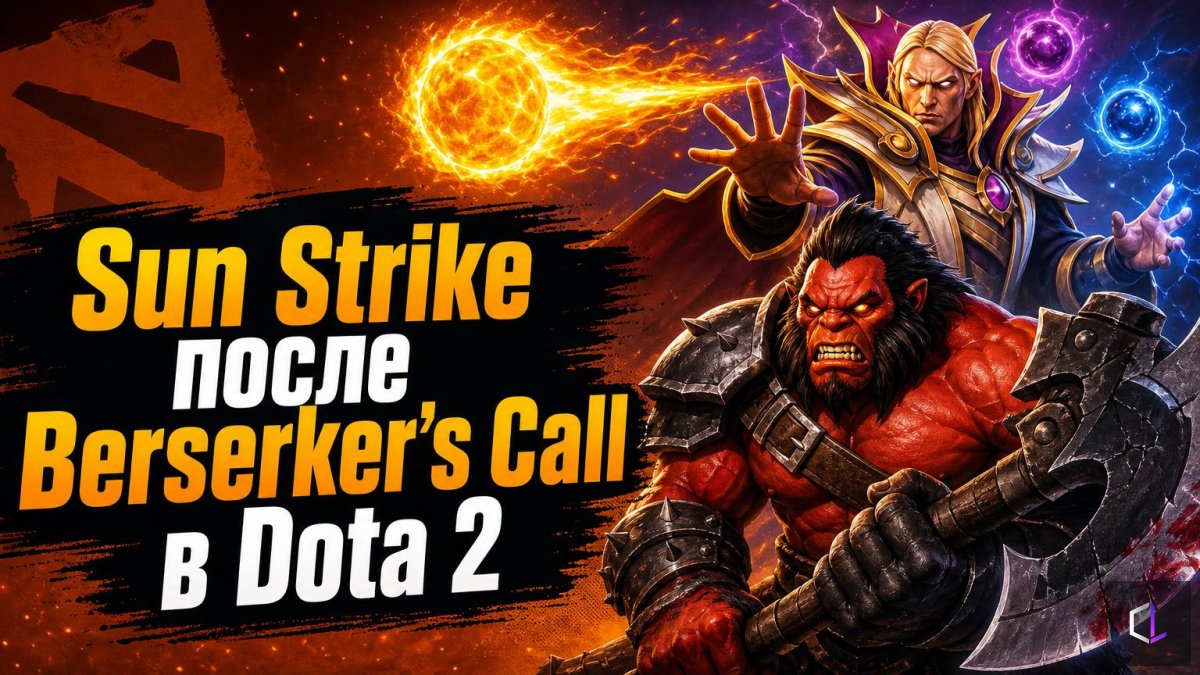
In a short community clip, a player going by the name Лизок shows how Sun Strike is placed "on the read" — Invoker lays the strike in advance on the spot where the enemies will end up on their own, because Berserker's Call has driven them there. The caption under the video is simple: "A basic Invoker on your team?". The answer to that question is more interesting than the trick itself.
Why Sun Strike fits so poorly into a fight
Sun Strike is a global ability: Invoker can place it at any point on the map, but the damage arrives with a delay. During that time, a target that sees the marker or is simply moving has time to get away. That's why in practice Sun Strike in a fight is often used as a finisher on an already immobilized target or as a pre-placed "trap" on a predictable route.
This is exactly why it is so often paired with allied crowd control. Any stun, trap, or forced movement turns the ability's weak point — the delay — into predictability.
What Berserker's Call gives you
Berserker's Call is an Axe ability: he lets out a shout, and all enemies within the radius are forced to attack only him for the duration. They cannot choose another target, and Axe gains a bonus to armor in the process. For Invoker this matters most of all: while the enemies are busy with Axe, they stand packed tightly around him and don't leave the zone.
The result is a combination of two roles. Axe creates a "cage" out of the opponents' own bodies, Invoker takes that time and places the damage where no one will move. Without such a combination, Sun Strike is guesswork; with it, it's an almost guaranteed hit.
How to set up the order
The key is that the decision is made by Invoker, not by Axe. Axe lets out the shout when it suits him to enter the fight, and after that Invoker is left with a short window. If you wait for confirmation of "the shout went through" in voice chat, Sun Strike comes too late; if you place the strike in advance without seeing who exactly was caught by the effect, you can waste the ability on empty space.
A workable scheme looks like this:
- Axe gets into position and announces the shout in advance ("in a second"), not after.
- Invoker doesn't wait for the effect to appear on screen, but orients on the spot where Axe is standing: the targets will gather around him.
- Sun Strike is placed in the center of this zone, not on an individual hero.
This combination works precisely because it doesn't require an exact hit on a specific target: the zone is enough.
Where the combo breaks
The idea has weak points, and they also come from the mechanics, not from statistics.
First, not all targets get caught by the shout: the ability works within a radius, and heroes who stand farther away or managed to step back remain free. Sun Strike is more likely to miss them than those whom Axe has "taken."
Second, some heroes can interrupt the effect or simply ignore it: a single way out of the state is enough to empty the whole zone. Then Invoker hits an empty spot, and Axe has no second attempt in that fight.
Third, the combination has no time margin: if Axe doesn't reach the fight or is intercepted earlier, the combo doesn't happen at all, and Invoker is left with a ready but useless setup.
What remains off-screen
The clip itself shows the execution, not statistics: we don't know how often such a combination works in ranked games, and there is no data on the pair's win rate in the source. So it's reasonable to treat it not as "meta" but as an example of team thinking: an ability with a delay starts working when an ally knows in advance where the opponent will go.
The same principle carries over to other combinations in Dota 2. Any area strike, any slow, and any delayed ability wins where someone else has restricted the target's movement. The question is not how many buttons you press, but which of the five is responsible for making sure the enemies end up where you expect them.