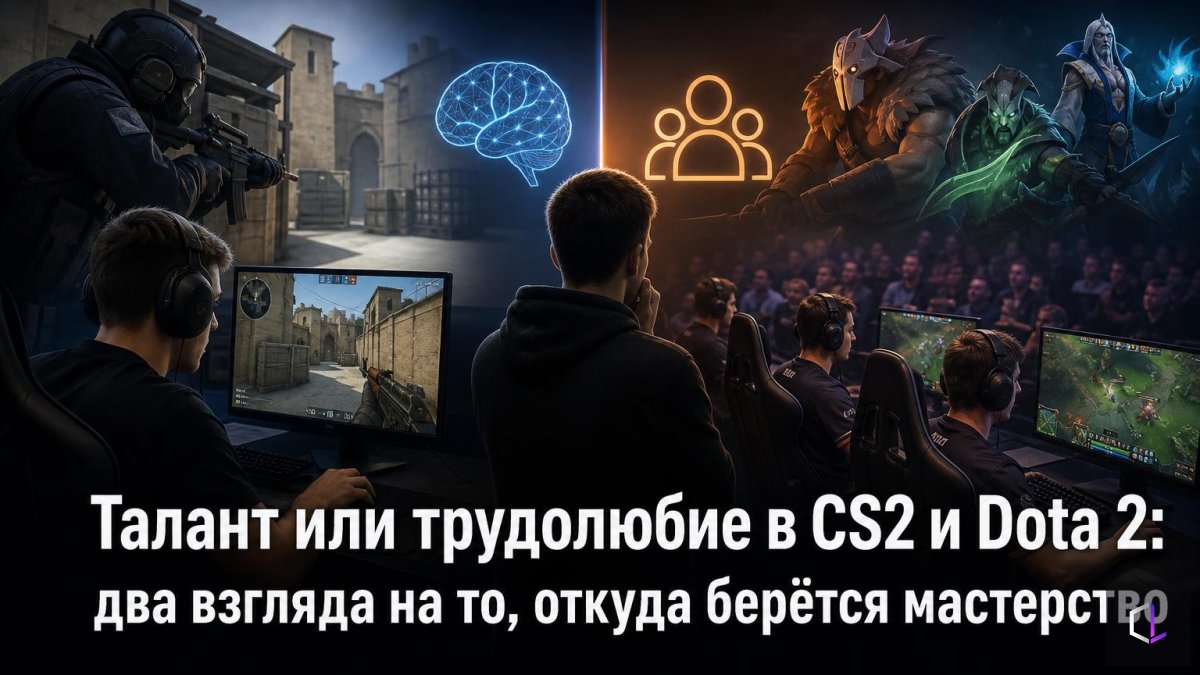
One day in the esports community, two remarks were made that at first glance have nothing to do with each other. One was about the claim that talent does not exist. The other was about Dota no longer allowing one player to carry a match. Put side by side, they make for an interesting comparison of two approaches to the question of what makes a player strong in the first place.
The first approach: talent is unseen work
The player Recrent stated that he does not believe in talent as a phenomenon. By his logic, it is a convenient excuse for those who haven't succeeded: "he has talent, and I don't." In reality, he says, we simply don't see the work a person does behind the scenes. As an example, he cited donk: according to him, by the age of 18 the player had accumulated about 30 thousand hours in CS — and that can hardly be called a gift of nature.
It is a strong argument, but it is worth noting where it is weaker. The figure of 30 thousand hours is the speaker's own claim, not verified statistics, and one could argue about it for a long time. More important is something else: the thesis "talent is a myth" is as hard to prove as it is to refute. We don't know how many of the people who logged the same number of hours reached donk's level. This is the classic survivorship bias: we see those who succeeded and attribute the result to the hours.
The second approach: the game's framework narrows the room for a hero
Dendi expressed a completely different thought. In his assessment, Dota has become too team-dependent: a player alone no longer pulls a match out the way they used to. Add smurfs, abusers, and cheaters, he says, and every ranked match turns into a roulette.
Here the question is not where mastery comes from, but how much of it remains in the end. You can be a player with enormous accumulated practice and still lose, because the result depends on four other people and on who you happened to get in your lane. This is the opinion of one well-known player, not a measured fact, but it explains well the common complaint of ranked players about the "impossibility of carrying."
What they have in common
Both statements are, in essence, about the limits of personal contribution. Recrent believes the contribution is enormous and depends entirely on your work. Dendi believes the contribution is enormous, but the ceiling is set by the environment. Both can be true at the same time: hours are needed to get anywhere near the ceiling at all, and the ceiling is determined by the format of the game.
The difference also shows in where these approaches look for the cause of failure. For the first, it is insufficient practice. For the second, it is the structure of matchmaking and team dependence. The first is encouraging: everything is in your hands. The second is more honest about variance: part of the outcomes is not controlled by you at all.
Where the boundary between them lies
The practical conclusion from the comparison is simple if you separate two things. There is what is solved by repetition: aim, smokes and utility lineups, knowledge of timings, hero mechanics. Here the position "there is no talent, only hours" works almost without caveats, because any skill of this kind is measurable and improvable. And there is what does not depend on you: team composition, other people's mistakes, dishonest opponents. Here it is pointless to cite a lack of training.
The mistake arises when these two layers are confused. A player who blames a loss on the "team" overlooks their own mistakes. A player who blames themselves for every defeat burns out over problems they have no connection to. A mature approach is to break an episode down into two columns: what I could have done differently and what was outside my control. The first column gets work, the second gets acceptance.
There also remains a question that the argument about talent never closes: if hours decide everything, why do only a few out of thousands of players with the same amount of practice reach the very top? Perhaps it is not about the hours themselves, but about how deliberately they were spent — but this cannot be verified from a single remark on a stream, which means each of the two views still retains its share of being right.