128 Tick Rate in CS2: Why Jame and CS:GO Veterans Still Miss the Old Netcode
Nostalgia for CS:GO: PARIVISION captain recalls tick rate 128
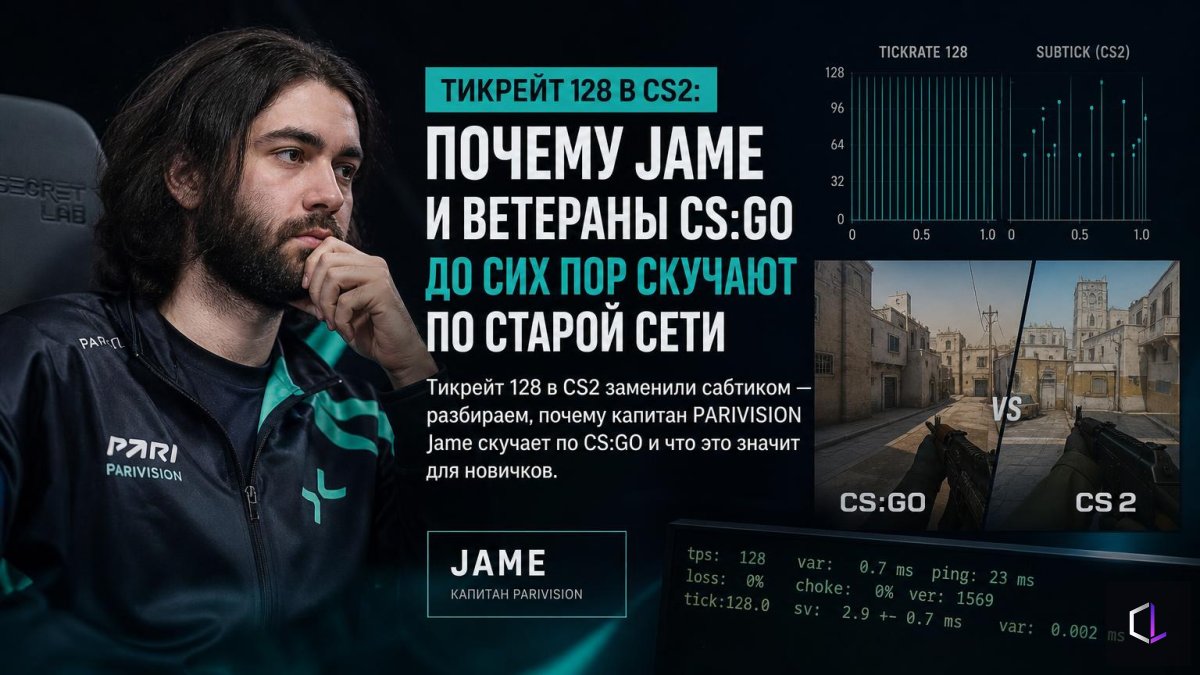
One of the well-known captains of the post-Soviet scene recently admitted that he misses good old CS:GO — specifically the 128 tick rate system, which in CS2 was replaced by the so-called sub-tick. It might seem like a trivial detail to an outside observer, but for a professional player, it's a conversation about the very essence of how the game works on a millisecond level.
The community's reaction was predictable: many admitted they miss it too. And this isn't just nostalgia for "the good old days" — behind this topic lies a real technical discussion that concerns everyone who plays CS2 seriously.
What tick rate actually is and why it matters
Tick rate is the frequency at which the game server updates the state of the world: player positions, hits, grenade physics. In CS:GO, top servers ran at 128 ticks per second, meaning the server "photographed" what was happening 128 times per second. The higher the tick rate, the more precisely the server records the moments of shots and movements, and the fewer discrepancies there are between what the player sees on screen and what the server actually registers.
In CS2, the developers abandoned the classic tick rate in favor of sub-tick technology. The idea is for the server to account for the exact time of a player's action (shot, jump, turn) within the interval between ticks, rather than rounding it to the nearest tick as before. On paper, this should be even more precise than the old system. But in practice, some professional players and coaches continue to feel the difference — subjectively, intuitively, through muscle memory built up over thousands of hours in CS:GO.
Why experienced players feel the difference while newcomers don't
This is a classic case of how a high skill level makes a person more sensitive to details that an ordinary player wouldn't even notice. Professionals spent years training their reflexes around specific server behavior: how grenades fly, how hits register at the edge of visibility, how hit registration behaves in duels. When the fundamental mechanics change — even if the new version is technically superior — the body and habits keep expecting the old behavior.
For young players who start their CS2 journey without a CS:GO background, sub-tick is simply a given, part of the game from day one. There's no nostalgia here, but there is a chance to build skills from the very start around the current mechanics, rather than having to relearn them.
What this means for those learning to play now
The tick rate story is a good occasion to explain an important thing to teenagers about esports in general: the game isn't just about reflexes and aim, but also about understanding how the system you're competing in is technically built. Top players don't just "feel the game" — they understand why it behaves the way it does, and know how to adjust their strategy and training accordingly.
That's why, in developing a young player, it's important not only to practice shooting at bots, but also to break down how game mechanics work at the server level, latency, and synchronization of actions within a team. This is the layer of knowledge that separates a casual player from someone who truly understands CS2 from the inside.