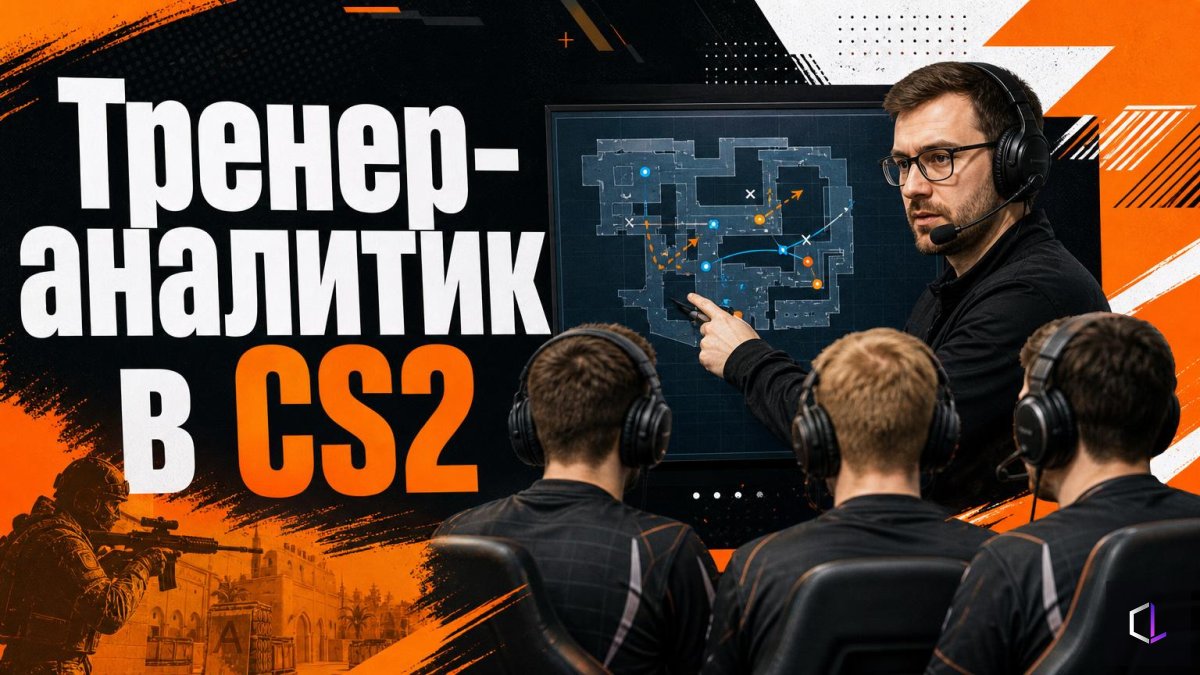
The Russian team HOTU has a new analyst coach in its staff: cau, who previously worked with 1w Team, has taken the position. For the scene this is a routine personnel move, but it shows well how the structure of professional teams has changed. Just a few years ago a single coach was usually enough for a staff. Today clubs increasingly assign a separate person who deals only with information: what the opponent does and what their own team does.
The coach manages people, the analyst works with data
The head coach is responsible for people: the mood in the five, the schedule, conflicts, role distribution, decisions during timeouts. The analyst is responsible for facts. His product is not a motivational speech but a document or a short briefing after which the players understand what to expect from a specific opponent on a specific map.
In practice the boundaries blur. In small staffs one person can combine both roles, which is why the job title is often "analyst coach": he both breaks down the game and takes part in the training process.
What match preparation consists of
The work starts with demos — recordings of matches that can be opened and reviewed from any point of view. A typical sequence looks like this:
1. Maps. The analyst looks at which maps the opponent picks and bans, and predicts the veto — the procedure in which teams take turns removing and choosing maps.
2. Pistol rounds and economy. How the opponent buys after a won and a lost pistol round, when they go for a force-buy and when they save money.
3. Defaults. This is the standard setup at the start of a round, when the team gathers information. What matters is who goes where and at what moment a decision is made.
4. Favorite executes. The set of grenades, timings, and which site the main hit most often goes to.
5. Individual habits. Where the sniper holds an angle, who takes the duel first, who rotates most often.
The result is anti-strats — prepared counters to the opponent's favorite setups. For example, if a team regularly takes a certain site with the same combination of grenades, you can prepare counter-utility and a position that breaks that timing.
How analysis gets into the game
The most delicate part of the work is not finding a pattern but passing it on in a way the players can use. Nobody can hold five pages of notes in their head before a match. That is why a good briefing boils down to two or three concrete things per map: "they more often go here after a lost round, we cover it with a grenade and hold this position." The rest stays in the archive.
The second half of the work is directed inward. The analyst watches his own team's demos and finds what is invisible from the inside: a player is systematically late with rotations, the five opens rounds too predictably, the same utility is repeated too often. The opponent watches recordings too, so predictability is expensive.
What skills the role requires
The analyst role requires several qualities:
- the ability to watch a demo not for spectacular moments but for recurring patterns;
- the habit of recording observations and boiling them down to a short conclusion;
- good knowledge of the maps and the current meta: without it, it is easy to mistake chance for a pattern;
- the ability to explain things to players, who are often more experienced than the analyst himself.
The first point can be trained today, even without a staff.
A mini-analysis for an amateur five
Before an important match, for example in a FACEIT season or at an open tournament, it is enough to set aside an hour and answer three questions about the opponent's last two or three recordings:
- which map is their strongest and what they do there in the first 20 seconds of a round;
- how they behave after a lost pistol round;
- which player makes the decision when the team is confused.
One conclusion for each question and one prepared response — that is already enough to go into the map with a plan rather than hoping for the best.