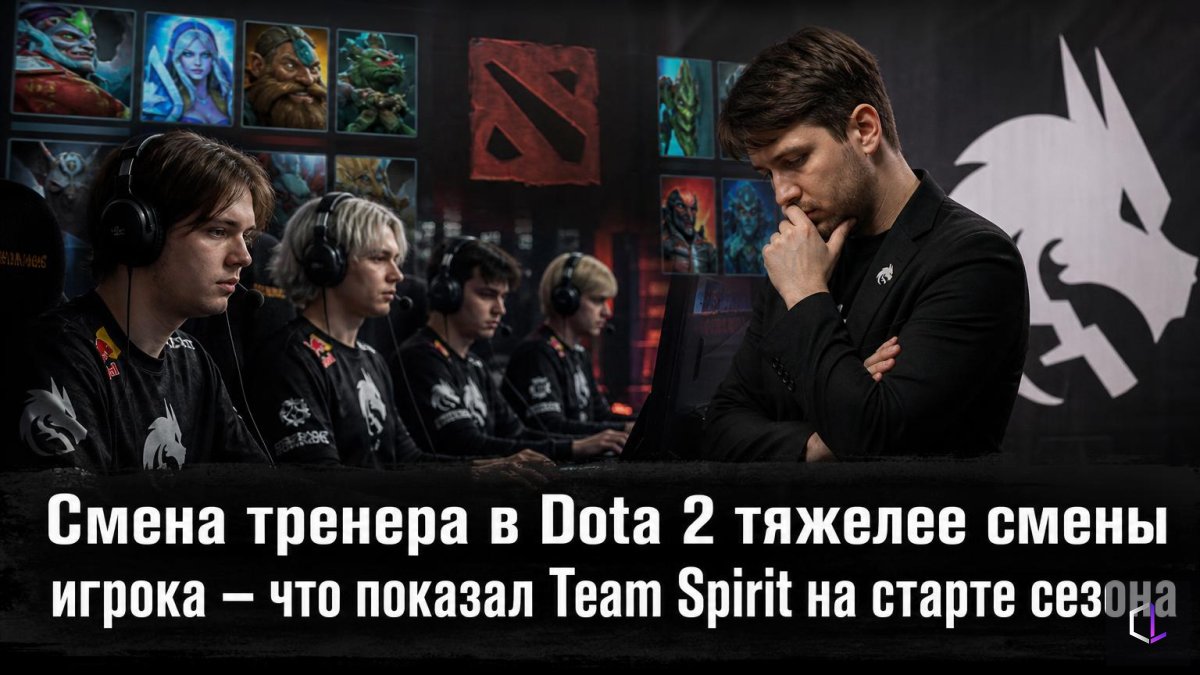
When a player changes in a team, fans discuss his mechanics and heroes. When a coach changes, most often they discuss the results a couple of months later. Yatoro, a Team Spirit player, believes that it is the second event that turns a team upside down more: by his observation, replacing a coach makes a bigger difference than replacing a single player.
What exactly Yatoro says
His argument is built on a comparison. When Collapse left the roster and Batyuk came in, the change was less noticeable than with a coach change: both players play at a high level, and they occupy a similar role in the team. A coach, according to Yatoro, brings a lot both in the game and outside it. The team plays the way the coach sees it: from movements around the map to hero selection. The style of the players themselves does not change, but the draft and the overall vision of the match can change dramatically.
This is the opinion of one person from inside the team, and it cannot be verified with numbers from these posts. But the logic itself is interesting and explains why in Dota 2 coaching decisions so often become a subject of analysis.
What a coach is responsible for in Dota 2
In Dota 2 a match begins even before loading onto the map: the draft (the hero selection phase, where teams take turns banning and picking characters) lays down the plan for the entire game. The tempo, the way of winning fights, and who will farm on whom all depend on which heroes are chosen. A coach usually keeps more information in mind than a player busy with his own lane: what the opposing team has picked before, where its weak spot is in the laning phase, what the timing of its strong heroes is.
The second layer is movements. This is where the team goes after a won fight, when it splits up, when it gathers at one point, at what minutes it pressures Roshan. These decisions add up to a single pattern of play, and changing it with one player replacement is hard. Changing the coach can do it.
The third layer is what is least visible: preparation between games, analysis of mistakes, work routine, psychological climate. Yatoro directly notes that a coach contributes a lot outside the game, and this is the hardest part to measure.
Why a player's opinion should be taken with a caveat
It is important to remember where this assessment comes from. A player at a high level feels the coach's work on himself: he is positioned, he is given heroes, the draft is built around him. For him the difference between two coaches is physically tangible. A viewer from the outside sees the result, not the process, and finds it easier to attribute a win to brilliant mechanics than to boring preparation.
There is also a flip side. If a coach determines the draft and the movements, he is also responsible for the weaknesses the team shows from match to match. That is why a coach change leads to sharp jumps in both directions: the team can suddenly start playing differently or lose its familiar pattern.
Curiously, Yatoro stipulates: so far everything is fine. The new Team Spirit roster, by his words, is showing decent play, which means that replacing Collapse with Batyuk did not break the team system. This is consistent with his own thesis: as long as the coaching framework stays the same, a single player changes without upheaval.
For an ordinary pub team the practical conclusion from this is: a team at any level has a person whose vision of the game determines how everyone else moves around the map. If there is no such person, movements are decided on the fly and chaotically, and the draft turns into a set of the five players' favorite heroes.
For a viewer this is a reason to watch matches differently. Instead of the question "who played better," it is more useful to ask: why did the team choose exactly these heroes and why did it go to this point. The answer often lies by the coach's bench, not in the player's hands.