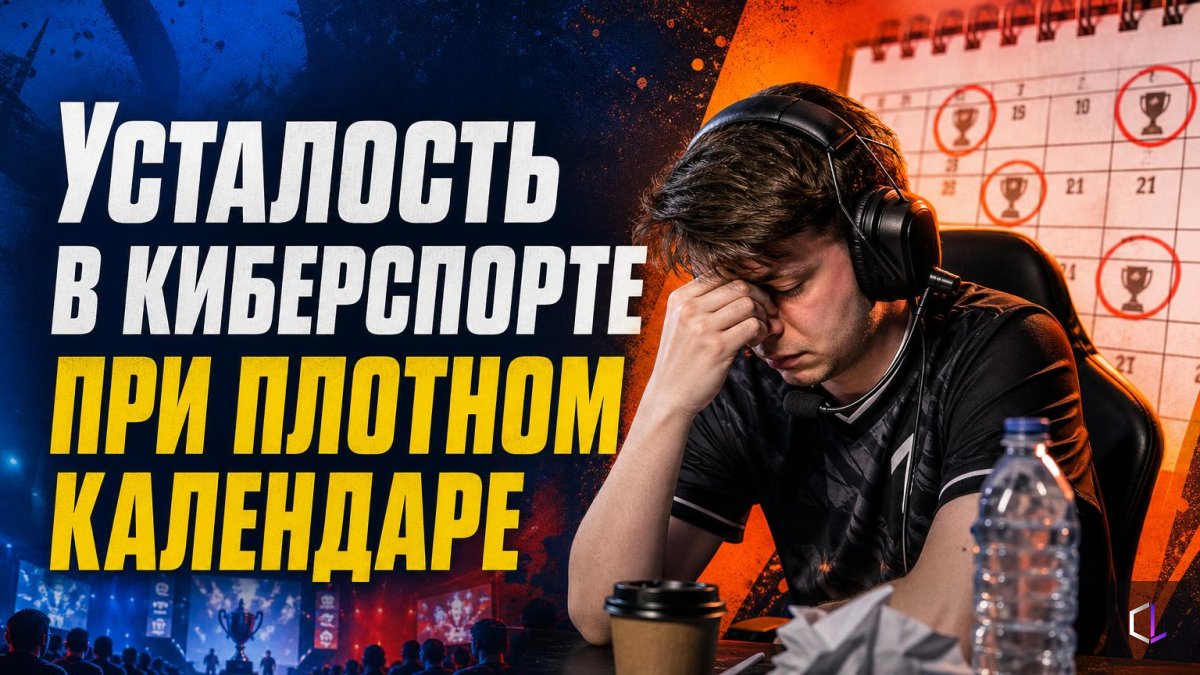
Six tournaments in two autumn months, two of them won, and the rare free days spent on flights between countries. That is what autumn looks like for one team, and it is not an exception but rather the norm for the top scene. Against the backdrop of such a calendar, one question is heard more and more often: should teams skip tournaments in order to rest?
The debate in the community runs along two lines. Some believe that in esports you need to play a lot: form is maintained by game practice, and a skipped tournament means lost rating points, prize money, and a place in next season's invitations. Others remind us that a human is not a server: recovery does not switch on according to a schedule.
What Fatigue Is Made Of
The load in esports is twofold. The first part is cognitive: during a match, a player continuously holds in mind the economy, timings, opponents' positions, and voice communication. Every map at a tournament is hours of concentration, and a series of two to three maps a day repeats for several days in a row.
The second part is physical and logistical. Flights, time zone changes, hotels, unfamiliar sleep, eating whatever is available. A free day spent traveling restores nothing — it simply carries the fatigue over to the next city. We have already written separately about the mechanism of time zone changes; what matters more here is something else: when flights come in series, the body does not manage to return to its baseline routine even once over the entire stretch.
Signs of accumulated fatigue in a player are usually as follows:
- the number of minor mistakes in routine situations grows — a forgotten grenade, a wrong timer, an unnecessary peek;
- the accuracy of decisions drops in the late rounds of a map, even though everything is fine in the first half;
- reaction to the unexpected — a flank, a change of tempo — becomes slower, and communication becomes shorter and more irritable;
- interest fades in practice sessions that used to be enjoyable.
Why "Playing More" Doesn't Always Work
The argument about game practice is only partly right. Aiming skill and map knowledge really are maintained by regular play. But the quality of play depends on condition, not only on the number of hours. Practicing while fatigued reinforces not the best habits: a player compensates for sluggish reactions with caution, and caution in duels means lost duels.
There is also a team effect. One tired player slows the tempo of the whole five: his calls come later, and it is harder for him to execute complex setups. A team that won two tournaments out of six still lost four — and reviewing those four against a background of general fatigue can be harder than with a fresh head: losses are perceived as chance rather than as material to learn from.
Looking at the Calendar as a Resource
Our position is this: skipping a tournament for the sake of recovery is not weakness but a tool, provided it is planned in advance. The calendar should be read as a budget, where each trip costs not only the ticket and the hotel room but also a week of full form after returning.
A point of contention for the community: we do not consider "you need to play a lot" and "you need to rest" to be opposing positions. The difference lies in what exactly is called playing. A training block with a clear goal — drilling specific situations, communication, reviewing weak spots — is useful and is not replaced, in a tired state, by mindless ladder grinding. And a series of matches in a row without a pause and without objectives is simply a drain on resources.
In practice it looks like this:
1. Between tournaments, set aside at least a few days without playing at all, not just without matches: no "just a few games."
2. Do not count flights as a day of rest; recovery begins the day after returning.
3. Before a series of several events, choose the priority ones in advance — those where the team is genuinely fighting for a result — and allow less intensive preparation for the rest.
4. Monitor signs of fatigue in each player individually: in some it shows in their aim, in others in their mood and communication.
The professional scene has not yet worked out a single answer. A dense schedule benefits organizers, prize money and visibility benefit clubs, and players want both of those and rest at the same time. So in practice each team finds its own balance, and the measure of a right decision is not the number of tournaments played but how the play looks in each subsequent one.