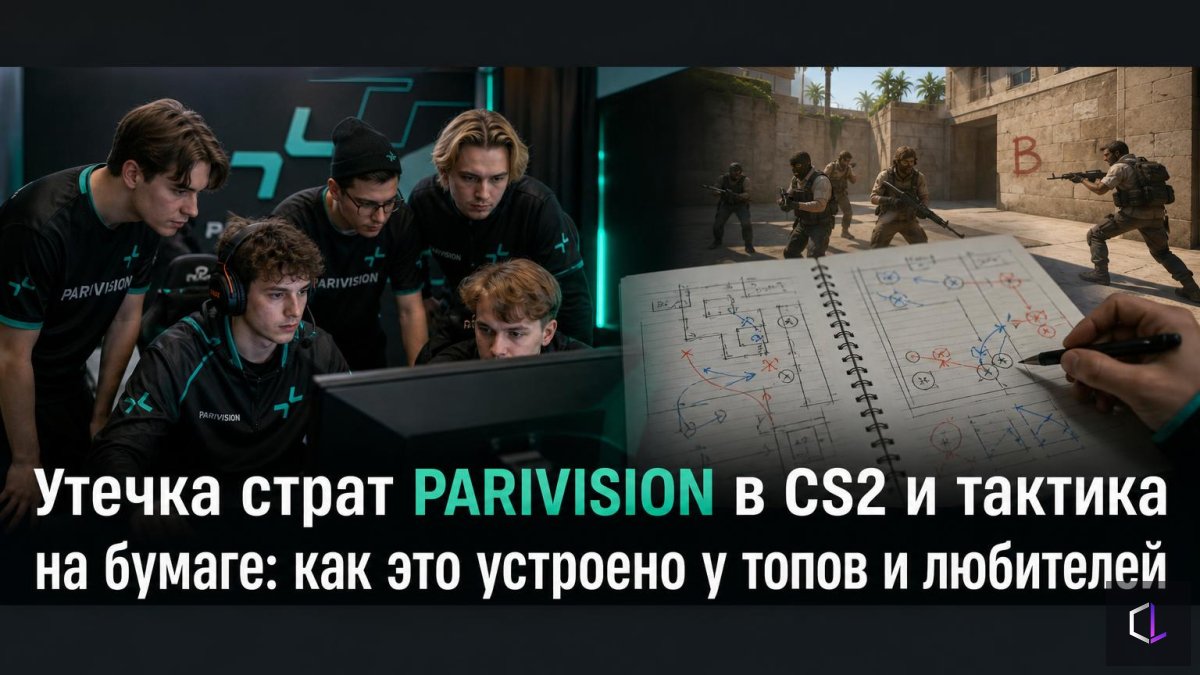
The line from the news feed sounds like an anecdote: a girl found printed PARIVISION CS2 tactics in a trash bin and posted a video about them on social media. Judging by the comments, viewers quickly figured out whose sheets they were. The team's captain, Jame, explained that one of the players had printed the schemes to memorize them better and simply threw away the failed printout. According to him, there is nothing critical there, and the exposed details are "known to everyone." He contacted the author of the video personally, and she agreed not to publish anything more and stated that she had thrown the papers away.
The story is funny, but behind it lies a serious question: how do teams of different levels actually handle tactics? Let's compare two approaches.
The Playbook: What It Is and Why It's Needed
A playbook is a set of prepared schemes for a map: how the team attacks a site, how it defends, what it does when a key player is lost, which grenades it throws and in what order. For a professional, it is as much a working tool as crosshair settings. The problem is that a tactic is valuable only as long as the opponent cannot predict it. A leaked scheme does not lose a round by itself, but it narrows the range of options for the opponent.
The Top Team: Tactics as a Working Document
Among professionals, the playbook lives in closed documents and on shared screens during reviews. Paper hasn't disappeared, though: it is easier for a player to memorize a scheme when he can see it and mark it up, and this is exactly the habit we observe in the PARIVISION story. But paper has a cost: it is a physical object that can be forgotten, lost, or thrown into the wrong bin.
Jame's position, meanwhile, is sober, and there is logic in it. Modern teams study each other's demos (match recordings) so thoroughly that most basic schemes are long since known to every opponent. The real advantage is created not by the scheme itself, but by the speed of its execution, its variability, and the ability to adapt on the fly. That is why a leak of standard setups really is almost harmless, whereas a leak of fresh in-house preparations for a specific opponent would be far more painful.
The Amateur Five: A Different Problem
For beginner teams, the picture is the opposite. There are almost no secrets to protect: opponents rarely study other teams' demos, and secrecy affects little. What is lacking is the system itself. Schemes are kept in heads, in voice chat, or in random notes, and after every roster change the team essentially starts from zero.
Hence the paradox. A top team ought to handle paper more carefully, while amateurs, on the contrary, would benefit from creating at least a simple shared document with setups, utility lineups, and roles. The difference is not in who has something to hide, but in who has something to write down.
What They Have in Common
In both cases there is one thing in common: tactics on paper do not replace tactics in the head. A player who needs a sheet of paper in the middle of a round won't have time to take it out. A printout is useful as a stage of memorization, as a reason to go through a scheme together, but execution rests on automatism. That is why both professionals who print schemes to memorize them and amateurs who write up notes after practice are doing the same thing: transferring knowledge from a document into habit.
The trash-bin story is unlikely to affect PARIVISION's results, and Jame himself says outright that the topic is closed. But as a small case study in information hygiene, it is useful to everyone: the more valuable a scheme is, the more carefully you need to treat where it is kept, and the simpler it is, the more important it is that all five players know it without prompts.