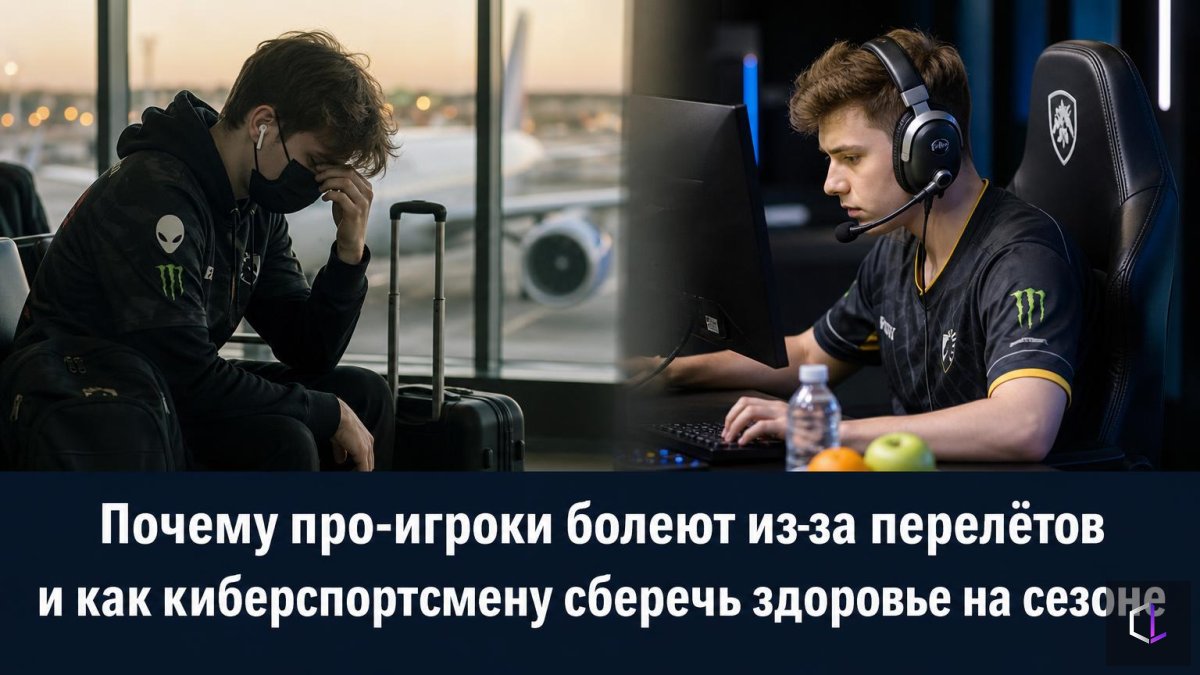
Mid laner Xxs has announced that he is leaving the pro scene. The reason given is not game-related: last season he was often sick because of flights and food poisoning, and now he is preparing for his wedding and does not plan to return anytime soon. The story is short, but behind it lies a question that is rarely discussed while people are watching the bracket and the picture from the arena: why is professional esports so physically exhausting when players sit all day?
Why do pro players get sick so often?
From the outside, the career looks simple: sit down at a computer, play, collect the prize. In reality, a top team's season is a string of tournaments in different cities and countries. The player lives out of a suitcase: plane, transfer, hotel, venue, plane again.
In this setup, health suffers for several reasons at once:
- Changing time zones. The body does not have time to adjust its sleep, while matches are scheduled by the venue's local time.
- Dry cabin air and crowds. Airports and planes are an ideal environment for colds; an immune system worn down by lack of sleep resists less well.
- Unfamiliar food. Hotel breakfasts, catering at the venue, dinners in unfamiliar places — the risk of food poisoning is higher than at home, where the products and the cook are familiar.
- Low physical activity. Between flights and matches there is almost no real exercise, and the back and neck suffer from sitting for hours on end.
Each of these factors on its own is tolerable. Together they produce what Xxs is talking about: an illness that recurs several times a season.
Why is illness especially dangerous for a player?
In esports, the cost of one "off" day is higher than it seems. Reaction time, attention, speed of decision-making — all of these suffer from fever, lack of sleep, and dehydration before the person notices it themselves. A mid laner in Dota 2 or a captain in CS2 makes dozens of decisions a minute, and fatigue turns into mistakes: a missed timing, a wrong pick, a late call.
There is also a team effect. A sick player either plays while worn out or misses the match — and then the team needs a substitute who does not know the setups. That is why serious organizations monitor routine as carefully as they do the training plan.
What can a player of any level take from this?
You do not need to travel the tournament circuit to apply the same principles. A routine is not about touring, but about consistency:
- Sleep on a schedule. Going to bed and getting up at the same time, even on weekends, is the cheapest prevention against breakdowns.
- Water and food without experiments. Before an important match, you should not try an unfamiliar dish or an energy drink on an empty stomach.
- Movement every day. A walk and a light warm-up for the back and wrists relieve strain that you won't notice until the first pains appear.
- A time cushion for travel. If the match is offline, arrive a day ahead rather than a few hours before: the body needs a buffer.
Is leaving for "personal reasons" normal?
The wording "I'm preparing for my wedding, I don't plan to return for now" shows another side of the profession: a career at the highest level is poorly compatible with ordinary life, and players increasingly make a conscious choice in favor of family and health. This is neither a defeat nor a weakness — the pro scene demands constant travel, and not everyone is ready to pay that price indefinitely.
For those who are only thinking about a professional path, the practical takeaway from this story is this: before assessing whether your talent and aim are enough, it is worth honestly considering whether you are ready to live in a touring routine. Game skill is only half of what determines how long a person lasts on the scene, and the other half is the ability to take care of yourself between matches.