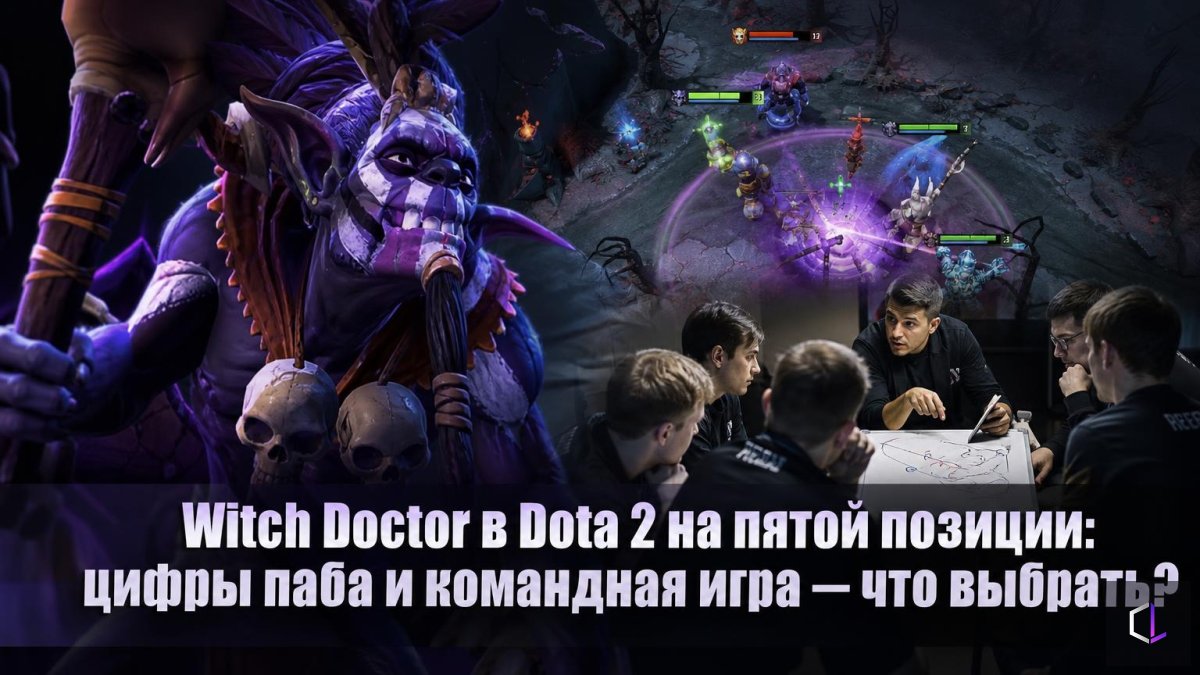
When a hero sits at the top row of a stats site, it is tempting to just pick him and play. Witch Doctor is exactly that case right now: according to Dotabuff, he is considered the best support in pubs — with a 52.2% win rate and a 60% pick rate. Pick rate is the share of games in which the hero was picked; win rate is the share of wins in those games. Side by side, these two numbers look good, but they say different things, and it is precisely this difference that is worth understanding for those who play position five.
Two Numbers, Two Stories
A 60% pick rate is about popularity. The hero is picked willingly: he is easy to understand, he has a short list of actions, and even in a game with unfamiliar teammates his role does not need to be explained for long. A 52.2% win rate is about results: an excess over fifty percent, albeit a small one. For a pub, where chaos reigns and the five often do not agree on a plan, such a margin is a notable argument in the hero's favor.
But between "he is picked" and "he wins" there is no guaranteed connection. A hero with a high pick rate ends up in all sorts of games — both well-organized ones and completely scattered ones. When the sample is huge, a margin of a couple of percentage points reflects not the hero's "magical power" but how much he forgives the team's mistakes. Witch Doctor is exactly such a hero: his usefulness does not depend much on how well coordinated the rest of the lineup is.
Approach One: Choose by the Table
The simplest way to choose a position five is to open the statistics and take whoever is at the top. It has real advantages:
- you pick a hero who has already shown results over a huge number of games;
- you do not need to guess how he will play in your specific situation — you rely on the averaged experience of thousands of matches;
- it saves draft time when you need to decide quickly.
The downside is that the table does not know your game. It does not see that your team has no initiation, that the opponent has two heroes with strong early pressure, or that your carry is weak in the lane and needs a different type of support. Pub statistics average all of this out, while you have to play one specific match.
Approach Two: Choose for the Task
The second path is to first understand what the team lacks, and then look for a hero who fills the gap. If the lineup already has a lot of damage but lacks control and healing, then Witch Doctor fits with his kit: he combines abilities that hold a target in place and deal area damage with an ultimate that turns a fight in a choke point in your favor. These features are well known, and choosing a hero "for the task" rests precisely on them, not on the win rate figure.
The advantage of this approach is purposefulness: you understand why you are picking the hero and can answer the question "what should I do in the first ten minutes." The drawback is that it requires more work at the draft and the ability to read what the team has and what it lacks.
What They Have in Common and Where They Differ
Both approaches lead to the same hero as long as the team's lineup happens to match the "average" situation. The difference shows when the picture is non-standard. The table will keep recommending Witch Doctor, while the analysis of tasks may suggest a different hero — or, conversely, will confirm the choice consciously, and then you will play him with more confidence.
There is also common ground: any good pick in position five relies on understanding what the hero does in your hands. Statistics is a starting point, not an answer. If you took the win rate leader but do not know when to hold abilities and when to spend them, the advantage of 2–3 percentage points is eaten up by the first mistake with positioning.
How to Check Your Choice
A simple way to compare the two approaches is to ask yourself three questions after the game. What did the team do best in fights? Which ability of my hero brought more benefit than the others? At what moment did I lack exactly what my hero can do? If the answer to the third question is "nothing was lacking, everything was as it should be," the pick was a good one regardless of the numbers. If the answer is "something else was lacking" — write it down: in the next game, precisely this gap will suggest what to look for in the draft.
Dotabuff's numbers remain a good guide: a 60% pick rate for a hero in position five is no accident. But a guide is not a route, and the one who can tell "strong by the statistics" from "needed by my team right now" wins more than the one who simply repeats after the table.