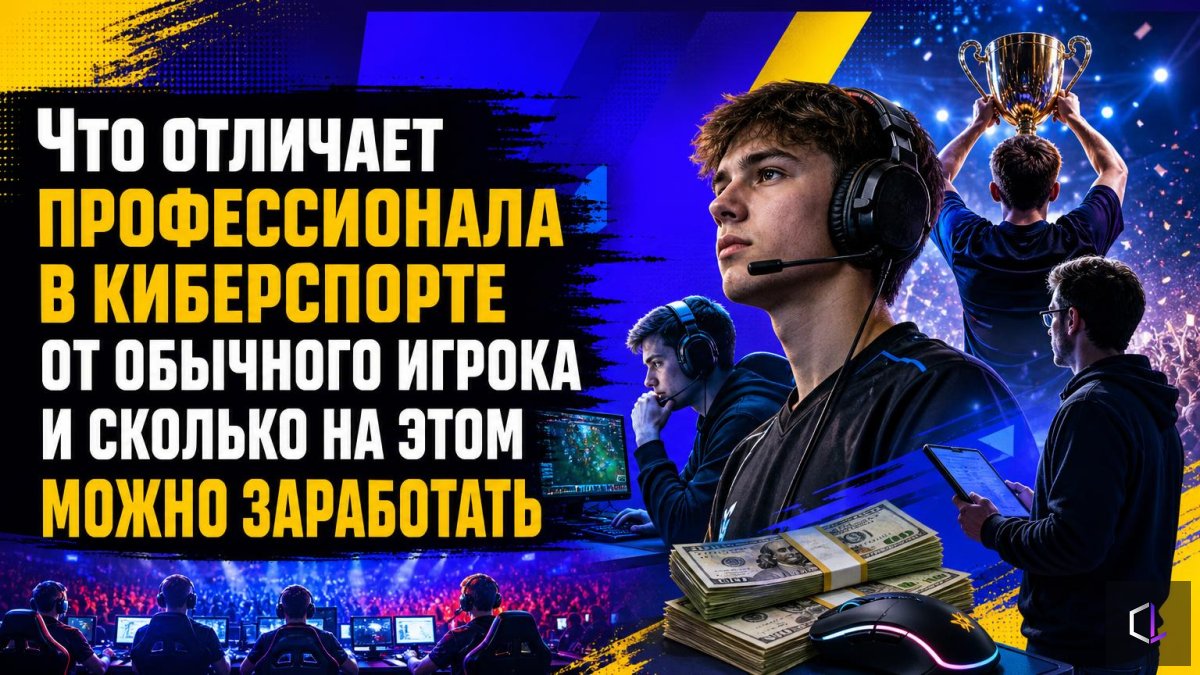
How to become a professional player is the question people ask most often. And almost always the answer is the same: "play more." The story of Mikhail defz0r Alekseev, a two-time winner of mobile "tanks" tournaments in the Blitz Point League (the Tanks Blitz discipline), shows that the answer is more complicated. His path from an ordinary player to the professional scene is described by a set of habits that work equally well in mobile disciplines and in CS2 and Dota 2.
How much you can actually earn
It is worth starting with the numbers, because they are exactly what brings many people into esports. The total prize pool of the Blitz Point League this year was 42 million rubles. defz0r's own share after his second championship is about 1.8 million rubles, which is just over 4% of the entire pool. It is a serious sum, but a telling one: even a champion who has won the league twice takes only a small part of the total pool. The rest is distributed among teams and players in other places.
For a reader who is weighing the profession, the conclusion is simple: prize money is the income of winners, not a guaranteed salary for everyone who steps onto the stage. That is why the question "how do I get better" matters more than the question "how much does it pay."
Why more practice does not mean better
The first principle from the interview sounds almost like a challenge to conventional logic: you need to keep learning and analyze your own mistakes, rather than just increasing the number of practice sessions. The difference is fundamental. A player who has played a hundred matches in a row has repeated the same decisions a hundred times. A player who has played ten and honestly worked out why they lost five of them has received ten different lessons.
In practice this means building the habit of asking yourself specific questions after a match. Where did I lose the initiative? Which decision cost me a round or a frag? What would I do differently in the same situation? Without answers, hours in the game turn into reinforcing mistakes.
Psychological resilience as a working skill
The second point is working on resilience under pressure. At major tournaments, the opponent is not always the most dangerous adversary: the worst enemy is your own head, when serious money, spectators, and a decisive moment are at stake. The ability to stay focused in such an environment does not appear on its own. It is built the same way as mechanical skill: by playing in conditions where something is at stake, and by developing the habit of returning to the process after a mistake instead of getting stuck on it.
For team disciplines this is especially important. One player who breaks down in a tense series can drag the others down with him, while a calm one can stabilize the whole five.
Teamwork matters more than individual skill
The third rule: learn to play for the team. According to defz0r, individual skill is not enough if a player cannot work with teammates. This is a well-known paradox of esports. In CS2 and Dota 2 you regularly see a set of individually strongest players lose to a well-coordinated team with more modest individual stats.
Teamwork is also a set of concrete skills: passing information clearly and briefly, making decisions with a common voice, holding your role, and not intruding on someone else's area of responsibility. All of this can be trained, and a player who remembers it has a noticeably better chance of earning a place in a lineup than a lone wolf with excellent aim.
Rest as part of preparation
The fourth point is the one most often ignored: you must not forget about rest and recovery, so that many hours of practice do not lead to burnout. Burnout in esports is not a weakness of character but the expected result of a regime with no pauses. Reaction, attention, and decision-making decline long before the player feels tired.
That is why sleep schedule, breaks between sessions, and days without gaming should be planned as seriously as the practice schedule. A professional measures progress not by the number of hours spent at the monitor, but by the quality with which those hours are used. That is exactly why a player who plays less but analyzes mistakes, keeps a clear head, and works in a team arrives at the tournament stronger than one who simply squeezed out the maximum number of hours.