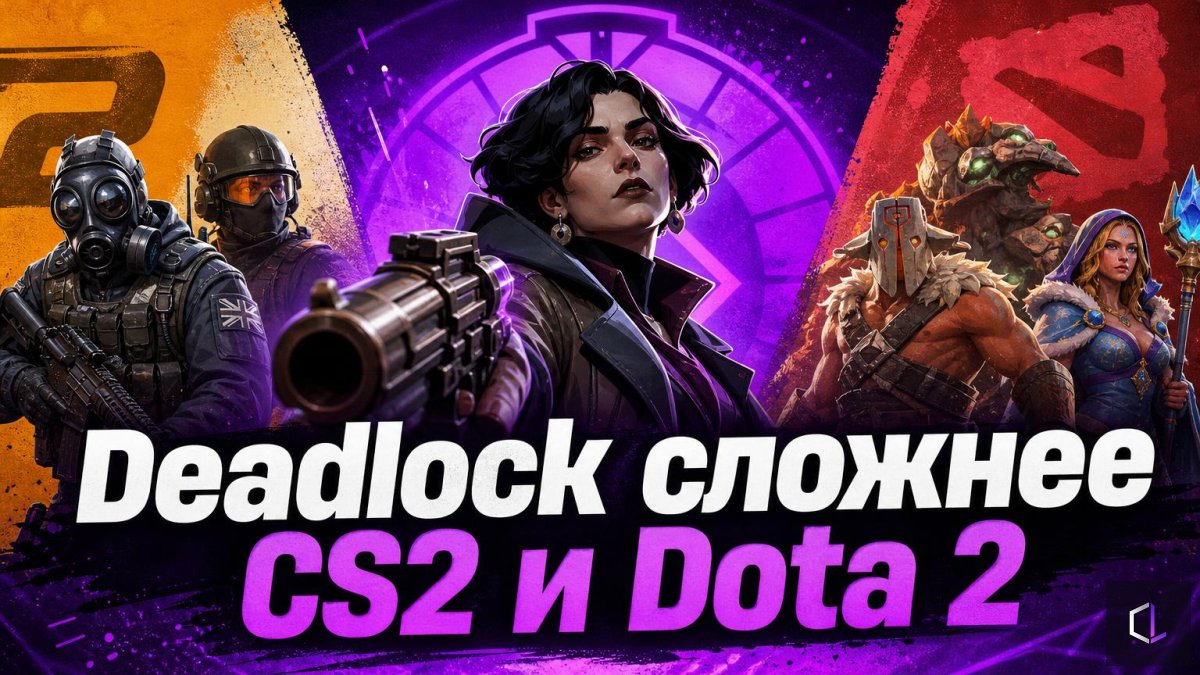
Commentator Maelstorm rated the difficulty of three Valve games on a ten-point scale: CS2 got a 3, Dota 2 a 5, and Deadlock a whopping 11. His main complaint about the newcomer hero shooter Deadlock concerns movement. According to Maelstorm, the skill ceiling there is enormous, and at tournaments pixel-perfect jumps across the entire map may become a basic skill. His own question is this: how deep does an average player have to "grind" just to feel comfortable in the game at all?
The rating is subjective, and you can argue with the numbers endlessly. But the conversation itself is useful: it forces us to understand what a game's difficulty is actually made of.
Three kinds of difficulty
Broadly speaking, a competitive game has three layers, and each of the three Valve games loads them differently.
Mechanics is what the hands do: aiming, recoil control, movement, ability timings. This is the layer Maelstorm singled out in Deadlock: if the speed and trajectory of movement decide the outcome of a firefight, then every second without polished movement is a loss. Mechanical skill can't be "understood"; it can only be trained through repetition.
Knowledge is maps, heroes, items, lineups, mechanics. Dota 2 has the most of this layer: over a hundred heroes, hundreds of interactions between abilities and items, and no amount of reaction speed can replace knowing who counters whom. Knowledge accumulates over months, but it can be read, watched, and verified.
Decisions are where to go, when to fight, what to spend resources on. This layer is the least visible: you won't see it in highlights, but it is exactly what distinguishes a player who "seems to be doing everything right" from one who wins.
Why CS2 is called "simple" even though it isn't
A three out of ten for CS2 looks underrated, and this is a typical illusion. CS2 has a low barrier to entry: the rules are clear within an hour, and the objective is obvious. But the skill ceiling is extremely high, because mechanics (aim, recoil) and team decisions (round economy, lineups, timings) come into play simultaneously. A game's difficulty is better measured not by how quickly you can start playing it, but by how long you can keep improving in it.
The same goes for Dota 2: the five reflects not the depth of the game, but the fact that many people perceive its difficulty as "there's a lot to know." Knowledge can be acquired, but team coordination and the ability to make decisions under pressure take years to grow.
What Deadlock adds to the overall picture
If Maelstorm's assessment is fair, Deadlock shifts the load onto movement mechanics — a layer that plays a secondary role in CS2 and Dota 2. This doesn't mean the game is "better" or "worse": it simply demands a different skill profile. A player with excellent game sense but average motor skills may feel right at home in Dota 2 and get stuck in a game that emphasizes movement.
This is where the practical point of talking about "difficulty" lies: before taking up a discipline, it's worth honestly figuring out which of the three layers is stronger for you and which is weaker. Someone who is used to solving problems with their head will quickly hit the ceiling of mechanics. Someone with excellent reactions risks getting stuck at a level where you can't grow any further without understanding the game. And no scale from one to ten can replace this: you can compare games by score, but you have to grow in them through the specific skill that is lagging behind for you.
As for Maelstorm's prediction itself — that pixel-jump techniques will become the norm at tournaments — only one thing can be said for now: it is the commentator's assumption, not a fact. Whether top-tier movement technique becomes mandatory will be shown only by the practice of the competitive Deadlock scene.