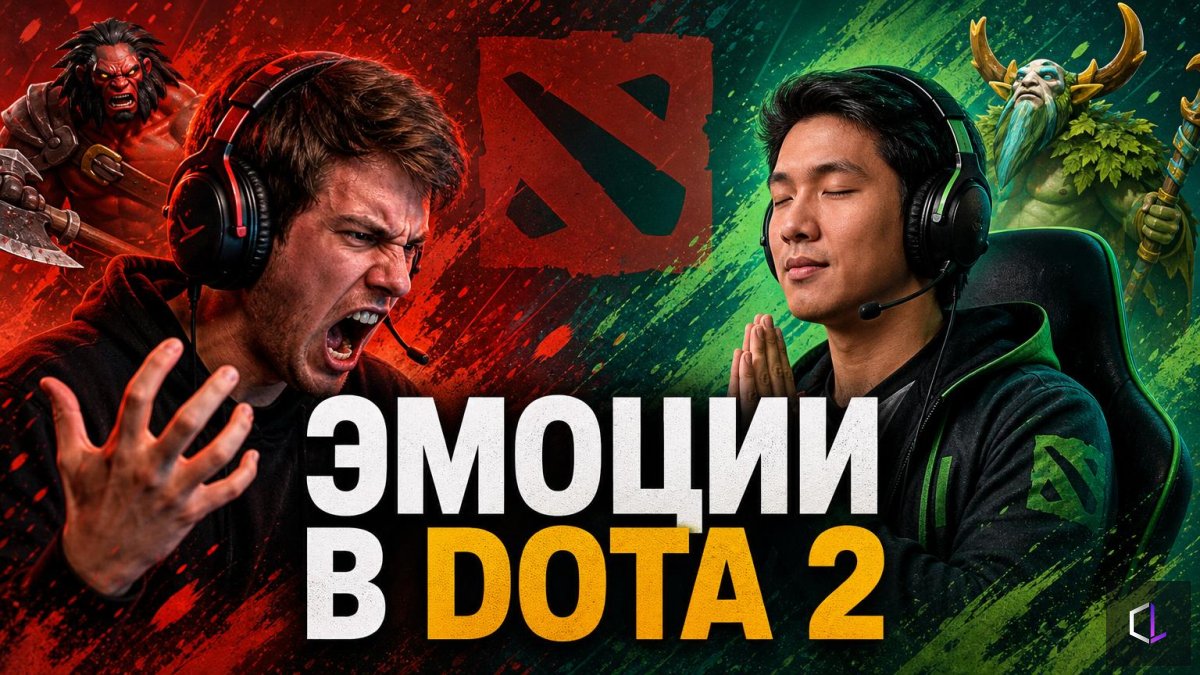
One MMR booster recently shared a theory of his own on stream, which he called exactly that, a theory, not a medical fact: according to him, constantly suppressing your emotions can end badly for your health, and he doesn't want to die of an illness in the middle of a game. It was said as a joke, almost in passing. But that phrase hides a question that sooner or later comes up for everyone who plays a lot of Dota 2: what do you do with anger when an ally has thrown away the fifth tower and there are still forty minutes left on the clock?
We'll leave the medical side to doctors: nobody here is going to prove or disprove a link between emotions and health. Something else is more interesting: the in-game meaning of the advice "don't hold back."
Suppressing and working through are different things
When a person says "I'm calm, I'm calm" through gritted teeth, they are usually doing the wrong thing. Suppressing an emotion is an attempt to push it out of awareness. Psychologists have long described the effect: the more insistently you forbid yourself to think or feel something, the more strongly the subject comes back. In a game it looks familiar: you stay silent in chat, but two minutes later you force a fight that is clearly a loser, because everything inside is boiling.
Working through an emotion is something else. It means acknowledging: "I'm furious right now, and that's okay." The emotion is named, which means it stops controlling your hands from the shadows. After that you can decide what to do with it instead of pretending it isn't there.
Where emotion hits your game
Irritation damages not your mechanics but your decisions. Your hands still land last hits on creeps, but your head starts choosing differently:
- you want to "make up for it" immediately and go into a fight without an advantage;
- you stop looking at the minimap because you're looking at the person who made you angry;
- you type in chat instead of giving a short, useful call;
- you make a decision about an out or a pick based on resentment rather than on the situation on the map.
Notice that none of these points requires you to play badly with your hands. These are errors of choice, and they are what eats your rating over a long series of games.
Practical techniques
There is no single recipe, but most experienced players are familiar with a few working habits:
1. A pause between death and your next action. While you're on the respawn timer, you have a few seconds. Using them to exhale and look at the state of the map is more useful than rereading chat.
2. Naming the emotion, aloud or to yourself. "Angry," "frustrated," "tired." It sounds naive, but it is precisely the naming that reduces the feeling that the emotion is in control of you.
3. The "one message" rule. If you want to speak your mind, say one short, to-the-point sentence and that's it. Long arguments in the middle of a match don't win games.
4. A stop signal known in advance. For example, two games lost in a row with the same feeling of irritation is a reason to end the evening. It's hard to decide this in the moment, so it's better to choose the condition beforehand.
5. Physical release outside the game. A walk, water, stretching. An emotion with nowhere to go builds up.
Why this matters at any level
At low rating, emotions usually interfere because of allies: their mistakes are more noticeable than your own. At high rating, it's because of the cost of every mistake: the stakes are higher and the pressure is stronger. The source changes, but the mechanism stays the same. A player who has learned to notice the moment when irritation starts dictating choices gains an advantage that doesn't depend on the patch or the meta and doesn't go out of date in six months.
The booster's words can be taken as a joke, but the advice behind them is honest: you don't need to pretend your emotions are absent in a game. It is better to learn to see the second at which they stop being background and start making decisions for you, and in that second to do the one thing that really helps: slow down.