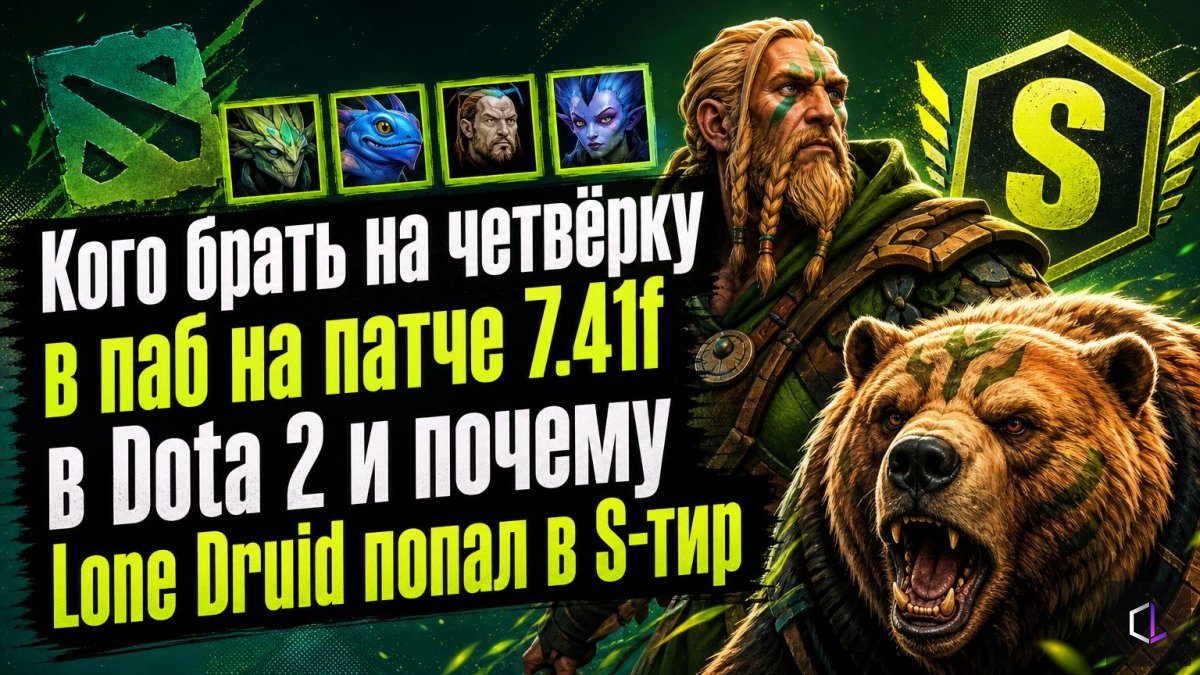
PARIVISION support 9Class, who recently returned to the top of the European ladder, put together a tier list of heroes for position 4 in pubs on patch 7.41f. The list itself is less interesting than the questions it raises: what is actually required of a position 4 in a pub, how it differs from the professional scene, and why a hero who is usually picked in position 1 ended up in the top row.
What a Position 4 Needs to Do in a Pub
Position 4 is a support-initiator: a player who doesn't sit in one lane with the carry, but moves around the map, picks the flank for a fight, and opens the engagement. Position 4 is often called the "roamer" — the one who moves between lanes looking for an opportunity to get a kill. In a pub, where there is no voice chat and no rehearsed setups, the position 4's task is simpler and tougher: create an advantage quickly, before the team has had time to scatter to do their own things.
That is the logic behind the tier list. The heroes in S-tier — Bounty Hunter, Lone Druid, Io, Rubick, Hoodwink, Windranger — solve this in different ways, but each provides either initiation, pressure on the map, or a way to cover for a weak link on the team.
Why These Particular Heroes Are Strong
Bounty Hunter and Hoodwink are heroes that punish other people's mistakes: a lone enemy in a lane can be caught, and the opponents' positions are revealed in advance. Windranger is a classic "catcher" with single-target control. Io and Rubick work differently: they amplify allies or other players' spells, and their value grows when a strong carry or mid is nearby.
Lower down, in A-tier, are Pudge, Dark Willow, Keeper of the Light, and Spirit Breaker. These are heroes with a clear script: catch, stun, reveal, take the fight onto your own territory. B-tier includes Skywrath Mage, Nyx Assassin, and Techies — heroes that require more nuanced play or fit better with a team where everything has been agreed in advance.
How Lone Druid Ended Up in S-Tier
Lone Druid is usually seen as a carry: he has a bear that fights alongside him and takes on part of the item load. In position 4, the same hero works differently — as pressure on the map that doesn't depend on gold. He doesn't need expensive items to be useful: the bear and the hero themselves deal damage and force the opponents to react.
This matters for pubs for a simple reason: in a pub there is rarely a player who can truly protect a lone support. A hero who doesn't weaken without gold and forces the enemies to respond to pressure gains an advantage against disorganized teams. That is exactly why Lone Druid's appearance in S-tier looks unexpected but not accidental: the list was compiled for pubs, not for the tournament scene.
How a Pub Differs from the Pro Scene
A tier list for pubs and a tier list for professionals answer different questions. In professional play, a hero is evaluated through the draft, combinations, and timings: a strong hero is often not picked simply because he doesn't fit the team's strategy well. In a pub everything is simpler: five random people with no plan discussed beforehand. The winner is the one whose hero delivers results without complicated combinations.
That is why, instead of blindly copying the list, you should ask yourself three questions before picking. Is there a hero on the team who can take advantage of my initiation? Whom do I need to protect — the carry or the mid? And what should I be doing on the map in the first minutes, while the opponents haven't yet grouped up? If you have an answer to these questions, an A-tier hero may turn out to be more useful than an S-tier one.
Why the List Shouldn't Be Treated as Dogma
One player's tier list is his experience, not a verdict. It was compiled on a specific patch, 7.41f, and a specific sample of games, and after the next update the picture will change. The more lasting value of such a list lies in the way of thinking it demonstrates: evaluating a hero by the task he solves for his team and choosing him to fit the composition, not the other way around. A player who understands why Rubick is strong alongside one composition and useless alongside another will play confidently on any patch, even when a particular tier list is long out of date.